In short
A Holter monitor records every heartbeat for a day or two while you live normally. Here is how to wear it, why the diary matters, what ectopics, pauses, SVT and AF burden mean on the report, which findings are common in healthy people, and when not to wait for the result.
Emergency if: Palpitations that do not go away, or palpitations with chest pain, shortness of breath, feeling faint or fainting: call emergency services or go to an emergency department now, even if you are still wearing the monitor. Do not drive yourself.
On your report
Hemoglobin, TSH, Potassium
On this page
01
What a Holter monitor records
A Holter monitor is a small battery-powered recorder that continuously records your heart's electrical activity, the same signal an ECG picks up, while you go about your normal life. MedlinePlus and the American Heart Association describe it being worn for 24 to 48 hours, and the NHS says it can be up to 7 days. The British Heart Foundation calls it a 24-hour ECG or ambulatory ECG monitoring.
The reason for wearing one is that a resting ECG shows the heart for only a few seconds, while abnormal rhythms and symptoms may come and go. Doctors use it to find out why someone feels palpitations, dizziness or faintness, to check whether heart medicines are working, and to look for signs that the heart muscle is not getting enough oxygen. If your symptoms happen only every few weeks, the BHF notes that a longer event recorder or an implanted loop recorder may be used instead.
02
Wearing it, and why the diary matters
Sticky electrodes are placed on your chest, sometimes after shaving a small area, and wired to the recorder, which you carry in a pouch or on a belt. You cannot bathe, shower or swim while wearing it, so MedlinePlus suggests showering before the test. Keep it away from magnets, metal detectors, high-voltage areas and electric blankets, and do not have an X-ray while wearing it. Tell the staff if you are allergic to tape, and report any skin irritation.
Keep up your normal activities; if your symptoms usually come on with exercise, you may be asked to exercise during the recording. The diary is the most important part of your job: whenever you feel something, such as palpitations, chest pain, breathlessness or dizziness, write down the time and what you were doing. The doctor lines up your diary with the recording, so a symptom with a time attached can be matched to exactly what the heart was doing. The American Heart Association says results usually take one to two weeks.
03
The words on a Holter report
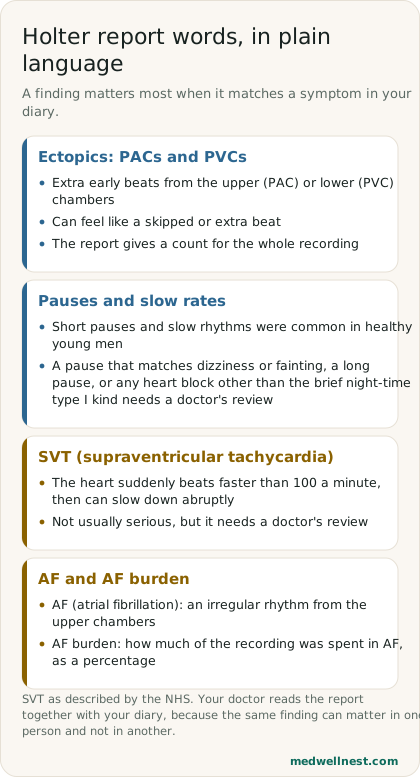
Ectopics are extra beats that come earlier than expected. A PAC (premature atrial contraction) starts in the upper chambers; a PVC (premature ventricular contraction) starts in the lower chambers. The NHS describes palpitations with skipped or extra beats as ectopic beats. The report usually gives a count for the whole recording rather than just saying present or absent.
A pause is a gap between beats, usually given in seconds. SVT, supraventricular tachycardia, is a rhythm in which the NHS says the heart suddenly beats faster than 100 beats a minute and can then slow down abruptly. AF, atrial fibrillation, is an irregular rhythm from the upper chambers; AF burden is how much of the recording was spent in AF, often given as a percentage. The report also lists your slowest, fastest and average heart rates.
04
Findings that are common in healthy people
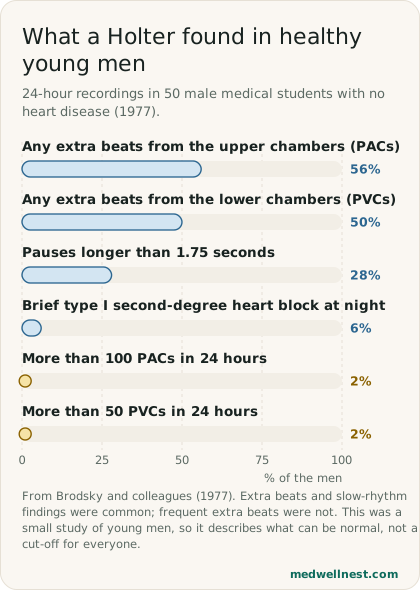
Many people are surprised by how much turns up in a normal heart. In a small 1977 study of 50 healthy male medical students wearing a 24-hour monitor, 56% had extra beats from the upper chambers and 50% had extra beats from the lower chambers. Frequent ones were rare: only 2% had more than 100 PACs, and 2% had more than 50 PVCs, in 24 hours.
Slow-rhythm findings were common too. In the same study, 28% had pauses longer than 1.75 seconds, usually during sinus arrhythmia, the normal speeding up and slowing down of the heart with breathing, and 6% had a brief type I second-degree heart block at night. The authors concluded that slow-rhythm findings, including pauses and night-time block, are common in young men while frequent extra beats are unusual. The study was small and in young men only, so it does not tell you what is normal in women, at older ages or with heart disease. MedlinePlus says a normal result means no significant rhythm changes and a rate that is not abnormally slow or fast.
05
What makes a finding matter
The same word on a report can mean very different things in two people. Doctors weigh how often something happened, how long it lasted, whether it matched a symptom in your diary, and what else they know about your heart. A handful of ectopics with no symptoms is usually a normal finding; very frequent ectopics, AF, a long run of fast beats or a pause at the moment you felt faint are the kinds of findings a doctor looks at more closely.
The NHS lists common triggers for palpitations, including strenuous exercise, lack of sleep, stress and anxiety, some medicines, and alcohol, caffeine, nicotine and recreational drugs. They can also come from a condition such as anaemia, an overactive thyroid or a heart valve problem, which is why blood tests or an echocardiogram sometimes follow a Holter. A normal Holter does not rule out a rhythm problem that simply did not happen during the recording.
06
When not to wait for the result
Do not wait for the report if symptoms become serious. The NHS says to call emergency services or go to an emergency department if you have palpitations that do not go away, or palpitations with chest pain, shortness of breath, feeling faint or fainting. It also advises against driving yourself there. If you had those symptoms but they have stopped, it advises an urgent appointment the same day.
Outside an emergency, the NHS suggests seeing a doctor if palpitations keep coming back or are happening more often, last longer than a few minutes, or if you have a heart condition or a family history of heart problems.
When to act
Emergency — act now
Palpitations that do not go away, or palpitations with chest pain, shortness of breath, feeling faint or fainting: call emergency services or go to an emergency department now, even if you are still wearing the monitor. Do not drive yourself.
Same-day — call promptly
You had palpitations with chest pain, breathlessness or faintness, but they have now stopped: get an urgent appointment with a doctor today, and bring your Holter diary if you have it.
Routine — see a doctor
Palpitations that keep coming back, happen more often, or last longer than a few minutes, or palpitations when you have a heart condition or a family history of heart problems: see a doctor, who may arrange a Holter or a longer recorder.
Values mentioned in this story
Each one opens a visual guide with its normal range and what moves it — upload a report and we place your own numbers on the same scale.
Sources
- Holter monitor (24h) — MedlinePlus Medical Encyclopediamedlineplus.gov
- Holter Monitor — American Heart Associationheart.org
- ECG — British Heart Foundationbhf.org.uk
- Heart palpitations — NHSnhs.uk
- Supraventricular tachycardia (SVT) — NHSnhs.uk
- Arrhythmias documented by 24 hour continuous electrocardiographic monitoring in 50 male medical students — PubMedpubmed.ncbi.nlm.nih.gov
Share this story
Curious where your own values stand?
Two minutes from upload to a full visual picture. Free to analyze.