In short
For adults and children from 10, a normal resting pulse is 60 to 100 beats a minute. Babies and young children run much faster, and fit athletes can sit at 40 to 60. Here is the chart by age, how to take your pulse properly, and when a number needs a doctor.
Emergency if: A heart rate that is suddenly very fast, very slow or irregular with chest pain, shortness of breath, dizziness, fainting, weakness or numbness on one side, or confusion or difficulty speaking: call emergency services now.
On your report
TSH, Free T4, Potassium, Hemoglobin
On this page
01
What counts as a resting heart rate
Your heart rate, or pulse, is the number of times your heart beats in a minute. Your resting rate is the number when you have been still for a while. MedlinePlus says you must have been resting for at least 10 minutes to measure it. The American Heart Association (AHA) describes a normal resting rate as one taken while sitting or lying, calm and feeling well.
Many everyday things push the number up for a while. The AHA lists heat and a raised body temperature, first standing up, exercise, stress, anxiety and other strong emotions, and pain. Some medicines, such as beta blockers, do the opposite and slow it. MedlinePlus adds that a fast pulse may signal an infection or dehydration. That is why a single high reading after climbing the stairs or during a fever does not mean much; a rate that is high at true rest, again and again, does.
02
Normal resting heart rate by age
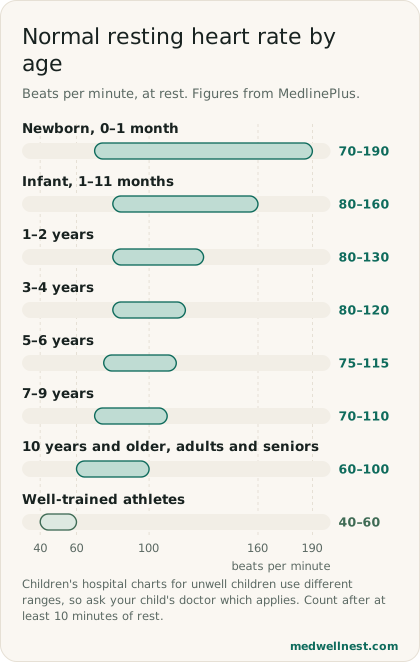
MedlinePlus gives these normal resting ranges in beats per minute. Newborns up to 1 month: 70 to 190. Infants from 1 to 11 months: 80 to 160. Children aged 1 to 2: 80 to 130. Aged 3 to 4: 80 to 120. Aged 5 to 6: 75 to 115. Aged 7 to 9: 70 to 110. From 10 years old, and for adults including older people: 60 to 100.
The adult range of 60 to 100 is the one the AHA uses too. It is wide on purpose. A healthy adult resting at 62 and another resting at 92 are both unremarkable, and your own usual number, measured the same way over several days, is more useful than a single reading compared with a chart.
03
Children's ranges differ between sources
Children's figures are less settled than adults'. A leading children's hospital guideline publishes ranges for assessing unwell children in hospital, and they are not the same as the MedlinePlus figures. For a newborn it gives 120 to 170, where MedlinePlus gives 70 to 190; for a 1-year-old, 105 to 150, where MedlinePlus gives 80 to 130 for ages 1 to 2; and for a 10-year-old, 60 to 130, where MedlinePlus gives 60 to 100.
The hospital guideline itself says published values are quite disparate, probably because they come from different groups of children measured in different ways. It also says that the pattern of change, such as a heart rate steadily climbing, often matters more than the value itself. A child's pulse also rises with crying, fever and activity. If your child's number worries you, look at how they are, and ask their doctor which range they go by.
04
Athletes, and a low number that is normal
Fit people often have slower hearts at rest. The AHA explains that an athlete's heart muscle is in good condition and does not need to work as hard. MedlinePlus gives 40 to 60 beats per minute as normal for well-trained athletes. The AHA notes that a heart rate below 60, called bradycardia, does not always signal a problem: it is common in athletes, the rate may be lower during sleep, and some medicines, such as beta blockers, slow it.
What matters is whether a low number comes with symptoms. A fit person at 50 who feels well is usually fine. The AHA advises telling your doctor if your heart rate has been slower or faster than usual and you have felt weak, dizzy or as if you might faint.
05
How to take your pulse
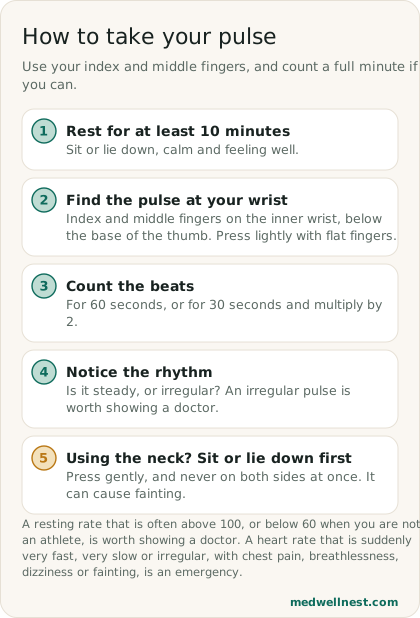
The wrist is the easiest place. Rest two fingers, not your thumb, flat on the inside of the other wrist just below the thumb, and press gently until you can feel the beat, as MedlinePlus describes. The AHA also lists the inside of the elbow, either side of the neck and the top of the foot. Count the beats for a full 60 seconds, or count for 30 seconds and multiply by 2. MedlinePlus says counting for 10 or 15 seconds and multiplying by 6 or 4 is usually accurate too.
Notice the rhythm as well as the count. A steady beat is normal. An irregular pulse, where the gaps between beats vary, can indicate a problem, and the NHS lists it first among the symptoms of atrial fibrillation, a heart rhythm problem that sometimes causes no other symptoms.
If you use the neck, sit or lie down first and press gently on one side only. MedlinePlus warns that the neck arteries can be sensitive to pressure, which can slow the heart or cause fainting, and never to press both sides at once.
06
When a heart rate needs attention
The AHA says a resting rate over 100 beats per minute may mean tachycardia, and below 60 may mean bradycardia, though neither is always a problem. MedlinePlus advises talking to your doctor about a resting rate that is continually high, or below the normal values, about a very forceful pulse that lasts more than a few minutes, and about an irregular pulse. MedlinePlus notes that infection and dehydration can speed the pulse, and the AHA that medicines such as beta blockers can slow it.
Some combinations cannot wait. The AHA advises calling emergency services if your heart rate is suddenly very high or very low for you, especially with chest pain, shortness of breath, dizziness or fainting. The NHS gives the same advice for a fast or irregular heartbeat with chest pain, breathlessness, sweating, feeling sick, fainting, feeling dizzy or falling over, a severe headache, weakness or numbness on one side, blurred vision or loss of sight, or confusion or difficulty speaking.
When to act
Routine — see a doctor
A resting rate that is often above 100, or below 60 when you are not an athlete, an irregular pulse you have noticed, or palpitations that keep happening or are getting worse, with no other symptoms: book an appointment with your doctor.
Same-day — call promptly
A heart rate slower or faster than usual for you with feeling weak, dizzy or as if you might faint: get medical advice today.
Emergency — act now
A heart rate that is suddenly very fast, very slow or irregular with chest pain, shortness of breath, dizziness, fainting, weakness or numbness on one side, or confusion or difficulty speaking: call emergency services now.
Values mentioned in this story
Each one opens a visual guide with its normal range and what moves it — upload a report and we place your own numbers on the same scale.
Sources
Share this story
Curious where your own values stand?
Two minutes from upload to a full visual picture. Free to analyze.