In short
A 2025 review of 57 studies found the biggest gains in lower risk of death at roughly 5,000 to 7,000 steps a day, and the 10,000 target likely began as a pedometer's name. These are observational results. Chest pain or fainting while walking needs emergency care now.
Emergency if: Chest pain or pressure that does not go away, pain spreading to your arm, neck, jaw, shoulder, stomach or back, or chest pain with sweating, feeling sick, light-headedness or shortness of breath, during a walk or at any time: stop, sit down and call emergency services now. If you have angina and the pain does not stop after resting for a few minutes or after your angina medicine, call emergency services now. Do not drive yourself. Someone who collapses or passes out and is not responding normally: call emergency services now.
On your report
HbA1c, Fasting Glucose
On this page
01
How many steps a day should I walk?
The sources used here give no single official step target. The NHS guidelines are written in minutes of activity, not steps. The step evidence points to a range. A 2025 systematic review of 57 studies from 35 cohorts of adults, using device-measured steps, pooled 31 of those studies (24 cohorts) in meta-analyses. It found that for death from any cause, new heart and blood vessel disease, dementia and falls, risk fell fastest and then flattened, with a bend at around 5,000 to 7,000 steps a day.
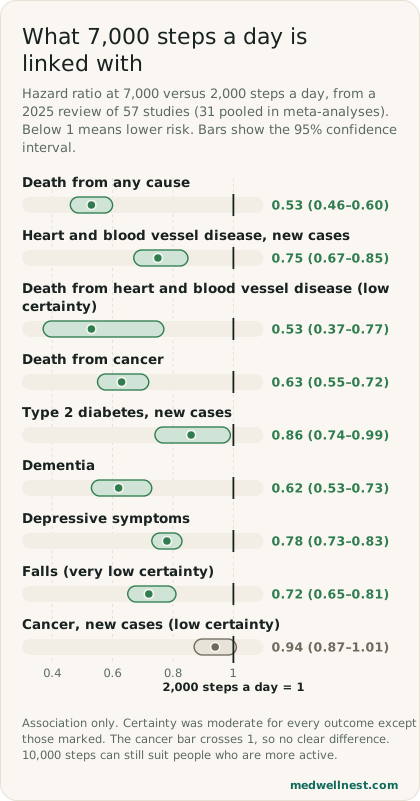
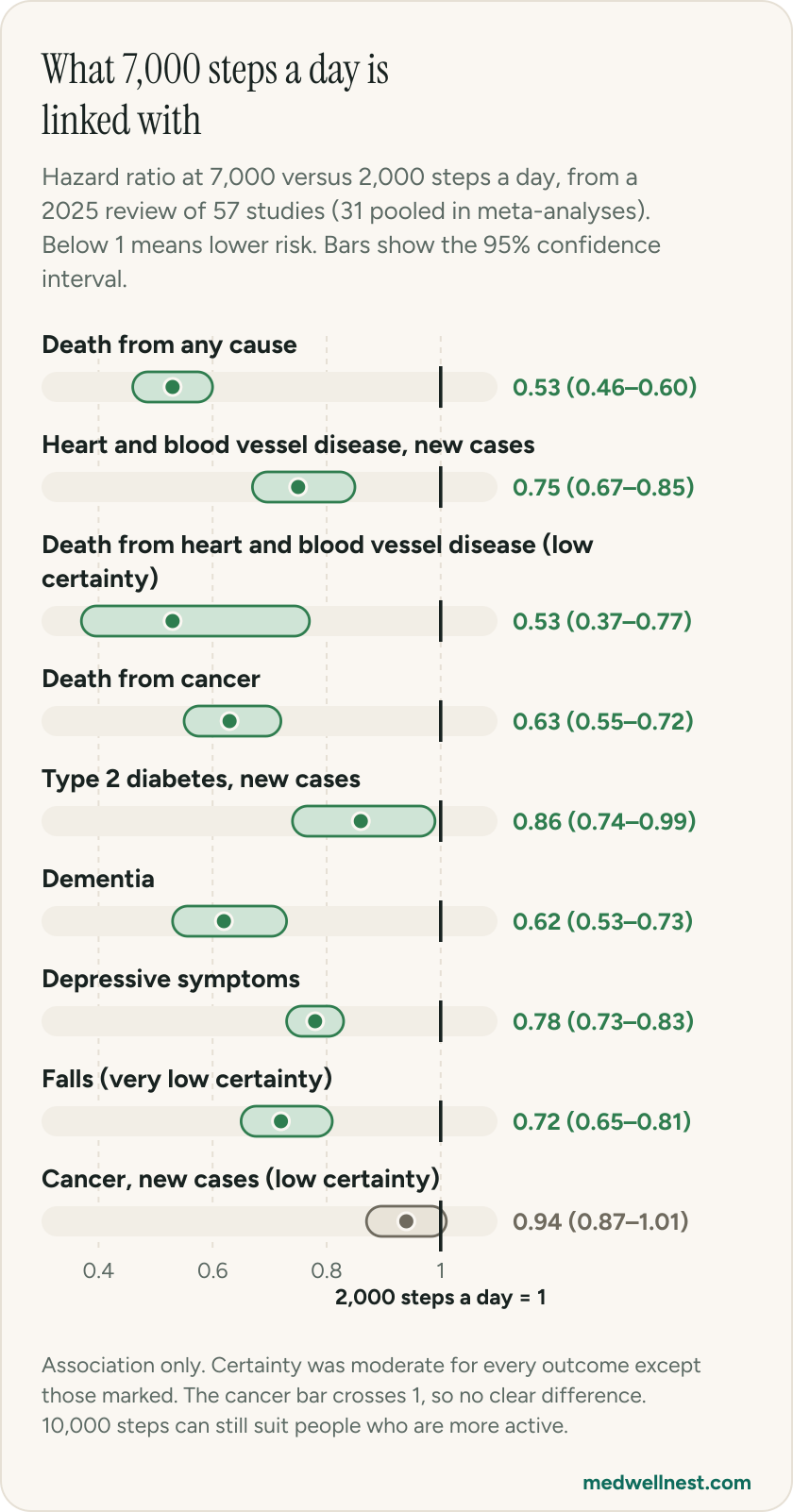
Compared with 2,000 steps a day, 7,000 steps a day was linked with a 47% lower risk of death from any cause (hazard ratio 0.53, 95% confidence interval 0.46 to 0.60). The authors say 7,000 steps is linked with clinically meaningful improvements and may be a more realistic target for some people, while 10,000 steps can still be a viable target for those who are more active.
02
Is 10,000 steps a day necessary, or is it a marketing number?
A 2019 study in older women says the origin of the 10,000-step goal is unclear. It likely comes from the trade name of a pedometer first sold in 1965, the Manpo-kei, whose name translates to "10,000 steps meter". The same paper says the number has been spread by the popular press and is often the default on wearables and phones. The 2022 meta-analysis of 15 studies opens by saying there is little evidence to support the 10,000-step recommendation.
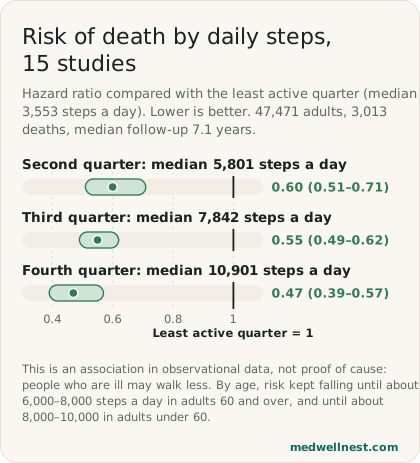
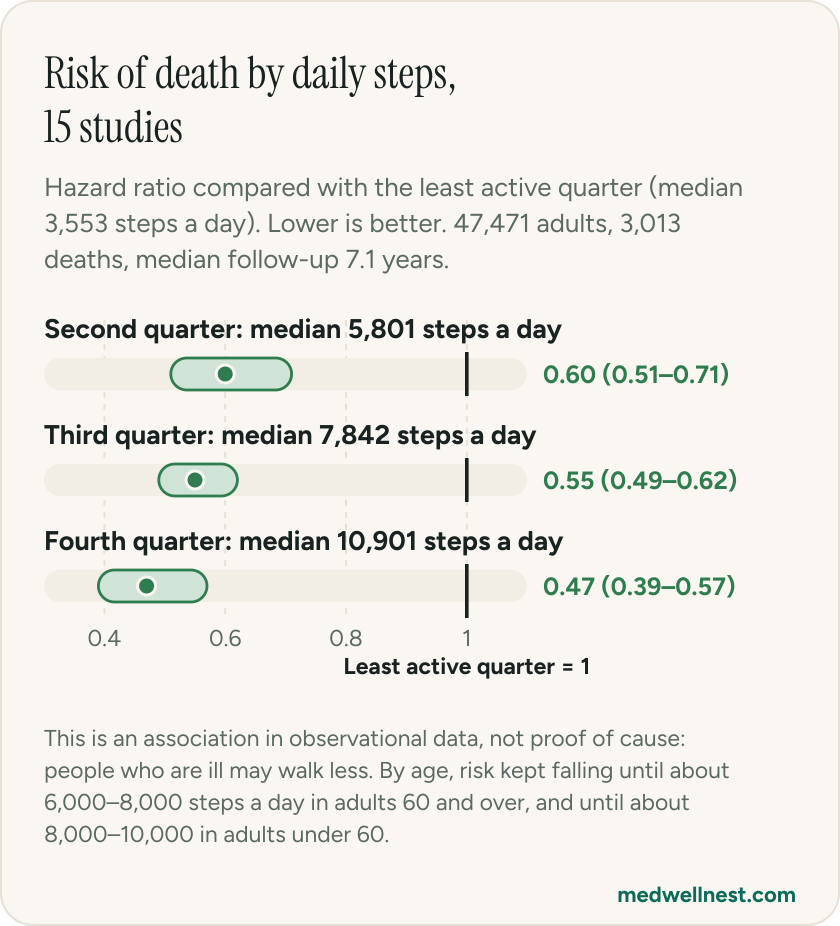
That does not mean 10,000 is harmful. In the 2022 analysis of 47,471 adults, the estimate for risk of death was lowest in the most active quarter (median 10,901 steps a day), but a large part of the benefit was already there at lower counts. Compared with the least active quarter (median 3,553 steps), the hazard ratio was 0.60 for the second quarter (median 5,801), 0.55 for the third (median 7,842) and 0.47 for the fourth.
03
Does the right number of steps depend on my age?
In the 2022 analysis, risk of death kept falling with more steps until about 6,000 to 8,000 steps a day in adults aged 60 and older, and until about 8,000 to 10,000 steps a day in adults younger than 60. The 2019 study, of about 16,700 women with a mean age of 72, split them into quarters by daily steps. Risk fell until about 7,500 steps a day and then levelled, and the second quarter (median about 4,400 steps a day) had a lower death rate than the least active quarter (median about 2,700), with a hazard ratio of 0.59.
The 2025 review says it had no age-specific analysis, so its 5,000 to 7,000 range is for adults overall. Treat these figures as bands, not exact cut-offs. If you are well below these counts today, the 2022 data show the largest drop in risk between the least active quarter and the next one.
04
What else is 7,000 steps a day linked with besides living longer?
Compared with 2,000 steps a day, 7,000 steps was linked in the 2025 review with a 25% lower risk of new heart and blood vessel disease, a 14% lower risk of new type 2 diabetes, a 38% lower risk of dementia, a 22% lower risk of depressive symptoms and a 37% lower risk of dying from cancer. For death from heart and blood vessel disease the figure was 47% lower, but with low certainty. For new cancer cases the difference was not significant (hazard ratio 0.94, interval 0.87 to 1.01).
Falls were 28% lower, but with very low certainty. The authors rated the evidence as moderate for all outcomes except heart and blood vessel death (low), new cancer (low), physical function (low) and falls (very low). The number of studies was small for most outcomes.
05
Do these studies prove that walking more makes you healthier?
No. They are observational: they follow people and compare, rather than assigning people to walk more. The 2025 review lists residual confounding and bias in individual studies among its limits. The 2019 paper says reverse causation remains a possibility, meaning that people who are already ill or frail may walk less, so low steps can be a sign of poor health rather than only a cause of it. It also says the findings may reflect prior habitual stepping and an associated healthy state.
What the studies do show is a consistent pattern across many cohorts and several outcomes. The sensible reading is that more movement than you do now is linked with better health, with smaller gains at higher counts, not that a particular number is a pass mark.
06
Does walking faster matter, or only the number of steps?
The evidence is mixed. In the 2022 analysis, after adjusting for total steps a day, a higher peak stepping rate over 30 minutes and over 60 minutes stayed linked with lower risk of death (both hazard ratios 0.67), but time spent walking at 40 steps a minute or faster, or at 100 or faster, did not. In the 2019 study of older women, after adjusting for steps a day, most intensity measures were no longer significant. In both, the link with intensity was weaker after adjusting for total steps.
Guidelines count intensity in minutes. The NHS guidelines say adults should do at least 150 minutes of moderate intensity activity a week or 75 minutes of vigorous intensity activity a week, plus strengthening activities on at least 2 days a week. The NHS says you are at a moderate level if you can still talk but not sing, and lists brisk walking as an example. It gives no conversion from minutes to steps. Our exercise story covers the minutes in more depth.
07
When should I stop and get help while walking?
The NHS says to call emergency services now for chest pain or discomfort that does not go away, pain spreading to the arm, neck, jaw, shoulder, stomach or back, or chest pain with sweating, feeling sick, light-headedness or shortness of breath. If you know you have angina and the chest pain does not stop after resting for a few minutes or after your angina medicine, that is also an emergency. Do not drive yourself. The NHS heart attack page also says to call emergency services now for someone who has passed out and is not responding normally.
The NHS says to get urgent advice the same day for chest pain or other angina symptoms that come and go, or angina that feels worse than before, happens more often, lasts longer or happens when resting. The NHS activity page also says to speak to your doctor first if you have not exercised for some time or have medical conditions or concerns, and to match the activity and its intensity to your fitness.
Walking and your heart: how fast to act
Emergency — act now
Chest pain or pressure that does not go away, pain spreading to your arm, neck, jaw, shoulder, stomach or back, or chest pain with sweating, feeling sick, light-headedness or shortness of breath, during a walk or at any time: stop, sit down and call emergency services now. If you have angina and the pain does not stop after resting for a few minutes or after your angina medicine, call emergency services now. Do not drive yourself. Someone who collapses or passes out and is not responding normally: call emergency services now.
Same-day — call promptly
Chest pain or other angina symptoms that come and go, or known angina that is worse than before, happens more often, lasts longer or comes on at rest: get urgent medical advice today.
Routine — see a doctor
You have not exercised for some time, or you have a medical condition such as heart disease, diabetes or joint problems and want to build up your steps: speak to your doctor first, and increase gradually in a way that suits your fitness.
Values mentioned in this story
Each one opens a visual guide with its normal range and what moves it — upload a report and we place your own numbers on the same scale.
Sources
- Daily steps and health outcomes in adults: systematic review and dose-response meta-analysis — Lancet Public Health 2025pubmed.ncbi.nlm.nih.gov
- Daily steps and all-cause mortality: a meta-analysis of 15 international cohorts — Lancet Public Health 2022pubmed.ncbi.nlm.nih.gov
- Association of Step Volume and Intensity With All-Cause Mortality in Older Women — JAMA Intern Med 2019pubmed.ncbi.nlm.nih.gov
- Heart attack — NHSnhs.uk
- Physical activity guidelines for adults aged 19 to 64 — NHSnhs.uk
- Angina — NHSnhs.uk
Share this story
Curious where your own values stand?
Two minutes from upload to a full visual picture. Free to analyze.