In short
Most inhaler problems are technique problems: less medicine reaches the lungs and more stays in the mouth. Here are the steps for a puffer with and without a spacer, how dry powder inhalers differ, spacers for children, and the signs of an asthma attack that need emergency help.
Emergency if: An asthma attack where your reliever is not helping, you feel worse at any point, or you have no reliever and are struggling to breathe; trouble walking or talking because of breathlessness, hunching over to breathe, blue or grey lips or fingernails, or confusion: call emergency services now.
On your report
Absolute Eosinophil Count, Total IgE
On this page
01
Why technique matters
An inhaler only works if the medicine reaches your airways. MedlinePlus warns that when a metered-dose inhaler is used the wrong way, less medicine gets to the lungs and most of it stays in the back of the mouth. Asthma + Lung UK says good technique helps you manage symptoms without needing a higher dose of your medicine.
There are different types of inhaler, and each needs its own technique. The most common are pressurised metered-dose inhalers (pMDIs), often called puffers, which are used on their own or with a spacer, and dry powder inhalers. If you are not sure which you have, ask your doctor, nurse or pharmacist. MedlinePlus advises bringing your inhaler to your appointments so someone can check you are using it the right way.
02
Using a puffer on its own
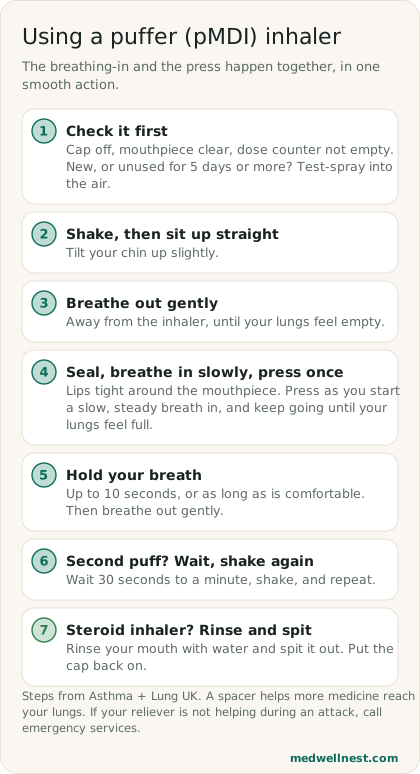
Start with a check. When the inhaler is new, or if you have not used it for five days or more, Asthma + Lung UK says to test it: take the cap off, shake it, point it away from you and press out a puff into the air. Your leaflet says how many test sprays your inhaler needs. If it has a dose counter, check it is not empty.
Then, in order: hold the inhaler upright, take the cap off, check nothing is inside the mouthpiece, and shake it well. Sit or stand up straight with your chin tilted slightly up. Breathe out gently, away from the inhaler, until your lungs feel empty. Put your lips around the mouthpiece to make a tight seal. Start to breathe in slowly and steadily and, at the same moment, press the canister once. Keep breathing in slowly until your lungs feel full.
Take the inhaler out of your mouth and, with your lips closed, hold your breath for up to 10 seconds, or as long as is comfortable. Breathe out gently. If you need a second puff, Asthma + Lung UK says to wait 30 seconds to a minute, shake again and repeat. MedlinePlus puts the gap at 1 to 2 minutes for quick-relief medicine and says other medicines need no wait, so follow what your own prescriber has told you. Put the cap back on when you finish.
03
Adding a spacer
A spacer is a tube that fits onto a puffer. The medicine is sprayed into the tube first and you breathe it in from there. Asthma + Lung UK says a spacer helps the medicine get into your lungs and lowers the risk of side effects, and that it is best to use one with a pMDI.
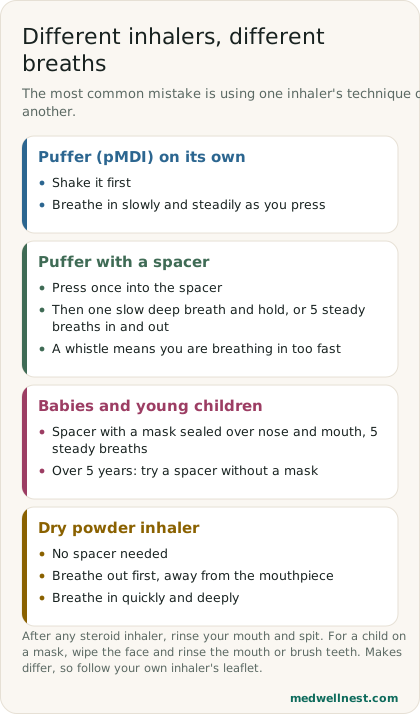
Shake the inhaler, fit it into the back of the spacer, and if your spacer has a valve, make sure it faces upwards. For the single-breath method, breathe out gently away from the spacer, seal your lips around its mouthpiece, press the canister once, then breathe in slowly and steadily until your lungs are full and hold for up to 10 seconds. Some small spacers whistle if you breathe in too fast.
The other method is tidal breathing. Press once, then breathe in and out slowly and steadily through the spacer five times; a valve spacer should click as it opens and closes. Asthma + Lung UK says this is usually recommended if you cannot hold your breath for five seconds, and during an asthma attack. For a second puff, take the spacer away from your mouth, wait, shake again and repeat. MedlinePlus describes the spacer breath a little differently, as two deep breaths, so if you have been taught one method, stick with it.
04
Spacers for babies and children
MedlinePlus says almost all children can use a spacer. Babies and young children use one with a face mask. Asthma + Lung UK suggests sitting a baby or young toddler on your lap facing you, so you can keep eye contact. Place the mask so it seals over the nose and mouth, press the canister once, and let your child breathe in and out slowly and steadily five times. With a large spacer and a baby, tilt the end of the inhaler up so the valve opens.
Asthma + Lung UK says that once a child is over five, they should try a spacer with a mouthpiece instead, because medicine can stick to the face and the inside of the mask. After a steroid inhaler with a mask, wipe your child's face with a damp cloth and rinse their mouth with water or brush their teeth.
05
Dry powder inhalers work differently
A dry powder inhaler needs a different breath from a puffer. Asthma + Lung UK's steps for the Turbohaler, one common dry powder device, say to breathe out gently away from the inhaler first, then seal your lips and breathe in quickly and deeply until your lungs feel full, and hold your breath for up to 10 seconds. Hold that device level, not upside down, or the powder may fall out. Loading the dose differs between makes (on the Turbohaler you twist the coloured base), so follow your own inhaler's leaflet. MedlinePlus says you do not need a spacer with a dry powder inhaler.
Keep an eye on the dose counter whatever the type. On some Turbohalers, a red mark appears in the window when about 20 doses are left; check your own inhaler's leaflet. MedlinePlus advises replacing an inhaler before it runs out, and says floating a canister in water to see if it is empty does not work. Store a puffer at room temperature; it is under pressure, so keep it away from heat and never puncture it.
06
Rinse after steroids, and know the attack signs
Preventer inhalers often contain a steroid. After using one, rinse your mouth with water and spit it out; Asthma + Lung UK says this reduces the chance of side effects, and MedlinePlus adds gargling and not swallowing the water. Using a spacer lowers the risk of side effects too.
MedlinePlus lists the main asthma symptoms as cough, including at night, wheezing, breathlessness and chest tightness. If these build up into an attack, use your reliever as your written asthma action plan says. Asthma + Lung UK advises calling emergency services if you are having an asthma attack and your reliever is not helping.
MedlinePlus lists danger signs that need emergency help straight away: trouble walking or talking because breathing is so hard, hunching over, blue or grey lips or fingernails, and confusion or being less responsive than usual. It adds that everyone who looks after a child with asthma, including teachers and babysitters, should know these signs.
When to act
Routine — see a doctor
Unsure of your technique, or not sure which inhaler you have: book a check with your doctor, nurse or pharmacist and take your inhaler with you so they can watch you use it.
Same-day — call promptly
Cough, wheeze, breathlessness or chest tightness that is getting worse over days, needing your reliever more often than your action plan allows, or having just had an asthma attack, even if you now feel better: contact your doctor today.
Emergency — act now
An asthma attack where your reliever is not helping, you feel worse at any point, or you have no reliever and are struggling to breathe; trouble walking or talking because of breathlessness, hunching over to breathe, blue or grey lips or fingernails, or confusion: call emergency services now.
Values mentioned in this story
Each one opens a visual guide with its normal range and what moves it — upload a report and we place your own numbers on the same scale.
Sources
- How to use a pMDI inhaler — Asthma + Lung UKasthmaandlung.org.uk
- How to use a pMDI inhaler with a spacer, tidal breathing — Asthma + Lung UKasthmaandlung.org.uk
- How to use a spacer with a mask for a baby or child — Asthma + Lung UKasthmaandlung.org.uk
- How to use a Turbohaler inhaler — Asthma + Lung UKasthmaandlung.org.uk
- How to use an inhaler, with spacer — MedlinePlusmedlineplus.gov
- Signs of an asthma attack — MedlinePlusmedlineplus.gov
Share this story
Curious where your own values stand?
Two minutes from upload to a full visual picture. Free to analyze.