In short
An HSG X-ray shows whether dye passes through both fallopian tubes and what the uterine cavity looks like. Here is what free spill, fill and spill, proximal and distal block and hydrosalpinx mean, why a block can be a spasm, and what usually comes next.
Emergency if: Difficulty breathing, a feeling of choking, or swelling of the face, lips or neck in the first two days after an HSG: call emergency services now, because this can be a serious allergic reaction to the dye. Severe abdominal pain or cramping, heavy vaginal bleeding, or fainting: go to an emergency department now and say you recently had an HSG. Injury to the uterus and pelvic infection are, with allergy, the rare serious problems ACOG names.
On this page
01
What an HSG shows, and what it cannot
A hysterosalpingogram (HSG) is an X-ray test of the uterus and the fallopian tubes. The American College of Obstetricians and Gynecologists (ACOG) says it is often used to see if the tubes are partly or fully blocked, and that it can also show whether the inside of the uterus is a normal size and shape. A fluid containing dye is passed through the cervix into the uterus and tubes, and X-ray pictures are taken as it fills them.
In the NICE fertility guideline, an HSG is offered to screen for blocked tubes in women who are not known to have conditions such as pelvic inflammatory disease, a previous ectopic pregnancy or endometriosis, because it is a reliable test for ruling out tubal occlusion and is less invasive than laparoscopy. Women thought to have such conditions are offered laparoscopy with dye instead, so that the tubes and the rest of the pelvis can be looked at together. NICE's current guideline, NG257, was published on 31 March 2026 and replaced the 2013 guideline CG156; its advice on HSG is carried forward from the older text.
02
Bilateral free spill and fill and spill
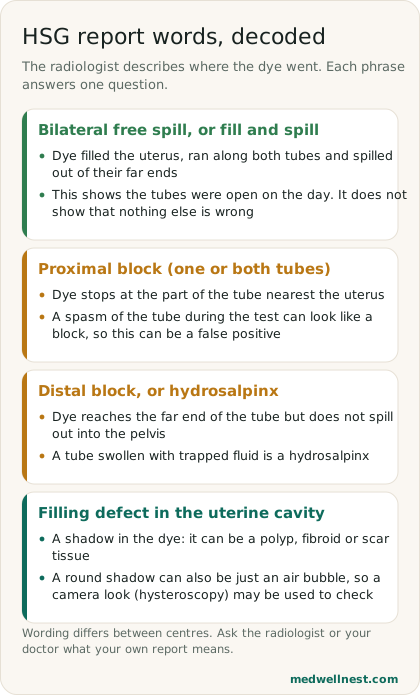
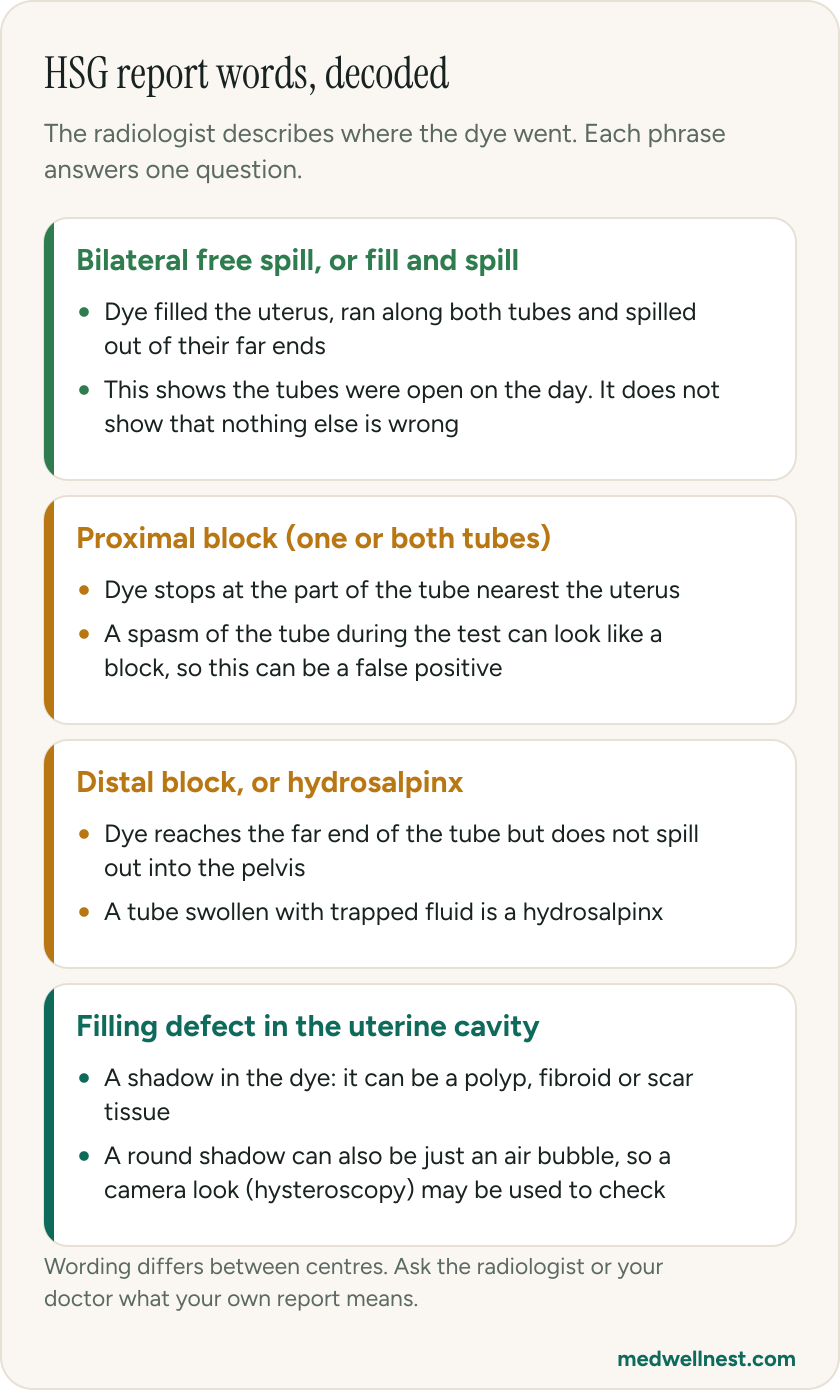
These are the words a report uses when the tubes look open. ACOG describes it this way: if there is no blockage, the fluid will spill slowly out of the far ends of the tubes, and the body then absorbs it. Free spill means the dye came out freely from the end of the tube into the pelvis; bilateral means it did so on both sides. Fill and spill means the same thing in two steps: the tube filled, and it spilled.
Read that as good news about the plumbing, not as a full fertility check. A 2026 hospital study of HSG compared with laparoscopy concluded that the test gives important information about whether the tubes are open but is not completely accurate, and that a normal finding does not eliminate the possibility of underlying pathology. Other causes, such as ovulation, sperm and the uterine lining, are looked at separately.
03
Proximal block, distal block, hydrosalpinx and uterine findings
A proximal block means the dye stopped in the part of the tube nearest the uterus. A distal block means the dye filled the tube up to its far end but did not spill out. A tube that swells with trapped fluid behind a distal block is called a hydrosalpinx; one study that graded HSGs defines it as partial tube filling at minimum, or tube swelling, without contrast appearing in the pelvis. Unilateral means one tube and bilateral means both: the 2026 hospital study notes that a finding of blockage on both sides has a high likelihood of tubal factor infertility, although false positives can occur.
The uterine cavity is judged on its outline. A filling defect is a shadow in the dye, and the report may suggest a polyp, a fibroid or scar tissue. These shadows are not always real: a study that compared HSG with hysteroscopy found that filling defects were often not due to any pathology confirmed on hysteroscopy, especially round ones, which could sometimes be an air bubble from the injection. That study confirmed them with a camera look inside the uterus, called hysteroscopy.
04
A blocked result can be a spasm, and what comes next
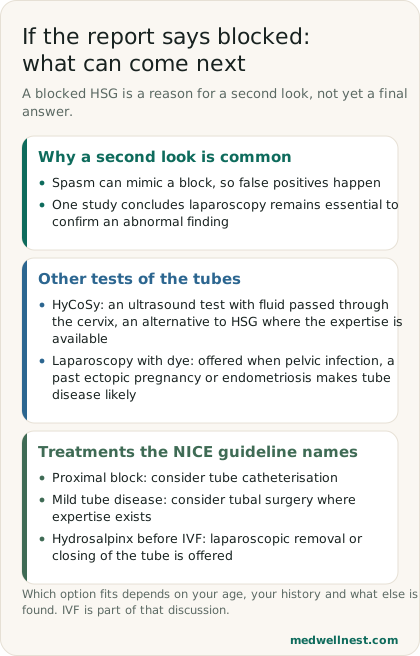
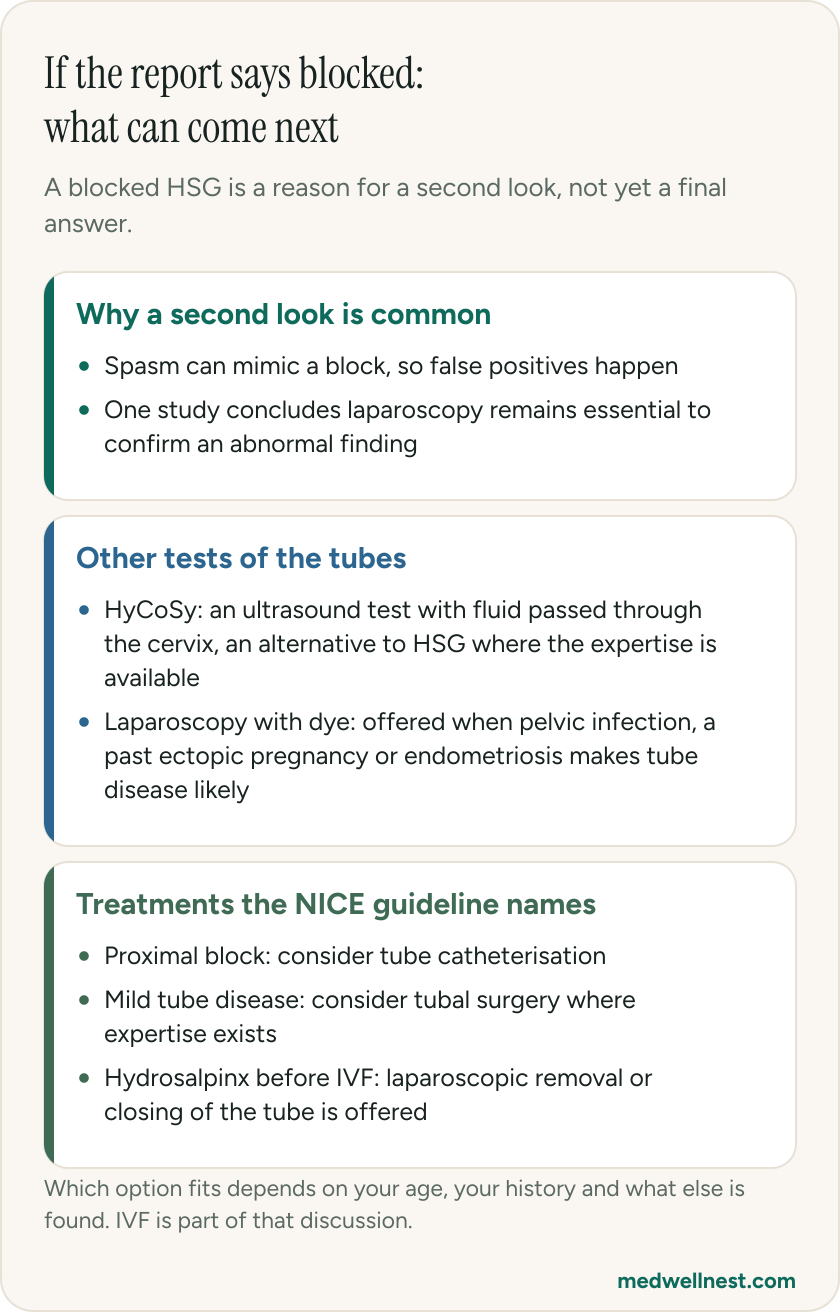
A blocked tube on HSG is not always a blocked tube. The 2026 hospital study notes that transient tubal spasm during the procedure can simulate tubal obstruction, giving a false-positive result, and a large study of HSG findings says that a proximal block may be attributed to tubal spasm induced by the pressure of the contrast injection. Its authors link proximal blocks to spasm of the muscle around the tube's entry in women with fibroids or adenomyosis.
That is why a blocked HSG usually leads to another look rather than straight to treatment. NICE names HyCoSy, an ultrasound version of the test, as an effective alternative to HSG for first screening where expertise is available, and offers laparoscopy and dye to women thought to have conditions such as pelvic inflammatory disease, a past ectopic pregnancy or endometriosis. The 2026 study concluded that laparoscopy remains essential to confirm abnormal findings. If a block is confirmed, NICE's 2026 recommendations include considering tube catheterisation for a proximal block, considering tubal surgery for mild tubal disease where expertise exists, and offering laparoscopic removal or closing of a hydrosalpinx before IVF. Which route fits depends on your age, your history and what else is found.
05
Timing in the cycle, pain, and when the test is not done
ACOG advises doing an HSG in the first half of the menstrual cycle, days 1 to 14 counting the first day of bleeding as day 1, because that timing reduces the chance that you may be pregnant. It also lists uterine bleeding at the time of the procedure as a reason not to do it, so in practice the test falls after the bleeding has stopped and before ovulation. Centres choose narrower windows: one hospital leaflet asks for a date approximately between day 8 and day 14 and asks patients not to have intercourse, with or without a condom, from the start of the period until the test is done. Follow the instructions of the centre that books you.
The test is not done if you are pregnant, which is why a urine pregnancy test may be asked for, if you have a pelvic infection, if you have uterine bleeding at the time, or if you have a moderate to severe allergy to the contrast dye. NICE adds that before any uterine instrumentation, women should be offered screening for chlamydia, with treatment and partner contact tracing if it is positive. Expect cramping as the fluid goes in; ACOG suggests agreeing a pain plan beforehand, which can mean an over-the-counter pain reliever taken an hour before or a numbing gel, cream or injection for the cervix, and in some cases an antibiotic before and after.
06
Infection risk and what to watch for afterwards
Afterwards a sticky discharge tinged with blood is expected as some fluid drains out. ACOG advises a pad rather than a tampon, and says slight vaginal bleeding, cramps, and feeling dizzy, faint or sick are also common. Severe problems after an HSG are rare, and ACOG names three: an allergic reaction to the dye, injury to the uterus and pelvic infection.
ACOG lists the symptoms to report to your doctor after the test: foul-smelling vaginal discharge, vomiting, fainting, severe abdominal pain or cramping, heavy vaginal bleeding, and fever or chills. Whoever you see, tell them that you recently had an HSG. The hospital leaflet adds that breathing difficulty or swelling of the face or neck within 48 hours can be a serious allergic reaction and needs emergency help at once. Our fertility guide and the ovulation guide explain the rest of the work-up, and the pelvic infection guide explains one of the conditions NICE names as a reason to choose laparoscopy instead.
After an HSG: what can wait and what cannot
Emergency — act now
Difficulty breathing, a feeling of choking, or swelling of the face, lips or neck in the first two days after an HSG: call emergency services now, because this can be a serious allergic reaction to the dye. Severe abdominal pain or cramping, heavy vaginal bleeding, or fainting: go to an emergency department now and say you recently had an HSG. Injury to the uterus and pelvic infection are, with allergy, the rare serious problems ACOG names.
Same-day — call promptly
Fever or chills, foul-smelling vaginal discharge, or vomiting after the test, without the signs above: contact the doctor who arranged the HSG today, or an urgent care service, and say you recently had the test. These are on ACOG's list of symptoms to report and may signal an infection.
Routine — see a doctor
A report that says block, hydrosalpinx or filling defect, or one you cannot follow: book a visit with your fertility doctor to talk about a repeat or second test. The wording alone is not an emergency, and a block can turn out to be a spasm.
Sources
- Fertility problems: assessment and treatment (NG257) — NICEnice.org.uk
- Hysterosalpingography (HSG) — ACOG patient FAQacog.org
- Diagnostic Accuracy of Hysterosalpingography Compared With Laparoscopy in Assessing Tubal Patency Among Subfertile Women — Cureus, 2026pmc.ncbi.nlm.nih.gov
- A Large Study About Reproductive Factors That Predict Hysterosalpingography-Identified Tubal Pathology — Journal of Clinical Medicine, 2025pmc.ncbi.nlm.nih.gov
- Correlation between hysterosalpingography diagnosis and final hysterolaparoscopy with dye-test diagnosis in women with unexplained infertility — SAGE Open Medicine, 2022pmc.ncbi.nlm.nih.gov
- Hysterosalpingogram: patient information leaflet — Dudley Group NHS Foundation Trustdgft.nhs.uk
Share this story
Curious where your own values stand?
Two minutes from upload to a full visual picture. Free to analyze.