In short
Sex from 5 days before ovulation until 1 day after it can lead to pregnancy, and the 3 days before ovulation carry the best odds. Here is how to spot those days, what ovulation tests show, why calendar predictions slip with irregular cycles, and when to ask for help.
Emergency if: Sudden, sharp, intense tummy pain with feeling very dizzy, fainting or looking very pale: call emergency services now.
On your report
LH (Luteinizing Hormone), FSH (Follicle-Stimulating Hormone), AMH (Anti-Müllerian Hormone), Progesterone +2 more
On this page
01
What ovulation is, and when it happens
Ovulation is the moment an ovary releases an egg. Usually one egg is released in each cycle, and you cannot get pregnant in a cycle in which you do not ovulate. After release, the egg moves down the fallopian tube, where it survives for about 24 hours.
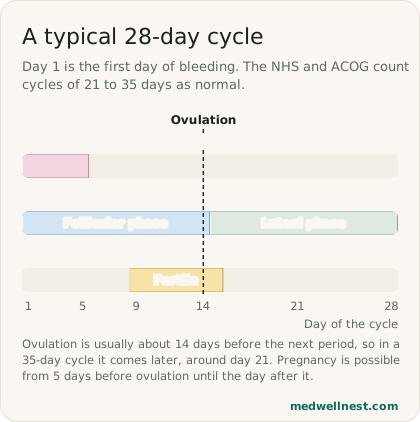
In a textbook 28-day cycle, ovulation falls around day 14. Beyond that, the sources give different numbers. ACOG says that in an average 28-day cycle ovulation happens about 14 days before the next period. The NHS says that in most women it happens around 10 to 16 days before the next period. The Office on Women's Health says the gap can be anywhere from 7 to 19 days.
The practical point is that ovulation is set by your next period, which you cannot see coming. The NHS notes that being fertile around day 14 applies to women with a regular 28-day cycle, and not to women whose cycles are shorter or longer.
02
Why the fertile window lasts several days
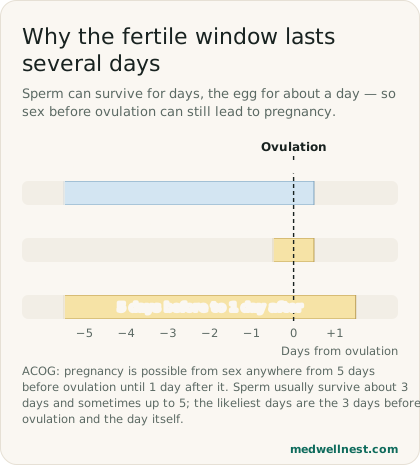
ACOG says you can become pregnant if you have sex anywhere from 5 days before ovulation until 1 day after it. The window opens early because sperm last much longer than the egg. Sperm can survive inside the body for about 3 days, and sometimes up to 5, so sperm from sex a few days earlier can still be waiting when the egg is released.
Your chances are not spread evenly across those days. The Office on Women's Health says pregnancy is most likely from sex in the 3 days before ovulation and on the day itself. It also gives a shorter life for the egg than ACOG: 12 to 24 hours rather than about 24.
The NHS gives a longer figure for sperm, saying they can survive for up to 7 days after sex. That would push the start of the window earlier still. If you are trying to avoid pregnancy, it is one more reason not to treat the days at the edge of the window as safe.
03
Signs your body gives
Cervical mucus is the most useful everyday sign. Just before ovulation there is noticeably more of it and it turns thin and slippery; the NHS likens it to raw egg white. Just after ovulation there is less, and it becomes thicker. ACOG notes that medicines, douching, sex, breastfeeding and lubricant can all change how it looks, so it takes a few cycles to learn your own pattern.
Your resting temperature, taken every morning before you get out of bed, eat or drink, rises slightly around ovulation, by about 0.3 to 0.6°C (0.5 to 1°F), and stays up until your next period. The catch is timing. ACOG says the most fertile days are the 2 to 3 days before the rise, so a temperature chart confirms ovulation after it has happened rather than warning you before. A fever makes the reading unreliable.
04
What ovulation test kits tell you
Home ovulation tests check your urine for luteinising hormone (LH). A surge of LH triggers the release of the egg. The Office on Women's Health says LH starts to surge about 36 hours before ovulation and peaks about 12 hours before it. ACOG says a positive test suggests ovulation will happen in the next 24 to 48 hours, which gives you an idea of the best time to have sex.
Because a positive result points to the next day or two, it flags the later part of the fertile window rather than its start. Sex in the days before a positive test still counts. Tests are easiest to use when you know roughly when to start testing, which is exactly what an irregular cycle makes hard.
05
Why calendar apps can mislead
A period app or calendar estimates your fertile days from the dates you enter. ACOG describes apps as tools to record your cycle and calculate your fertile periods. With regular cycles, that estimate has a sound basis, and the NHS notes that a regular 28-day cycle puts the fertile time around day 14. The trouble starts when the app has to guess when your next period will begin and count back from a date that keeps moving.
ACOG's own calendar rule, the Standard Days method, marks days 8 to 19 as fertile, but only for cycles that are consistently 26 to 32 days long. Outside that range, a fixed calendar rule no longer fits. ACOG also says fertility awareness can be harder to use soon after periods start, when approaching menopause, after having a baby, or after stopping hormonal contraception.
We found no health body that publishes accuracy figures for period apps. ACOG does publish figures for fertility awareness methods in general: with perfect use, fewer than 1 to 5 women in 100 become pregnant in the first year, but with typical use it is 12 to 24 in 100. If you are trying to conceive, ACOG suggests sex every day or every other day on your fertile days, which matters more than pinning down one exact date.
06
When to seek fertility help
ACOG recommends a fertility evaluation if you have not become pregnant after 1 year of regular sex without contraception, after 6 months if you are older than 35, and a conversation with a doctor straight away if you are older than 40. The NHS advises seeing a doctor after a year of trying, and sooner if you are 36 or over or already know you may have a fertility problem. ACOG's 'older than 35' and the NHS's '36 and over' draw essentially the same line; if you are close to it, it is reasonable to ask early.
Some context helps with the waiting. ACOG says healthy couples in their 20s or early 30s have about a 25 to 30 percent chance of pregnancy in any single cycle. That chance starts to fall in the early 30s, falls faster after 37, and drops below 10 percent per cycle by 40. The NHS says more than 8 in 10 couples where the woman is under 40 conceive naturally within a year with regular unprotected sex every 2 or 3 days.
Irregular or absent periods are a reason not to wait the full year, since ACOG says a problem with ovulation is the most common cause of female infertility. Men are part of the picture too. Problems with sperm are the most common cause of male infertility, and testing for a man often involves a semen analysis.
When to act
Routine — see a doctor
Trying for less than a year, aged 35 or under, with regular periods: sex every day or every other day through your likely fertile days, and give it time. No pregnancy after 12 months of trying, or after 6 months if you are over 35, straight away if you are over 40, or irregular or absent periods while trying: book a fertility assessment for both partners.
Same-day — call promptly
Could be pregnant and have pain low down on one side, unusual vaginal bleeding or brown watery discharge, or shoulder-tip pain: get medical advice today, even with a negative test, because it can be an ectopic pregnancy.
Emergency — act now
Sudden, sharp, intense tummy pain with feeling very dizzy, fainting or looking very pale: call emergency services now.
Values mentioned in this story
Each one opens a visual guide with its normal range and what moves it — upload a report and we place your own numbers on the same scale.
Sources
Share this story
Curious where your own values stand?
Two minutes from upload to a full visual picture. Free to analyze.