In short
Day 1 is the first day of bleeding, and a cycle anywhere from 21 to 35 days is usually normal. Here is what happens in each phase, what a typical period looks like, how much variation is fine, and the changes worth showing a doctor.
Emergency if: Soaking through pads or tampons every hour for more than 2 hours in a row together with chest pain, shortness of breath, or feeling lightheaded or dizzy, or sudden severe tummy pain with fainting when you could be pregnant: seek emergency care now.
On your report
Hemoglobin, Ferritin, FSH (Follicle-Stimulating Hormone), LH (Luteinizing Hormone) +2 more
On this page
01
How a cycle is counted
Your menstrual cycle starts on the first day of your period and runs until your next period begins. Doctors call the first day of bleeding day 1, and every other day of the cycle is counted from there. That is why a period calendar asks for the day your bleeding started, not the day it stopped.
You will often hear that a cycle lasts 28 days. That is an average, not a rule. The NHS says periods commonly come anywhere from every 21 days to every 35 days, and the American College of Obstetricians and Gynecologists (ACOG) gives the same 21 to 35 day range as normal. Many people's cycles are a few days longer or shorter than 28, and the length can change from month to month.
02
What happens in each phase
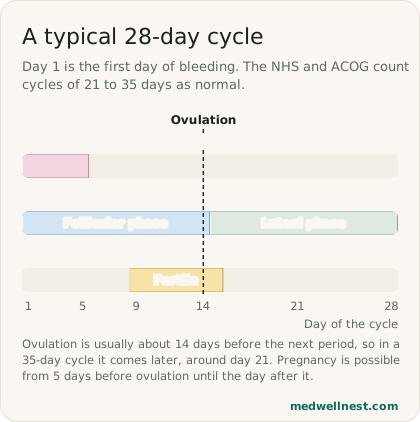
The cycle has two halves, split by ovulation, the moment an ovary releases an egg. The first half is the follicular phase. It begins on day 1 with your period, and during it the womb lining is first shed and then rebuilt. In a textbook 28-day cycle this phase runs from day 1 to day 14, and ovulation happens on about day 14.
The second half is the luteal phase, from ovulation to your next period. In a 28-day cycle it covers days 15 to 28. The lining is prepared to receive a fertilised egg, and if no pregnancy happens, it is shed as your next period and day 1 comes round again.
The key idea is that the two halves behave differently. The first half varies in length, while the second half is fairly steady for each person, typically about 14 days. So in a longer cycle it is usually ovulation that comes later: in a 35-day cycle it would fall around day 21. Even the second half is not fixed for everyone, though. The Office on Women's Health says the gap between ovulation and the next period can be anywhere from 7 to 19 days.
Pregnancy is possible from sex in the days just before ovulation, not only on the day itself, because sperm can live in the body for 3 to 5 days while the egg lives for 12 to 24 hours. In the chart, that fertile stretch runs from day 9 to day 15, from 5 days before ovulation to the day after. The likeliest days are the 3 days before ovulation and the day itself.
03
What a typical period looks like
A period can last between 2 and 7 days, the NHS says, and usually lasts about 5. Bleeding tends to be heaviest in the first 2 days. On the heaviest days the blood is red; on lighter days it may look pink or brown. ACOG describes a normal period as one that lasts up to 7 days.
The total amount is smaller than most people imagine, and the figures differ between sources. The NHS puts it at about 20 to 90 ml over a whole period (it describes this as about 1 to 5 tablespoons), while the Office on Women's Health says the average is about two to three tablespoons. Both describe the entire period, not a single day, and both say some women bleed more than this.
In the days before a period, hormone changes can bring physical and emotional symptoms, known as premenstrual syndrome (PMS). They usually ease once the period starts and go a few days afterwards. Not everyone who has periods gets PMS.
04
How much variation is normal
Your cycle does not have to be the same length every month. What matters is how far it swings and whether it stays inside the usual range. ACOG counts cycles shorter than 21 days or longer than 35 days as abnormal, and also cycles that vary in length by more than 7 to 9 days from one to the next.
The sources do not agree exactly on the outer limits. The Office on Women's Health says periods are still regular if they usually come every 24 to 38 days, a range that starts later and ends later than the 21 to 35 days used by the NHS and ACOG. If your cycle sits near the edge of either range, keep a note of your dates for a few months and mention it at your next check-up.
Age matters too. Periods usually begin at around 12, and the NHS says most girls have regular periods by 16 to 18. For a few years after the first period, cycles longer than 38 days are common. At the other end, cycles often turn irregular in the 40s on the way to menopause, which for most women arrives between 45 and 55 and is confirmed after 12 months in a row with no period.
05
Signs a period is too heavy
Heavy periods may be normal for you, but treatment can help if they are affecting your daily life. The NHS lists these signs: needing to change a pad or tampon every 1 to 2 hours, needing to use 2 types of period product together, periods lasting more than 7 days, passing clots larger than about 2.5 cm, bleeding through to clothes or bedding, and often feeling tired or short of breath.
The other sources set their lines a little differently. ACOG counts bleeding that soaks through one or more pads or tampons every hour, or bleeding for more than 7 days, as abnormal. The Office on Women's Health lists bleeding through one or more pads every one to two hours, clots larger than about 2.5 cm, roughly the size of a large coin, and bleeding that often lasts longer than eight days.
Tiredness and breathlessness are worth mentioning to a doctor because heavy bleeding can cause iron deficiency anaemia. A doctor may arrange blood tests to check for it, alongside looking for the cause of the bleeding.
06
When to see a doctor
Bleeding between periods, bleeding after sex, and any bleeding after the menopause should be checked by a doctor. The NHS notes it can come from an infection or changes in the neck of the womb, and in rare cases cancer, so it is not something to wait out.
If your period is late and you could be pregnant, take a pregnancy test first. The advice on how long to wait after that differs slightly. The NHS says see a doctor if the test is negative and you have missed 3 periods in a row. The Office on Women's Health says talk to a doctor after 90 days without a period if you are not pregnant or breastfeeding, and ACOG lists no period for 3 to 6 months as abnormal. A girl who has not had her first period by 15 should also be seen.
Book a visit, too, if your cycles are regularly shorter than 21 days or longer than 35, if periods last longer than 7 days, if the length swings by more than 7 to 9 days from one cycle to the next, if your periods change in a way that is new for you, or if pain or bleeding makes you miss school or work. Severe pain or bleeding that stops you doing normal things is not normal and can be treated.
When to act
Routine — see a doctor
Cycles between 21 and 35 days, periods of up to 7 days and bleeding that fits your usual pattern: keep a note of your dates. Book an appointment for 3 missed periods in a row with a negative pregnancy test, or heavy periods with tiredness or breathlessness.
Same-day — call promptly
Soaking through a pad or tampon every hour for several hours in a row, bleeding between periods or after sex, any bleeding after the menopause, or a late period with pain low down on one side or shoulder-tip pain: get medical advice today.
Emergency — act now
Soaking through pads or tampons every hour for more than 2 hours in a row together with chest pain, shortness of breath, or feeling lightheaded or dizzy, or sudden severe tummy pain with fainting when you could be pregnant: seek emergency care now.
Values mentioned in this story
Each one opens a visual guide with its normal range and what moves it — upload a report and we place your own numbers on the same scale.
Sources
- Periods — NHSnhs.uk
- Heavy periods — NHSnhs.uk
- Abnormal Uterine Bleeding — ACOGacog.org
- Your menstrual cycle — Office on Women's Healthwomenshealth.gov
- Physiology, Menstrual Cycle — StatPearls (NCBI Bookshelf)ncbi.nlm.nih.gov
- Ectopic pregnancy — NHSnhs.uk
Share this story
Curious where your own values stand?
Two minutes from upload to a full visual picture. Free to analyze.