In short
About three in four ureter stones under 5 mm pass on their own. Stones that pass take about 17 days on average. Larger stones pass less often, and the choice between waiting, shock-wave treatment, ureteroscopy and PCNL depends on size and where the stone sits.
Emergency if: Stone pain with a fever, chills or shivering, passing no urine, pain that painkillers cannot control, or any stone pain if you have only one kidney: go to emergency now. An infected, blocked kidney needs urgent drainage and antibiotics.
On your report
Creatinine, eGFR (Estimated Glomerular Filtration Rate), Uric Acid, Calcium +1 more
On this page
01
What the size on your scan means
A scan report gives a stone's size in millimetres, sometimes as one measurement and sometimes as two or three. The European Association of Urology (EAU) guideline groups stones into under 5 mm, 5 to 10 mm, 10 to 20 mm and over 20 mm, and those groups drive most treatment choices.
Location matters as much as size. A stone may sit inside the kidney, or it may have moved into the ureter, the tube that carries urine down to the bladder. Ureter stones are described as upper, near the kidney, middle, or lower, near the bladder. The lower a stone has travelled, the more likely it is to finish the journey.
This page is about size and treatment. For why stones form and what hydration does, see our guide Why Kidney Stones Form and What Hydration Actually Does.
02
The chance a stone passes on its own
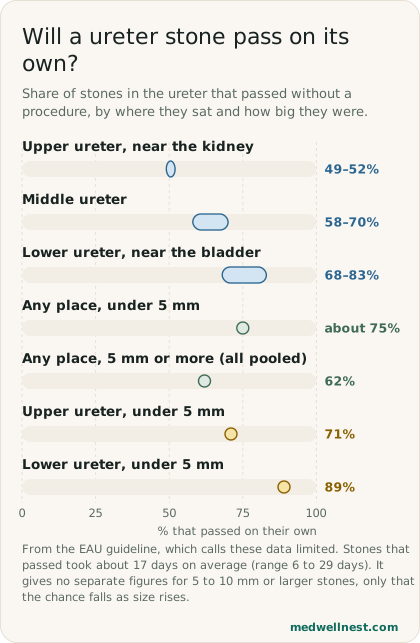
The EAU guideline pulls together the best available figures, while calling them limited. For stones in the ureter, about 75% of those under 5 mm and 62% of those 5 mm or larger passed without a procedure. By location, 49 to 52% of upper ureter stones passed, 58 to 70% of middle ones and 68 to 83% of lower ones.
Put size and place together and the figures spread further: a stone under 5 mm in the lower ureter had an 89% chance of passing, and one under 5 mm in the upper ureter 71%. Stones that did pass took about 17 days on average (the EAU gives a range of 6 to 29 days). The guideline gives no separate figures for 5 to 10 mm or larger stones, but says the chance falls as size rises and varies from person to person.
Stones still inside the kidney behave differently. In people with stones that caused no symptoms and were simply watched, the EAU found that between 3% and 29% passed, while 5% to 66% grew and 7% to 26% eventually needed surgery.
03
Waiting, and medicine that helps a stone pass
For a newly found small ureter stone with no reason to remove it, the EAU recommends watching it at first, with regular checks. Pain relief comes first: the NICE guideline makes an anti-inflammatory painkiller the first choice for kidney stone pain, and the NHS notes that a small stone can hurt until it passes, which can take a few weeks.
Some people are also given an alpha-blocker, a medicine to help the stone pass. The EAU recommends it as one option for stones in the lower ureter larger than 5 mm, where it seems to help most, and NICE says to consider it for lower ureter stones under 10 mm. Both note that this is an off-label use. The EAU says it should be stopped if infection, uncontrolled pain or worsening kidney function develops.
For a kidney stone that is causing no symptoms, NICE says watchful waiting can be considered if it is under 5 mm, and for larger stones after an informed discussion of the risks.
04
When waiting stops being the plan
The EAU lists four reasons to remove a ureter stone: a low chance of it passing, pain that continues despite adequate painkillers, a blockage that persists, and kidney function at risk, as with kidney failure, blockage on both sides or a single kidney.
NICE says that adults with a ureter stone and ongoing pain they cannot tolerate, or a stone unlikely to pass, should be offered treatment within 48 hours of diagnosis. For suspected kidney stone pain, NICE also recommends a low-dose CT scan within 24 hours in adults, with ultrasound instead for pregnant women and as the first scan in children.
05
The options by size and location
Shock-wave lithotripsy (SWL) breaks the stone from outside the body so the pieces can be passed, and may need more than one session. Ureteroscopy passes a thin telescope up through the bladder to remove the stone or break it with a laser. Percutaneous nephrolithotomy (PCNL) reaches the kidney through a small cut in the back. The NHS notes that ureteroscopy and PCNL are done under general anaesthetic.
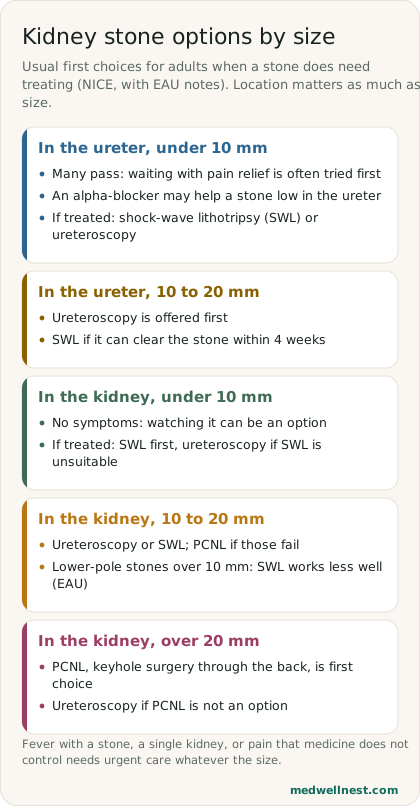
For adults, NICE offers SWL first for ureter stones under 10 mm and kidney stones under 10 mm, with ureteroscopy if SWL is unsuitable or has failed. For ureter stones of 10 to 20 mm it offers ureteroscopy, with SWL if the stone can be cleared within 4 weeks. For kidney stones of 10 to 20 mm it suggests ureteroscopy or SWL, and PCNL if those fail. For kidney stones over 20 mm, including staghorn stones, it offers PCNL.
The EAU broadly agrees but adds detail. It tells doctors to explain that ureteroscopy has a better chance of clearing a ureter stone in one go, but more complications than SWL. For kidney stones, it says SWL works well up to 20 mm except in the lower part of the kidney, where PCNL or ureteroscopy is preferred once a stone is over 10 mm, and PCNL is the first choice above 20 mm.
06
Red flags: when a stone is an emergency
A stone that blocks the kidney while there is infection behind it is a urological emergency, the EAU says. Fever or shivering with stone pain is the warning. The blocked kidney needs urgent drainage, with a tube called a stent passed up the ureter or a nephrostomy tube placed through the back, together with antibiotics started straight away. Removing the stone itself waits until the infection has cleared.
The EAU also calls for immediate assessment and imaging for anyone with a stone and a single kidney, or with a fever, and for drainage or removal of the stone when pain cannot be controlled with painkillers. Passing no urine at all is also treated as an emergency.
The NHS advises urgent help for severe pain, a high temperature or feeling hot, cold or shivery, and blood in the urine.
When to act
Routine — see a doctor
A small stone with pain that painkillers control and no fever: follow the plan your doctor has made, and go back for the follow-up scan to check it has passed.
Same-day — call promptly
Pain that keeps coming back or is not settling with the painkillers you have been given, or blood in your urine: see your doctor today. A stone that is unlikely to pass, or pain you cannot tolerate, should be treated within 48 hours.
Emergency — act now
Stone pain with a fever, chills or shivering, passing no urine, pain that painkillers cannot control, or any stone pain if you have only one kidney: go to emergency now. An infected, blocked kidney needs urgent drainage and antibiotics.
Values mentioned in this story
Each one opens a visual guide with its normal range and what moves it — upload a report and we place your own numbers on the same scale.
Sources
Share this story
Curious where your own values stand?
Two minutes from upload to a full visual picture. Free to analyze.