In short
A lipid profile measures total cholesterol, HDL and triglycerides and works out the rest. General guide levels exist for every line, but your own LDL goal depends on your heart risk, from below 100 mg/dL down to 30 or less, and 10 to 15 for the very highest-risk group.
Emergency if: Sudden, severe pain in the upper tummy that does not go away, especially if it spreads to your back, with vomiting, a fast heartbeat or difficulty breathing: this can be acute pancreatitis. Go to emergency now, particularly if you know your triglycerides are very high.
On your report
Total Cholesterol, LDL Cholesterol, HDL Cholesterol, Triglycerides +3 more
On this page
01
What the report actually measures
A standard lipid profile measures three things directly: total cholesterol, HDL cholesterol and triglycerides. The rest is usually worked out from them. MedlinePlus explains that an LDL marked "calculated" is an estimate made from those three numbers, while some labs measure LDL directly.
VLDL is the same kind of estimate. MedlinePlus notes that VLDL is hard to measure, so labs estimate it from the triglyceride level. That means the VLDL line moves with your triglycerides and does not add a separate piece of information. Non-HDL cholesterol is simply total cholesterol minus HDL, and it captures all the particles that can clog arteries, not just LDL.
Check the units. Most reports print mg/dL, but some use mmol/L, and so do some guidelines. Mayo Clinic gives two worked examples: 200 mg/dL of cholesterol is 5.2 mmol/L, and 130 mg/dL is 3.37 mmol/L.
02
Line by line: the general guide levels
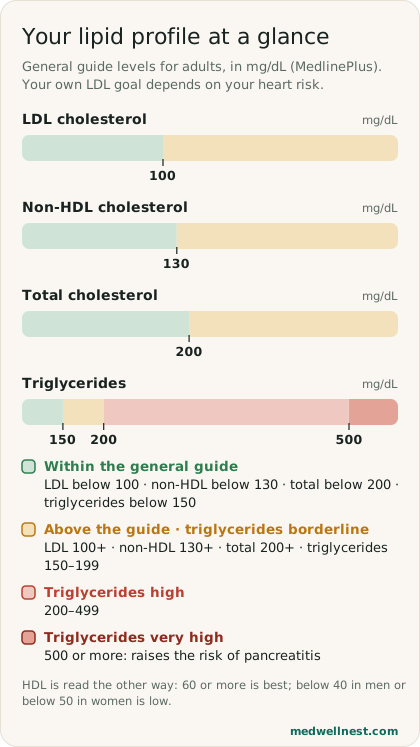
For adults aged 20 and over, MedlinePlus gives these healthy levels: total cholesterol below 200 mg/dL, LDL below 100, non-HDL below 130. HDL works the other way, since higher is better: 60 or more is best, and below 40 in men or below 50 in women is considered low. For young people aged 19 or under, the levels are a little lower: total below 170, LDL below 110 and non-HDL below 120, with HDL above 45.
Triglycerides have four bands in adults: below 150 mg/dL is healthy, 150 to 199 is borderline high, 200 to 499 is high, and 500 or more is very high. MedlinePlus says that very high triglycerides increase the risk of sudden pancreatitis.
These are general guides for people without known heart disease. They are not treatment targets for someone who already has heart disease or diabetes, whose goals are usually lower.
03
Ratios, and why non-HDL matters more
Many reports add a total cholesterol to HDL ratio. Mayo Clinic explains it as total cholesterol divided by HDL: a total of 200 with an HDL of 50 gives a ratio of 4 to 1, and a higher ratio means a higher risk of heart disease.
Mayo Clinic adds that many doctors now find non-HDL cholesterol more useful than the ratio for predicting heart risk, and that either is a better guide than total cholesterol alone. The LAI consensus, from the national association of lipid specialists, makes non-HDL a co-primary treatment target alongside LDL. So if your report shows both a ratio and a non-HDL figure, the non-HDL figure is the one to track.
04
"Kitna hona chahiye": it depends on your risk
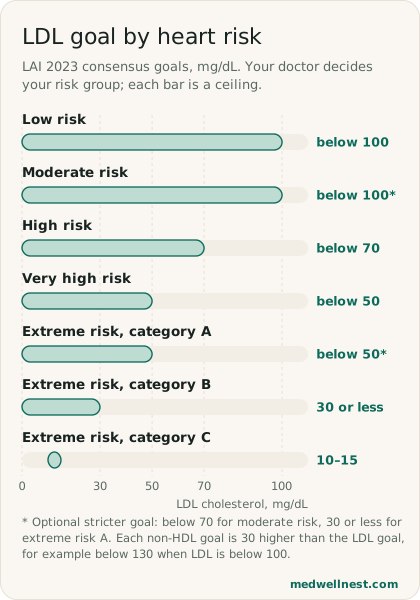
There is no single right LDL number. The 2023 update of the LAI consensus, written for the population it serves, sets LDL goals by risk group: below 100 mg/dL for low risk, below 100 for moderate risk (optionally below 70), below 70 for high risk, below 50 for very high risk, below 50 for extreme risk category A (optionally 30 or less), 30 or less for extreme risk category B, and 10 to 15 mg/dL for extreme risk category C, people who keep having heart events despite an LDL around 30. For non-HDL, each goal is 30 mg/dL higher.
The consensus says its goals are more aggressive than other guidelines, because heart disease tends to start younger and progress faster in that population, so it puts the emphasis on lifetime risk rather than 10-year risk. Your group is decided by your doctor, from your medical history, your risk factors and, where done, artery scans such as a coronary calcium score. It is not something to read off a chart.
The NICE guideline takes a different approach. For people who already have heart or artery disease, it aims for LDL of 2.0 mmol/L or less, or non-HDL of 2.6 mmol/L or less. For people treated to prevent a first heart attack or stroke, it aims for a fall in non-HDL of more than 40% rather than a fixed number. The two guidelines agree on the direction, lower is better for people at higher risk, but differ in how far to go.
05
Fasting or not before the test
Fasting matters less than it used to. NICE says a fasting sample is not required for a routine lipid test, and the LAI consensus notes that non-HDL cholesterol can be measured without fasting. The LAI treats triglycerides as a risk marker at 150 mg/dL or more when fasting, or 175 or more when not fasting.
Your doctor may still ask you to fast, and MedlinePlus says that can mean 9 to 12 hours. It matters most for triglycerides, which is why the LAI uses a higher cut-off for a non-fasting sample. NICE notes that a calculated LDL may not be reported when triglycerides are above 4.5 or 9 mmol/L, depending on the formula the lab uses, and that very high results should be repeated as a fasting test.
06
Very high triglycerides and the pancreas
At very high levels, triglycerides become a risk to the pancreas as well as the heart. MedlinePlus calls 500 mg/dL or more very high and says it raises the risk of sudden pancreatitis. The LAI notes that at 500 or more, and especially above 1000, the blood carries large fat particles called chylomicrons as well as VLDL.
NICE sets out what should happen next, in mmol/L. A triglyceride level above 20 mmol/L (about 1,770 mg/dL) that is not explained by heavy drinking or poorly controlled diabetes should be reviewed urgently by a specialist. A level between 10 and 20 mmol/L (about 885 to 1,770 mg/dL) should be repeated as a fasting test after 5 days to 2 weeks, with a search for causes, and specialist advice sought if it is still above 10.
NICE also asks doctors to look for common causes behind abnormal lipids before referral: heavy drinking, uncontrolled diabetes, an underactive thyroid, liver disease and nephrotic syndrome. Separately, a total cholesterol above 9.0 mmol/L (about 350 mg/dL) or non-HDL above 7.5 mmol/L (about 290 mg/dL) calls for a specialist assessment even without a family history of early heart disease, because it can point to an inherited lipid disorder.
When to act
Routine — see a doctor
LDL, non-HDL or total cholesterol above the general guide, or triglycerides of 150 to 499 mg/dL: book a visit to work out your risk group and your own LDL goal. Ask whether any other condition, such as thyroid or diabetes, needs checking.
Same-day — call promptly
Triglycerides of 500 mg/dL or more, or a very high total or non-HDL cholesterol: see your doctor within days for a repeat fasting test and a search for causes. Triglycerides of about 885 mg/dL (10 mmol/L) or more need a repeat fasting test after 5 days to 2 weeks, and above about 1,770 mg/dL (20 mmol/L) need urgent specialist review.
Emergency — act now
Sudden, severe pain in the upper tummy that does not go away, especially if it spreads to your back, with vomiting, a fast heartbeat or difficulty breathing: this can be acute pancreatitis. Go to emergency now, particularly if you know your triglycerides are very high.
Values mentioned in this story
Each one opens a visual guide with its normal range and what moves it — upload a report and we place your own numbers on the same scale.
Sources
- LAI 2023 update on cardiovascular risk assessment and lipid management: Consensus statement IV — Journal of Clinical Lipidologylipidjournal.com
- Cardiovascular disease: risk assessment and reduction, including lipid modification (NG238) — NICEnice.org.uk
- Cholesterol Levels — MedlinePlusmedlineplus.gov
- Triglycerides Test — MedlinePlusmedlineplus.gov
- Cholesterol ratio or non-HDL cholesterol: Which is most important? — Mayo Clinicmayoclinic.org
- Acute pancreatitis — NHSnhs.uk
Share this story
Curious where your own values stand?
Two minutes from upload to a full visual picture. Free to analyze.