In short
A newborn's first poo is black and sticky (meconium), then turns green and yellow within about a week. Breastfed and formula-fed babies differ. White, pale or clay-coloured poo, red poo, or black poo after the first days needs a doctor.
Emergency if: Your baby has jaundice and is sleepier than normal or hard to wake, is not feeding, is floppy or stiff, has jerking or twitching movements, has a high temperature of 38 °C or more or a low temperature of 36 °C or less, has no wet nappies, or has difficulty breathing with grunting, the tummy sucking in under the ribs, or very fast breathing; or your baby's skin or eyes look yellow when the baby is less than 24 hours old: go to an emergency department now or call emergency services now. The NHS lists these as emergency signs. Also go to an emergency department now if a baby under 3 months has a temperature of 38 °C or higher, unless a doctor can see the baby within 2 hours.
On this page
01
What colour should a newborn's poop be?
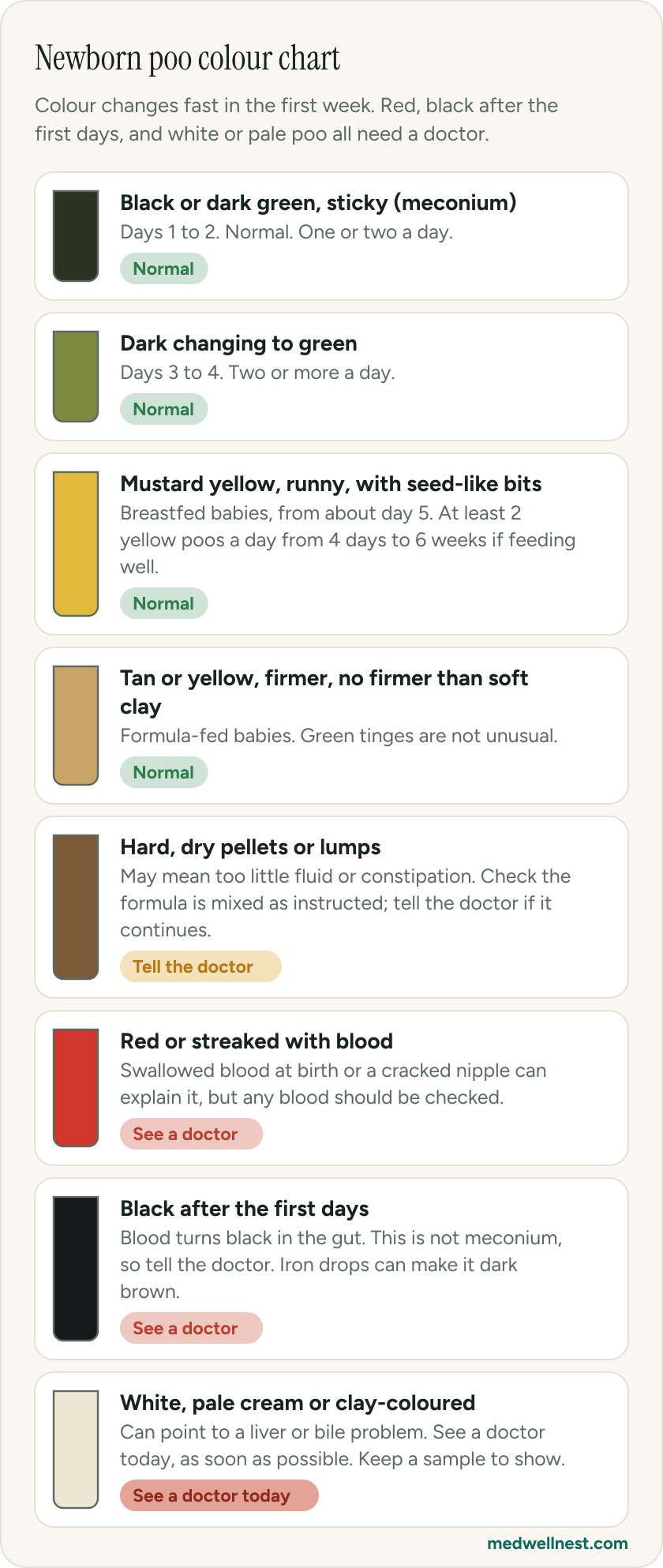
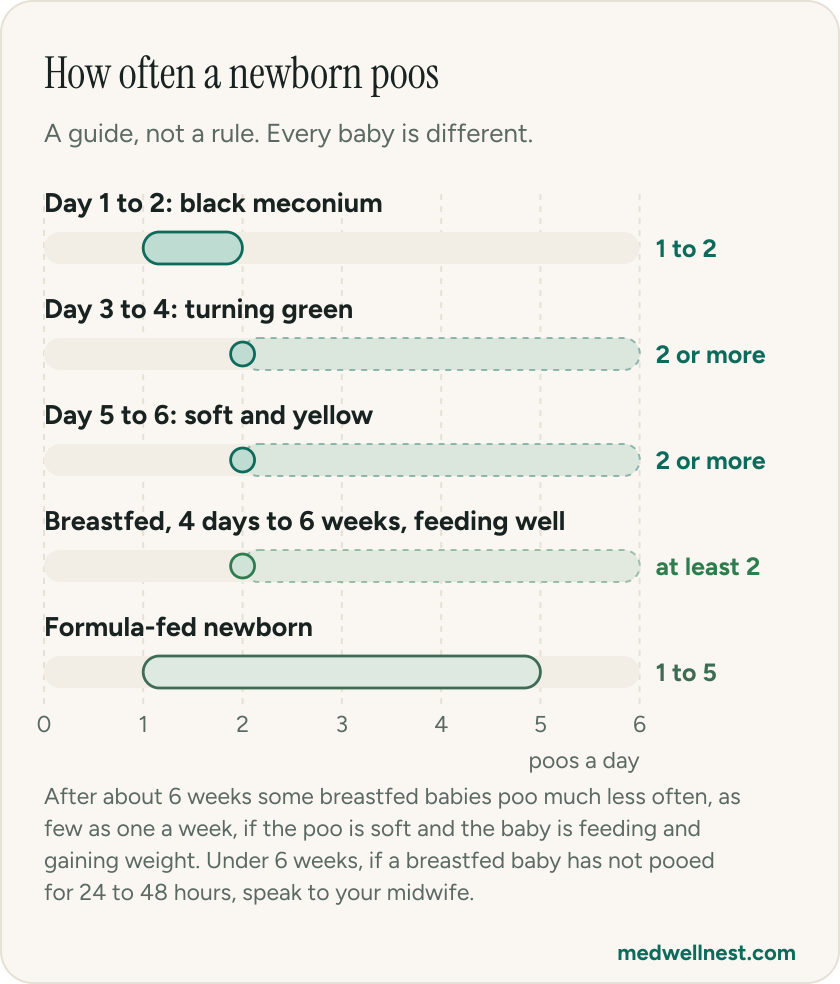
Black or dark green and sticky in the first days is normal. The AAP says that once a baby has passed the tarry meconium, all the shades of yellow, brown and even green that follow are considered perfectly acceptable. A health visiting service run by the NHS gives a day-by-day guide: on days 1 to 2 the poo is very dark and sticky, with one or two a day; on days 3 to 4 it changes from dark to green, with two or more a day; on days 5 to 6 it is soft and yellow, with at least two or more a day. It adds that some babies produce yellow poo before day 5, which is fine.
Feeding changes the look. The AAP says breastfed babies' poo should soon be yellow and liquid with seed-like bits, often described as mustardy. Formula-fed babies' poo is usually tan or yellow, firmer than a breastfed baby's but no firmer than soft clay, and green poo is not unusual and should not cause alarm. Iron supplements can turn the poo dark brown. Red, black after the first days, and white or pale poo are the colours that always need a doctor.
02
What is meconium, and is black poop in the first days normal?
Meconium is the thick black or dark green substance that filled your baby's intestines before birth, the AAP says. Once it has passed, the stools turn yellow-green. The NHS says that by day 3 the poo should be changing to a lighter, loose, greenish poo. The AAP says the warning about black poo does not apply to your baby's first few meconium stools, which you can fully expect to be black and tarry.
Blood is a different matter. The AAP says blood turns from red to black over time in the gut, so black poo after the meconium stage is worth attention. Red poo should be brought to your baby's doctor, though the AAP says it need not cause panic: babies can swallow some blood during delivery, and it can show up shortly after in spit-up or poo, and cracked nipples can be another source. Even so, the AAP says any amount of bloody poo should be evaluated, and that large amounts of blood, mucus or water in the stool need a call to the doctor immediately.
03
How many times does a newborn poop in a day?
It varies, but the sources give a guide. The NHS service above gives one or two on days 1 to 2 and two or more from day 3. The NHS says a baby aged between 4 days and 6 weeks who is breastfeeding well should pass at least 2 yellow poos a day, and that if a baby has not pooed in the past 24 to 48 hours you should speak to your midwife, nurse or baby's doctor, because it may mean the baby is not getting enough milk. Formula-fed newborns may poo up to 5 times a day, and the AAP says a formula-fed baby should have at least one bowel movement a day.
Later it changes. The AAP says that by three to six weeks of age some breastfed babies have only one bowel movement a week and are still normal, as long as the stools are soft and the baby is otherwise well, gaining weight steadily and feeding regularly. Grunting, squirming, going red and even crying during a poo are normal and do not mean constipation, the NHS service says. The NHS uses 6 weeks as the point after which breastfed babies may poo less often, and asks you to call your midwife, nurse or baby's doctor about a gap of 24 to 48 hours before then.
04
Pale, white or clay-coloured poop: is it an emergency?
It needs a doctor promptly, not a wait-and-see. The AAP says white poop is quite rare but needs to be brought to a doctor as soon as possible, because pale poo that lacks colour can be caused by an underlying liver problem and the earlier it is assessed, the better. The NHS says that for a baby over 24 hours old, a pale creamy poo or dark yellow or brown pee means asking for an urgent appointment, and to keep a sample of the poo to show the midwife or doctor. In practice that means seeing a doctor the same day, as soon as you can.
Time matters because of a rare condition called biliary atresia, a newborn liver disease that does badly if not recognised and treated early. A 2022 review reports that with surgery before 60 days of age, over 70% of patients become jaundice-free, and that recent studies show surgery before 30 days gives the best results. Stool colour cards that parents use for the first 30 days have been used to catch it. The review also notes that some pale stools turn out to be temporary, so a pale poo is a reason to be checked, not a diagnosis. The NHS says newborn jaundice usually takes around 2 weeks to go, so jaundice that is not getting better, is getting worse or lasts longer than that, especially with pale poo or dark pee, needs a doctor's check. Our newborn jaundice guide explains the yellow skin that often comes with it.
05
My baby's poop is hard, or my baby has not pooped: is it constipation?
Check the pattern before worrying. The NHS service says a baby is not constipated as long as the poos are soft, even if there has not been one for a few days. Signs of constipation, listed by the NHS, are pooing fewer than 3 times in a week, finding it hard to poo, dry, hard, lumpy or pellet-like poos, unusually smelly poo, a firm tummy, and being less hungry. The AAP says hard or very dry stools may mean the baby is not getting enough fluid or is losing too much through illness, fever or heat. For a formula-fed baby, check the formula is mixed as the instructions say, with the water added to the bottle first. Cow's milk is not recommended for babies under 12 months.
Diarrhoea is the other side. The AAP says the signs are a sudden increase to more than one bowel movement per feed and unusually watery stool, and the main worry is dehydration. It says to call your doctor immediately for large amounts of blood, mucus or water in the stool, and to call if your baby is under three months old with a rectal temperature of 100.4 °F (38 °C). A baby that young with a temperature of 38 °C or higher should go to an emergency department now, unless a doctor can see the baby within 2 hours. Our guides to diarrhoea and rehydration and to stool types give more background.
When to act
Emergency — act now
Your baby has jaundice and is sleepier than normal or hard to wake, is not feeding, is floppy or stiff, has jerking or twitching movements, has a high temperature of 38 °C or more or a low temperature of 36 °C or less, has no wet nappies, or has difficulty breathing with grunting, the tummy sucking in under the ribs, or very fast breathing; or your baby's skin or eyes look yellow when the baby is less than 24 hours old: go to an emergency department now or call emergency services now. The NHS lists these as emergency signs. Also go to an emergency department now if a baby under 3 months has a temperature of 38 °C or higher, unless a doctor can see the baby within 2 hours.
Same-day — call promptly
Your baby's poo is white, pale cream or clay-coloured, or the pee is dark yellow or brown: see a doctor today, as soon as possible, and keep a sample of the poo to show. Also see a doctor today for red poo or black poo after the first days, and call your doctor now for large amounts of blood, mucus or water in the stool. Also see a doctor today if your baby has been diagnosed with jaundice and it is not getting better or is getting worse, or if yellow skin or eyes are still there after about 2 weeks, especially with pale poo or dark pee. The NHS and AAP say not to wait.
Routine — see a doctor
Poos are hard or pellet-like, or a young breastfed baby seems to poo less often than the guide above while feeding well: mention it to your baby's doctor or nurse. Soft poos with a few days between them, in a baby who is feeding and gaining weight, are not constipation.
Sources
- The Many Colors of Baby Poop — AAP, HealthyChildren.orghealthychildren.org
- Baby's First Days: Bowel Movements & Urination — AAP, HealthyChildren.orghealthychildren.org
- Constipation and breastfeeding — NHS Best Start in Lifenhs.uk
- A guide to your baby's poo and wee — NHS health visiting servicefamily.kentcht.nhs.uk
- Jaundice in babies — NHSnhs.uk
- Biliary Atresia in 2021: Epidemiology, Screening and Public Policy — Journal of Clinical Medicinepmc.ncbi.nlm.nih.gov
Share this story
Curious where your own values stand?
Two minutes from upload to a full visual picture. Free to analyze.