In short
Low-osmolarity ORS replaces the water and salts that diarrhoea drains away. A WHO/UNICEF packet goes into 1 litre of clean drinking water, is given after every loose stool, and is thrown away after 24 hours. Children also need zinc for 10 to 14 days.
Emergency if: Very drowsy or hard to wake, or unable to drink, or two or more of: sunken eyes, drinking poorly, a skin pinch that takes 2 seconds or more to flatten: this can be severe dehydration and may need drip fluids. Go to an emergency department now.
On your report
Sodium, Potassium, Creatinine, Bicarbonate (CO2) +1 more
On this page
01
Why ORS works when water alone is not enough
Diarrhoea drains salts as well as water, and dehydration is what makes it dangerous. Oral rehydration salts (ORS) are a measured mix of glucose and salts that, once dissolved, are absorbed in the small intestine even during heavy diarrhoea. The World Health Organization (WHO) says dehydration from diarrhoea can be treated safely this way in over 90% of cases, except when it is severe.
WHO and UNICEF recommend the low-osmolarity formula. Each litre of solution contains 2.6 g of sodium chloride, 13.5 g of glucose, 1.5 g of potassium chloride and 2.9 g of trisodium citrate. Compared with the older formula, WHO says it cuts the need for drip fluids after first rehydration by 33%, vomiting by 30% and stool volume by 20%.
This guide covers the practical part: mixing it, how much to give and when home care is no longer enough. Our separate guide on diarrhoea covers causes and medicines.
02
Mixing a packet
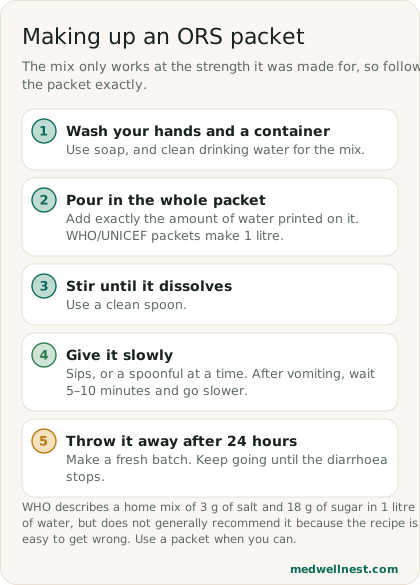
The instructions WHO and UNICEF print on their packets are short: dissolve the entire packet in one litre of drinking water. Use the whole packet and exactly the volume printed on it. Packet sizes vary, so read yours, and do not mix a packet with more or less water than it says.
Wash your hands and the container first, use clean drinking water, and stir until the powder has dissolved. The label then gives a rough pace for a litre: over 24 hours for an infant, 8 to 24 hours for a child depending on age, and freely as required for an adult. Keep giving it until the diarrhoea stops.
Whatever is left after 24 hours goes down the drain. The WHO/UNICEF label carries the warning to discard any remaining solution after 24 hours, so make a fresh batch each day.
03
How much to give
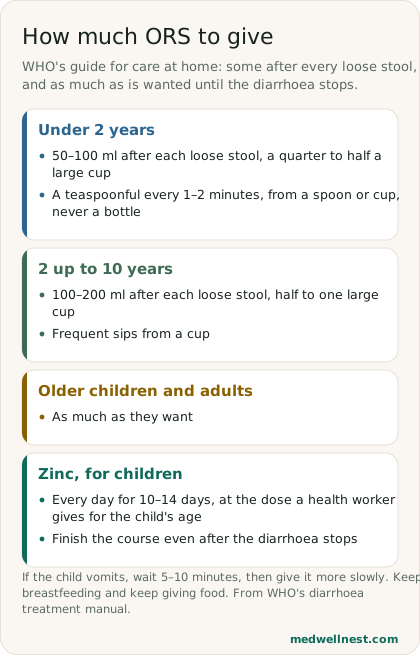
WHO's rule for care at home is to give as much as the person wants until the diarrhoea stops. As a guide, after each loose stool give a child under 2 years 50 to 100 ml, a quarter to half a large cup, and a child aged 2 up to 10 years 100 to 200 ml, half to one large cup. Older children and adults can drink as much as they want.
How you give it matters as much as how much. WHO says to use a clean spoon or cup for babies and young children, not a feeding bottle, and a dropper or syringe without a needle can help with small babies. Offer a child under 2 a teaspoonful every 1 to 2 minutes. Older children and adults can take frequent sips.
Vomiting is common in the first hour or two, especially if the solution goes down too fast. WHO says it rarely stops rehydration working, because most of the fluid is still absorbed. Wait 5 to 10 minutes and start again more slowly, for example a spoonful every 2 to 3 minutes.
04
The home recipe, and drinks to avoid
WHO does describe a home-made version: 3 g of table salt and 18 g of ordinary sugar in 1 litre of water. Measuring 3 g at home is hard, and a standard kitchen teaspoon of salt holds about twice that, which would make the drink too salty. It calls this effective but says it is not generally recommended, because the recipe is often forgotten, the ingredients may not be at hand, or too little gets given. A packet is the safer choice whenever you can get one.
If there is no ORS, WHO lists other drinks that contain salt, such as salted rice water, a salted yoghurt drink or vegetable or chicken soup with salt, and says plain clean water should also be given. What to avoid are sugary drinks, which can make diarrhoea worse and push sodium in the blood too high: WHO names fizzy soft drinks, commercial fruit juices and sweetened tea, along with coffee.
05
Zinc, and keeping up food
For children with diarrhoea, WHO and UNICEF recommend zinc every day for 10 to 14 days, as a syrup or a dispersible tablet, at the dose a health worker gives for the child's age. WHO says it shortens an episode by about 25% and cuts stool volume by about 30%. Finishing the course, even after the diarrhoea has stopped, replaces the zinc that was lost and lowers the chance of another episode over the next 2 to 3 months.
Food matters as much as fluid. WHO says food should never be withheld and a child's usual foods should not be diluted, and breastfeeding should always continue. Small, frequent meals are easier to manage than large ones.
A child who is severely malnourished is different. WHO says full-strength ORS provides too much sodium and too little potassium for these children, so their rehydration should be managed by a health worker.
06
Signs that need a health worker
WHO tells parents to take a child to a health worker if they start passing many watery stools, have repeated vomiting, become very thirsty, are eating or drinking poorly, develop a fever, have blood in the stool, or are not better in three days. Diarrhoea that lasts 14 days or longer also needs a doctor rather than more home care.
Dehydration has recognisable stages. WHO counts two or more of these as some dehydration: restlessness or irritability, sunken eyes, and drinking eagerly because of thirst. Two or more of these mean severe dehydration: being very drowsy or unconscious, sunken eyes, being unable to drink or drinking poorly, and a skin pinch that goes back very slowly, taking 2 seconds or more. Severe dehydration needs fluids through a drip.
Too much is possible, though rare. WHO says puffy eyelids are a sign of over-hydration; stop the ORS, keep giving breast milk or plain water and food, and start the ORS again once the puffiness has gone.
When to act
Routine — see a doctor
Loose stools in someone who is drinking well and alert: ORS after each loose stool, normal food, breastfeeding for babies, and zinc for 10 to 14 days for a child.
Same-day — call promptly
Many watery stools, repeated vomiting, great thirst, eating or drinking poorly, fever, blood in the stool, no improvement in three days, or puffy eyelids: see a health worker today.
Emergency — act now
Very drowsy or hard to wake, or unable to drink, or two or more of: sunken eyes, drinking poorly, a skin pinch that takes 2 seconds or more to flatten: this can be severe dehydration and may need drip fluids. Go to an emergency department now.
Values mentioned in this story
Each one opens a visual guide with its normal range and what moves it — upload a report and we place your own numbers on the same scale.
Sources
- The treatment of diarrhoea: a manual for physicians and other senior health workers — WHOiris.who.int
- Clinical management of acute diarrhoea: WHO/UNICEF joint statement — WHOiris.who.int
- Oral rehydration salts: production of the new ORS — WHOiris.who.int
- Diarrhoeal disease fact sheet — WHOwho.int
- How to make oral rehydration solution (ORS) — CDCcdc.gov
Share this story
Curious where your own values stand?
Two minutes from upload to a full visual picture. Free to analyze.