In short
Overactive bladder is a sudden, hard-to-delay urge to pass urine, usually with frequency, when no infection or other cause explains it. Bladder training is the treatment guidelines say to offer everyone. Blood in the urine, being unable to pass urine, or fever with back pain need prompt care.
Emergency if: You cannot pass urine at all, or you have severe pain or swelling in your lower tummy with the urge to go but little or nothing coming: go to an emergency department now. NIDDK says to get help right away because acute urinary retention can be life threatening. Also go now if you have back pain with weakness, tingling or numbness in both legs, loss of feeling around the genitals or anus, or new difficulty passing urine or loss of control of bladder or bowel, or if a urine infection comes with confusion, drowsiness or difficulty speaking. The NHS lists these as emergencies.
On this page
01
What is an overactive bladder (baar baar peshab ki hajat), and is passing urine many times a day normal?
The AUA/SUFU guideline defines overactive bladder (OAB) as urinary urgency, usually accompanied by frequency and waking at night to pass urine (nocturia), with or without leaking urine after a sudden urge, in the absence of a urinary tract infection or other obvious cause. It calls urgency the hallmark symptom and defines it as a sudden, compelling desire to pass urine that is difficult to put off. The NHS describes overactive bladder syndrome in similar terms, as the frequent urge to urinate that can happen with or without incontinence.
How many visits to the toilet count as too many is not a fixed number. The guideline says up to 7 passes of urine while awake has traditionally been seen as normal, but that this is highly variable with hours of sleep, fluid intake, other medical conditions and other factors. Drinking a lot, for example more than eight glasses of water a day, makes you go more often without being OAB, and a diary can show that difference. If your trouble is mainly at night, our story on nocturia covers that pattern.
02
Is it overactive bladder, an infection, diabetes or something else, and what will the doctor check?
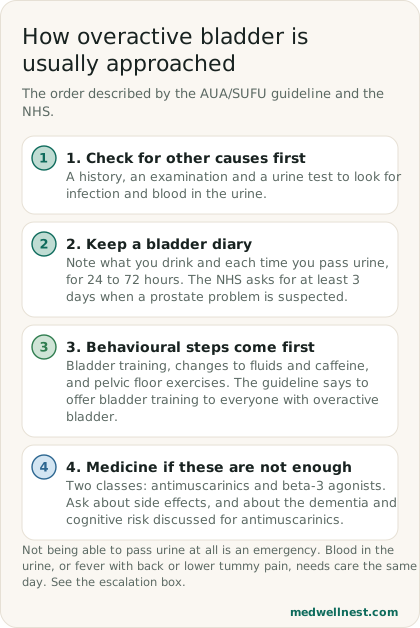
The guideline says the first visit should include a medical history with a full assessment of bladder symptoms, a physical examination, and a urine test to look for infection and microscopic blood. It says doctors should not routinely do urodynamic tests, cystoscopy or imaging of the urinary tract at the start, but may do them if the diagnosis is uncertain, and may measure the urine left in the bladder after you pass urine to look for incomplete emptying.
Several things can look like OAB or make it worse. The guideline lists excess fluid intake, poorly controlled diabetes, untreated sleep apnoea, recurrent urinary infections and some medicines, with special attention to water pills (diuretics) and to the diabetes medicines called SGLT2 inhibitors, which make you pass sugar in the urine. It also says certain signs may need further evaluation or a specialist: abdominal or pelvic pain, blood in the urine, recurrent infections, a sudden onset of severe symptoms, neurological symptoms such as blurred vision or limb weakness or numbness, bowel problems such as faecal incontinence or severe constipation, and incomplete emptying.
03
What is a bladder diary, and how do I keep one?
A bladder diary records what you drink and each time you pass urine. The guideline says a voiding diary can run from 24 to 72 hours and should capture typical behaviour, and that 3-day diaries have shown their worth by revealing symptom information that a history or questionnaire misses. For men with possible prostate symptoms, the NHS says you will usually be asked to keep a record for at least 3 days of how much you drink and how often and how much you pass urine.
Bring the diary to your visit with a list of your medicines. The guideline uses the diary to help diagnose OAB, exclude other disorders, judge how much it bothers you and check how treatment is working. It also says it is unclear whether keeping a diary improves the results of bladder training itself, so the diary is mainly a tool for the assessment.
04
How does bladder training work, and how long does it take?
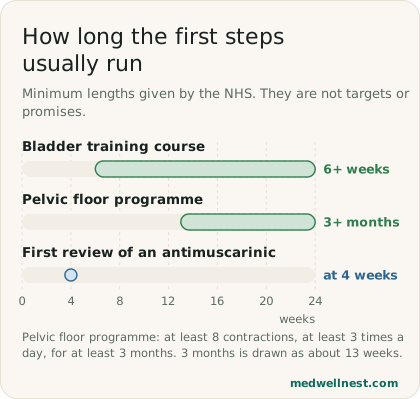
The NHS says bladder training involves learning techniques to increase the time between feeling the need to pass urine and actually passing it, and that one of the first treatments offered for urge incontinence is bladder training. The course usually lasts at least 6 weeks. The AUA/SUFU guideline makes this a strong recommendation, graded A for the quality of evidence: clinicians should offer bladder training to all patients with OAB. Its list of behavioural measures also includes timed voiding, urgency suppression and managing fluids.
The guideline is straightforward about the catch. Long-term benefit depends on sticking with the programme, and although short-term improvement may be clear, long-term success rates are low when people do not keep it up. Written instructions and checklists seem to improve outcomes, and follow-up visits and reminders may help people keep going. No source here gives a fixed timetable of minutes between toilet visits that suits everyone, so the schedule is set with the clinician or nurse who trains you.
05
Do pelvic floor exercises, caffeine and fluids help an overactive bladder?
For pelvic floor exercises the NHS says a programme should include a minimum of 8 muscle contractions at least 3 times a day and last for at least 3 months, and you can keep going if it is helping. It says research shows pelvic floor muscle training can benefit everyone with urinary incontinence, and that a specialist first assesses whether you can squeeze the right muscles. The AUA/SUFU guideline's discussion says pelvic floor training, including urge suppression techniques, should be recommended for OAB.
On drinks, the NHS says caffeine, found in tea, coffee and cola, can increase the amount of urine you make, and that drinking too much or too little can make bladder trouble worse, so the aim is a sensible amount rather than cutting fluids hard. It also lists losing weight if you are overweight. The guideline finds some evidence for caffeine reduction, dietary change (low fat, high in fruit and vegetables, whole grain) and more physical activity, and lists avoiding alcohol and managing fluids, for example less fluid at night, among its behavioural steps. It tells doctors to counsel that there is currently insufficient evidence for vitamins, supplements, herbal remedies or nutraceuticals as treatment for OAB.
06
When are medicines used for overactive bladder, and are they safe for older people?
Medicines come after the behavioural steps, or alongside them if symptoms are not controlled. The NHS says that if bladder training is not effective a doctor may prescribe an antimuscarinic (also called an anticholinergic), such as oxybutynin, tolterodine or darifenacin, and that if these are unsuitable or have not helped, an alternative such as mirabegron or vibegron may be offered. The guideline recommends offering either an antimuscarinic or a beta-3 agonist, and counselling on the side effects of each. The NHS lists dry mouth, constipation, blurred vision and extreme tiredness for antimuscarinics, and says that in rare cases they can lead to a build-up of pressure within the eye (angle closure glaucoma). It says the medicine is assessed after 4 weeks and every 6 to 12 months after that if it keeps working.
The guideline tells doctors to discuss the potential risk of dementia and cognitive impairment with anyone taking or prescribed an antimuscarinic. It reports an association: a pooled analysis of 14 studies with 1,564,181 people found antimuscarinic use linked to a higher risk of all-cause dementia (relative risk 1.20, 95% confidence interval 1.15 to 1.26). That is an association from observational studies, not proof that the medicine caused it, and the guideline says the finding needs validation and further study, both in younger people who take these medicines for long periods and in frail older adults, who may be the most vulnerable to cognitive decline. It quotes a SUFU white paper advising that chronic use (more than 3 months) is likely associated with a higher risk of new-onset dementia, that cognitive risks should be considered in all patient groups, and that when medicine is needed a trial of a beta-3 agonist is typically preferred before an antimuscarinic. The guideline adds that, although not directly compared in studies, beta-3 agonists appear to have fewer side effects, particularly less dry mouth and constipation. Tell your doctor if you already have memory problems, glaucoma, slow stomach emptying or trouble emptying the bladder (carers should say so for the person they look after), since the guideline asks for extreme caution with antimuscarinics in narrow-angle glaucoma, impaired gastric emptying or a history of urinary retention.
One beta-3 agonist, mirabegron, is not recommended for severe, uncontrolled high blood pressure (a top number of 180 or more or a bottom number of 110 or more), while vibegron does not carry that warning. Do not start, change or stop any of these medicines on your own.
07
Is frequent urgent urination in men the prostate, and when should men get checked?
It can be. The NHS lists needing to pass urine more often or urgently, including at night, among the symptoms of an enlarged prostate, together with difficulty starting, a weak or stop-start flow, feeling you cannot fully empty and dribbling after you finish. The AUA/SUFU guideline notes that mainly emptying symptoms can point to leftover urine or an outflow blockage, especially in people with a prostate, and that doctors may consider treating OAB symptoms in a man who also has an enlarged prostate. It says antimuscarinics may slightly increase leftover urine but do not appear to raise the risk of urinary retention significantly in groups with prostate blockage, and that the retention risk should be discussed when leftover urine is already high.
The NHS says to see a doctor if you have difficulty passing urine or need to go more often, and that it is important to get these symptoms checked because they can sometimes be caused by more serious conditions such as prostate cancer. The usual checks are a urine sample and a PSA blood test, and a record of drinks and urine for at least 3 days. Our prostate health guide covers an enlarged prostate in detail.
Urgency and frequent urination: how fast to act
Routine — see a doctor
You have a sudden urge to pass urine that is hard to put off, you go much more often than before, or you leak: see a doctor, take a 3-day bladder diary and a list of your medicines, and ask for a urine test. Men with a weak flow, straining, dribbling or a feeling of not emptying should be checked for the prostate. Also raise any recent sudden severe onset, recurrent urine infections, bowel leakage or severe constipation, or blurred vision, as the guideline says these may need further evaluation. If you have burning or pain when passing urine and none of the same-day signs below, see a doctor soon for a urine test.
Same-day — call promptly
You see blood in your urine, even a small amount or if you are not sure it is blood: get seen today. The NHS enlarged prostate page lists blood in the pee as a reason for an urgent appointment, and the NHS urine infection page lists it as a sign of infection. Also get seen today if you are a man with pain when passing urine (the NHS enlarged prostate page lists pain when peeing as urgent), or if you think you have a urine infection (burning or pain, or needing to pass urine urgently) and you are aged 65 or older, are a man, are pregnant, have diabetes, use a catheter or have a weakened immune system, have a very high or low temperature or are shivering, have pain in the lower tummy or in the back just under the ribs, or your symptoms are getting worse quickly or have not improved within 2 days of starting treatment. Some of these can be signs of a kidney infection, which can lead to sepsis.
Emergency — act now
You cannot pass urine at all, or you have severe pain or swelling in your lower tummy with the urge to go but little or nothing coming: go to an emergency department now. NIDDK says to get help right away because acute urinary retention can be life threatening. Also go now if you have back pain with weakness, tingling or numbness in both legs, loss of feeling around the genitals or anus, or new difficulty passing urine or loss of control of bladder or bowel, or if a urine infection comes with confusion, drowsiness or difficulty speaking. The NHS lists these as emergencies.
Sources
- Diagnosis and treatment of overactive bladder (non-neurogenic) in adults: guideline — AUA/SUFUauanet.org
- Urinary incontinence: non-surgical treatment — NHSnhs.uk
- Enlarged prostate — NHSnhs.uk
- Urinary tract infections (UTIs) — NHSnhs.uk
- Back pain — NHSnhs.uk
- Symptoms and causes of urinary retention — NIDDKniddk.nih.gov
Share this story
Curious where your own values stand?
Two minutes from upload to a full visual picture. Free to analyze.