In short
Palpitations are usually harmless: caffeine, stress, poor sleep and extra (ectopic) beats are common causes. But palpitations that do not go away, or come with chest pain, breathlessness or fainting, need emergency care now.
Emergency if: Palpitations happening now that do not go away, or palpitations with chest pain, shortness of breath, feeling faint or fainting: call emergency services or go to an emergency department now. MedlinePlus also lists loss of consciousness, unusual sweating, and dizziness or light-headedness. Do not drive yourself; ask someone to drive you or call for an ambulance.
On your report
TSH, Hemoglobin
On this page
01
Why does my heart beat fast or feel like it skips a beat?
The NHS says heart palpitations are when your heartbeat becomes more noticeable. It may feel like racing or beating very fast, irregular with skipped or extra beats (called ectopic beats), pounding or thumping, or fluttering. You may feel it in your chest, neck or throat, and it can last seconds, minutes or longer. The NHS says palpitations are common and not usually a sign of anything serious.
MedlinePlus adds that your heart's rhythm may be normal or abnormal when you have palpitations, so the feeling alone does not tell you which. A normal heart rate is 60 to 100 beats per minute, and it can be lower in people who exercise regularly or take medicines that slow the heart. The only way to know what rhythm is behind the feeling is to record it, which is why the tests below exist.
02
What are skipped beats (ectopics), and are they dangerous?
The NHS describes skipped or extra beats as ectopic beats, and MedlinePlus calls an occasional extra heartbeat out of rhythm an extrasystole. A review of premature ventricular contractions (PVCs), one common type, says they occur in 3% to 20% of the general population and are often found while checking palpitations or by chance on a routine ECG. It says they are usually considered benign but can be a sign of underlying heart disease. Our Holter story shows how counts of ectopic beats are reported.
MedlinePlus says to contact your doctor right away if you often feel extra heartbeats, meaning more than 6 per minute or coming in groups of 3 or more, or if your pulse is over 100 beats per minute at rest, without exercise, anxiety or fever. It also says to do so if you have heart disease or risk factors such as high cholesterol, diabetes or high blood pressure, or if your palpitations are new or different. This page treats that "right away" as contacting your doctor the same day. Two NHS points sit around it. If a fast or irregular heartbeat is happening now and does not go away, or comes with chest pain, shortness of breath or feeling faint, that is an emergency, not a same-day call: call emergency services now. And if your only reason is a known heart condition, and your palpitations have stopped and you feel well, the NHS says a routine visit is enough. If you are not sure which of these fits you, contact your doctor the same day. These conditions make an abnormal rhythm more likely: known heart disease when palpitations begin, significant heart-disease risk factors, an abnormal heart valve, or an electrolyte (blood chemical) imbalance such as low potassium.
03
What causes palpitations?
The NHS lists strenuous exercise, lack of sleep, stress and anxiety, some medicines, and alcohol, caffeine, nicotine and recreational drugs. It says palpitations can be a sign of the menopause, and some people get them in pregnancy. MedlinePlus also lists panic attacks, stimulant drugs such as cocaine and methamphetamine, decongestant medicines containing phenylephrine or pseudoephedrine, diet pills and fever.
Some causes are conditions. The NHS names iron deficiency anaemia, an overactive thyroid, a heart rhythm problem (arrhythmia) and other heart problems such as heart valve disease. MedlinePlus adds a low oxygen level in the blood and certain medicines used for asthma, high blood pressure or heart problems. The NHS says treatment depends on the cause, that palpitations often do not need treatment, and that avoiding triggers such as stress, smoking, caffeine and alcohol can help when no health condition is behind them. MedlinePlus says cutting back on caffeine, nicotine and other stimulants will often reduce them.
04
Is it anxiety or a heart problem?
Both are possible, and the feeling alone does not tell you which. MedlinePlus lists anxiety, stress, panic attack and fear among the causes of palpitations, and also lists abnormal heart rhythms, so one does not rule out the other. If you have palpitations for the first time, MedlinePlus says to see your doctor.
MedlinePlus says that once a serious cause has been checked for, it helps to try not to pay close attention to the palpitations, since doing so may cause stress. It suggests lowering stimulants, learning to reduce stress and anxiety, relaxation or breathing exercises, regular exercise and not smoking. It also says to contact your doctor if you notice a sudden increase or a change. Our anxiety and panic attack stories cover the other side of this question.
05
What tests are done for palpitations?
The NHS says you may have an electrocardiogram (ECG), where small pads on your skin record the heart's electrical signals, to help find the cause, and you may be referred to a heart specialist (cardiologist) for tests and treatment. MedlinePlus says your doctor will ask whether you feel skipped beats, whether the heart feels slow or fast, whether it began and ended suddenly, and when it happens. It also says most people with palpitations do not need to go to an emergency room for diagnosis and treatment.
If an abnormal rhythm is found, MedlinePlus says other tests may include a Holter monitor worn for 24 hours or another monitor worn for longer, an echocardiogram, an electrophysiology study or coronary angiography. Our Holter, ECG and atrial fibrillation stories explain these tests in more detail.
06
Which palpitations are an emergency, and when should I see a doctor?
The NHS says to call emergency services or go to an emergency department if you have palpitations now and they do not go away, or you also have chest pain, shortness of breath, or feeling faint or fainting. Do not drive yourself: ask someone to drive you or call for an ambulance, and bring your medicines. MedlinePlus lists loss of consciousness, chest pain, shortness of breath, unusual sweating, and dizziness or light-headedness as reasons to call the local emergency number.
If you had those symptoms but they have now stopped, the NHS says to ask for an urgent appointment, so we treat this as same-day care: see a doctor today. For palpitations that have stopped when you otherwise feel well, the NHS says to see a doctor if they keep coming back or happen more often, last longer than a few minutes, you have a heart condition, or heart problems run in your family.
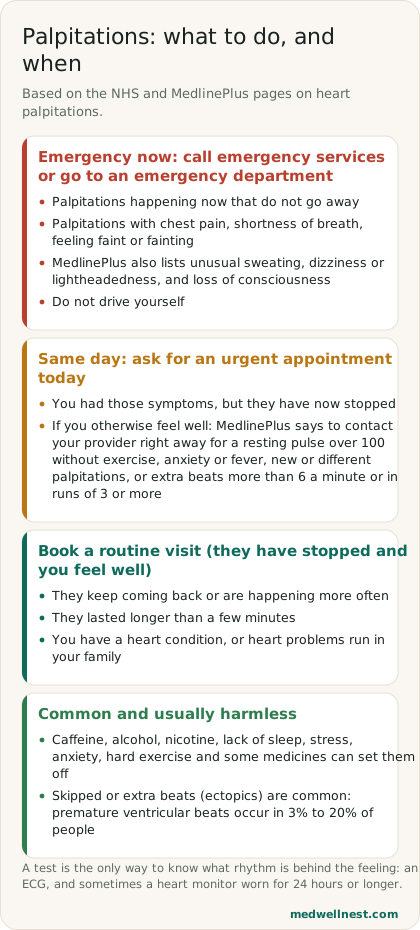
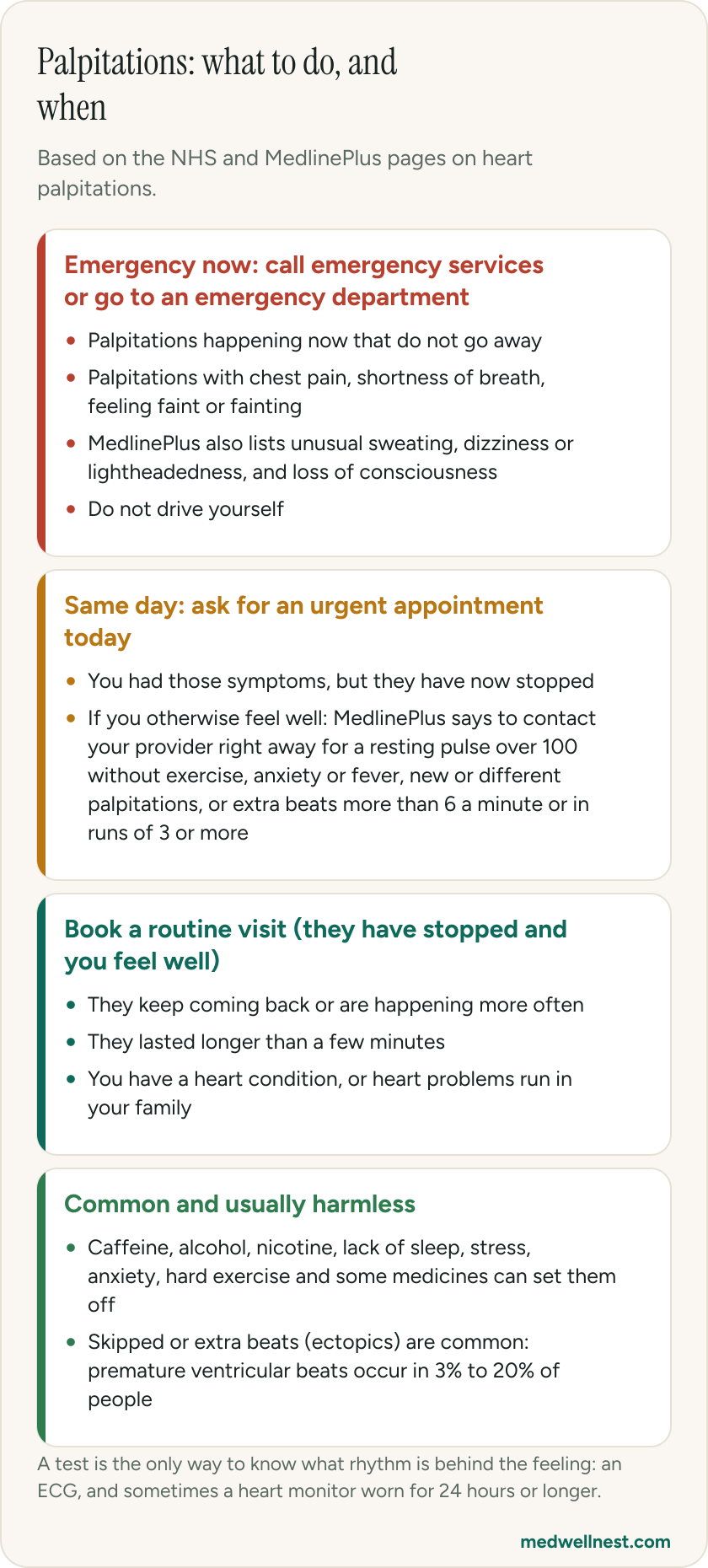
Palpitations: how fast to act
Emergency — act now
Palpitations happening now that do not go away, or palpitations with chest pain, shortness of breath, feeling faint or fainting: call emergency services or go to an emergency department now. MedlinePlus also lists loss of consciousness, unusual sweating, and dizziness or light-headedness. Do not drive yourself; ask someone to drive you or call for an ambulance.
Same-day — call promptly
You had palpitations with chest pain, breathlessness or faintness, but they have now stopped: ask for an urgent appointment today. If you otherwise feel well, also contact your doctor today (MedlinePlus says right away) for a pulse over 100 at rest without exercise, anxiety or fever, new or different palpitations, or extra beats more than 6 a minute or in groups of 3 or more. A fast heartbeat happening now that does not go away, or that comes with chest pain, breathlessness or feeling faint, is an emergency: see the tier above.
Routine — see a doctor
Your palpitations have stopped and you feel well, but they keep coming back, happen more often or lasted longer than a few minutes, or you have a heart condition or heart problems in the family: see a doctor, who may arrange an ECG or a longer heart monitor.
Values mentioned in this story
Each one opens a visual guide with its normal range and what moves it — upload a report and we place your own numbers on the same scale.
Sources
- Heart palpitations — NHSnhs.uk
- Heart palpitations — MedlinePlusmedlineplus.gov
- Premature Ventricular Contractions (PVCs): A Narrative Review — Am J Med 2022pubmed.ncbi.nlm.nih.gov
Share this story
Curious where your own values stand?
Two minutes from upload to a full visual picture. Free to analyze.