In short
Most foods are safe in pregnancy. The NHS asks you to avoid a short list (unpasteurised dairy, raw or undercooked meat and eggs, liver, some fish and alcohol) and to limit caffeine. The papaya, pineapple, saffron and hot-and-cold food beliefs are weighed here by what research actually shows.
Emergency if: You are pregnant and have a severe headache and stiff neck, find bright lights uncomfortable, have a fit, feel suddenly confused, feel very sleepy or are hard to wake, or have a rash that does not fade when a glass is rolled over it: go to an emergency department now. The NHS says these can be signs of meningitis caused by listeriosis, which needs hospital treatment straight away. If you are pregnant and your baby is moving less than usual, call your maternity unit or hospital now, at any hour; if you cannot reach them, go to the nearest emergency department now.
On this page
01
Which foods should I avoid during pregnancy?
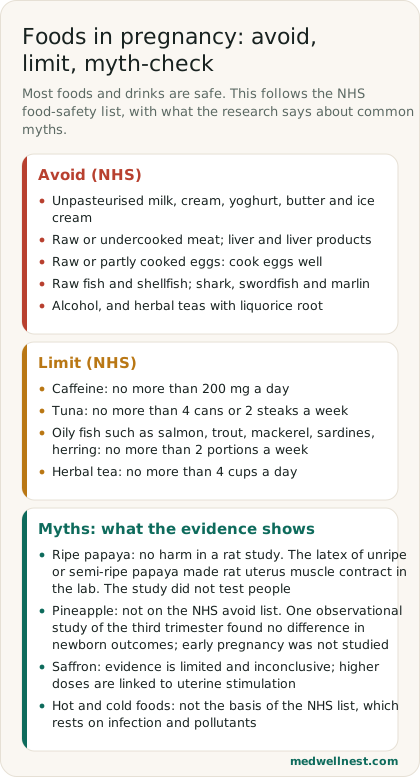
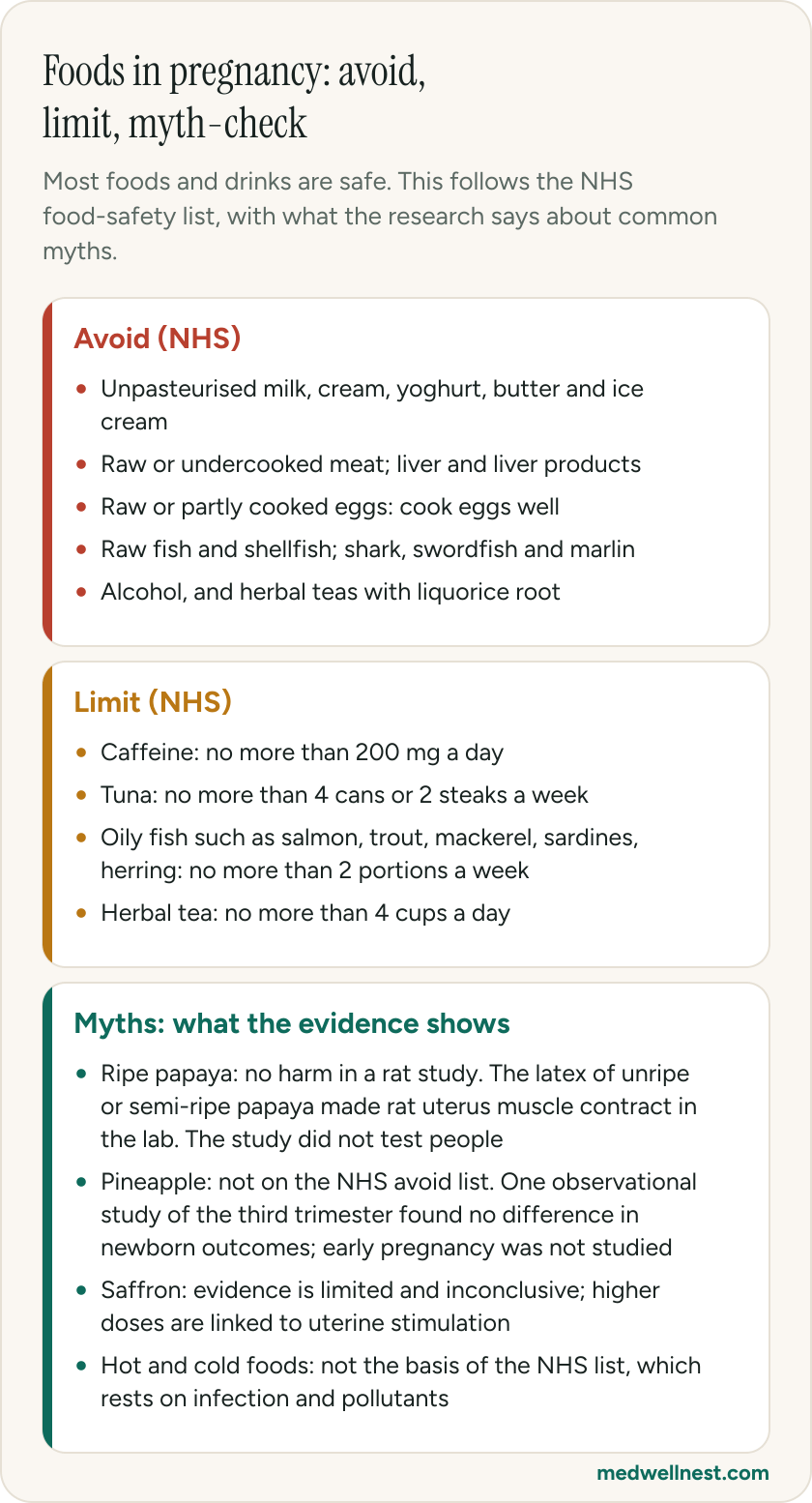
The NHS says most foods and drinks are safe in pregnancy, but a few need care. Its avoid list is short and rests on a few risks: infection from listeria and toxoplasma, pollutants or too much vitamin A, and alcohol. The foods to avoid are unpasteurised milk, cream, yoghurt, butter and ice cream; raw or undercooked meat; liver and liver products; raw fish and raw shellfish; shark, swordfish and marlin; and alcohol. Game meats such as venison and pheasant are also on the list because they may contain lead.
Eggs need to be well cooked, until the white and yolk are solid. The NHS exception for runny eggs applies only to eggs from one particular food-safety scheme that will not apply to most readers, so treat every egg, including duck, goose and quail eggs, as needing to be well cooked. If you have already eaten something on the list, the NHS says a small amount is unlikely to affect your baby if you did not get ill.
02
Is paneer, milk or curd safe in pregnancy?
The deciding word is pasteurised. The NHS says any pasteurised milk, butter, yoghurt, cream and ice cream is safe, and it lists paneer by name among the pasteurised soft cheeses that are safe. The foods to avoid are those made from unpasteurised milk, because they may contain listeria bacteria, which cause listeriosis. Listeriosis can cause miscarriage or stillbirth, or make a newborn very unwell. The NHS adds that most milk, cheese and butter bought in shops is pasteurised and the packaging will say so.
The NHS page does not discuss loose milk bought from a vendor, so if you cannot tell whether milk or paneer was pasteurised, ask your doctor or midwife before eating it. Listeria can also sit in chilled ready-to-eat foods: the NHS says to keep pre-packaged sandwiches, salads and pre-cut fruit chilled and eat them before the use-by date, and to cook cold preserved meats such as salami until steaming hot. Toxoplasmosis, the other infection behind the list, can come from raw or undercooked meat, or preserved meats such as salami, and can cause miscarriage. So cook meat until there is no trace of pink or blood, and wash fruit, vegetables and salad thoroughly to remove soil.
03
How much tea, coffee and fish is safe in pregnancy?
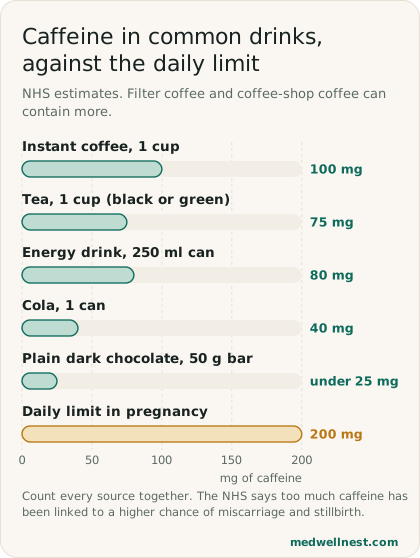
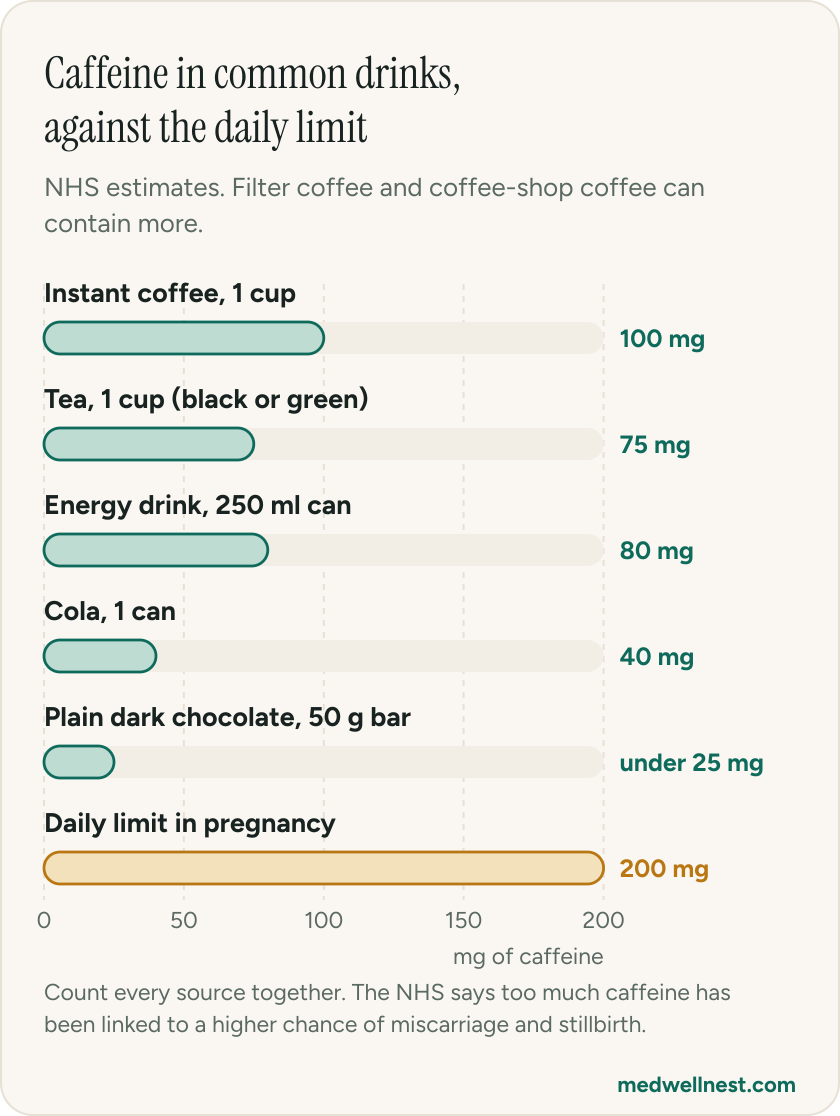
The NHS says not to have more than 200 milligrams of caffeine a day, counting every source: coffee, tea, cola, energy drinks, chocolate and some supplements. Its estimates are about 100 milligrams in a cup of instant coffee, 75 in a cup of black or green tea, 40 in a can of cola and 80 in a 250 ml can of energy drink, and filter or coffee-shop coffee can contain more. By those estimates two cups of tea come to about 150 milligrams, which leaves little room for anything else. The NHS says too much caffeine has been linked to a higher chance of miscarriage and stillbirth. It also advises no more than 4 cups of herbal tea a day and avoiding any tea containing liquorice root.
Fish is worth eating, within limits. The NHS says to have no more than 4 cans or 2 steaks of tuna a week, and no more than 2 portions a week of oily fish such as salmon, trout, mackerel, sardines and herring, because they can contain pollutants including mercury. It names shark, swordfish and marlin as fish to avoid, but it does not rank other fish for mercury, so for other types ask your midwife or doctor. Liver and foods containing liver are on the avoid list because they have high levels of vitamin A, which can be harmful to the baby.
04
Is papaya safe in pregnancy?
The belief that papaya causes miscarriage is common, and the evidence is narrower than the belief. A 2002 study fed rats a ripe papaya blend at different stages of pregnancy. There was no significant difference in implantation sites or viable fetuses, and no sign of harm to mother or fetus. In the lab, ripe papaya juice did not make isolated rat uterine muscle contract, but crude papaya latex did, with spasms similar to those caused by oxytocin.
The authors concluded that normal consumption of ripe papaya may not pose a significant danger, while unripe or semi-ripe papaya, which contains a high concentration of latex, could be unsafe in pregnancy. They said further studies are needed before the risk to people is known. So the honest summary is that this is animal and laboratory evidence only, with no human trial behind it either way. The NHS page does not mention papaya and says most fruit is safe if washed. Ripe papaya in ordinary food amounts looks low risk, and raw or semi-ripe papaya is the part to skip as a precaution, not because harm has been proved.
05
What about pineapple, saffron and hot and cold foods?
Pineapple is not on the NHS avoid list. The only human data we found is an observational study of 2,400 women who delivered between 2018 and 2023, half of whom reported eating pineapple regularly in the third trimester. After adjustment, newborn outcomes such as birth weight, Apgar scores and intensive care admissions did not differ, and the pineapple group had shorter labours on average. Because it is observational and covers only the last three months, it cannot show cause and says nothing about early pregnancy. The authors call for further investigation.
For saffron, a 2026 review of 12 studies called the evidence on safety and effect in pregnancy limited and inconclusive. It linked higher doses and occupational exposure to uterine stimulation and a higher miscarriage risk, and said standardised preparations and long-term safety data are needed. No safe amount has been set, so ask your doctor before using it as a remedy. Some families give saffron in pregnancy in the belief that it gives the baby fairer skin; the review records this belief, but none of the studies it included tested it. Its clinical findings were about labour, not about a baby's skin colour. As for hot and cold foods, the NHS list does not sort foods that way and we found no source that does. A hospital study of 822 pregnant women found 83.9% followed some food taboo. Those who followed food taboos had more low vitamin B12 and high homocysteine, while those who did not follow them had more miscarriages. It was cross-sectional and cannot prove cause either way, but it is a reason to ask your doctor before dropping a nutritious food.
When to act
Emergency — act now
You are pregnant and have a severe headache and stiff neck, find bright lights uncomfortable, have a fit, feel suddenly confused, feel very sleepy or are hard to wake, or have a rash that does not fade when a glass is rolled over it: go to an emergency department now. The NHS says these can be signs of meningitis caused by listeriosis, which needs hospital treatment straight away. If you are pregnant and your baby is moving less than usual, call your maternity unit or hospital now, at any hour; if you cannot reach them, go to the nearest emergency department now.
Same-day — call promptly
You feel unwell after eating something on the avoid list, you have had vomiting and diarrhoea for more than 48 hours, or you have fever, aches, chills or diarrhoea and think it could be listeriosis or toxoplasmosis: contact your doctor or midwife today.
Routine — see a doctor
You are unsure whether a food is safe, or you have been told to avoid or add a food or herb such as saffron: ask your midwife or doctor at your next visit. Do not cut out a nutritious food without checking what can replace it.
Sources
- Foods to avoid in pregnancy — NHSnhs.uk
- Listeriosis — NHSnhs.uk
- Papaya (Carica papaya) consumption is unsafe in pregnancy: fact or fable? Scientific evaluation using a rat model (2002)europepmc.org
- The impact of pineapple consumption on cervical ripening and labor outcomes: a retrospective cohort study (2026)pmc.ncbi.nlm.nih.gov
- Saffron and Pregnancy: Cultural Practices, Beliefs, and Safety Evidence: An Integrative Review (2026)pmc.ncbi.nlm.nih.gov
- Food taboos and other cultural taboos in history of miscarriage: a hospital-based study (2026)pmc.ncbi.nlm.nih.gov
Share this story
Curious where your own values stand?
Two minutes from upload to a full visual picture. Free to analyze.