In short
Nausea and vomiting in pregnancy usually start in weeks 4 to 7, peak around week 9 and clear by weeks 16 to 20. Small plain meals, sips of fluid and anti-sickness medicines a doctor can prescribe help. Here are the signs of hyperemesis gravidarum, when to call the same day, and when to go to an emergency department.
Emergency if: You vomit blood (red, or dark like coffee grounds), especially if you also feel faint, dizzy or unwell or have tummy pain, or you faint or collapse: go to an emergency department now. The NHS says vomiting blood with feeling faint, dizzy or unwell, or with tummy pain, needs emergency care.
On your report
Sodium, Potassium
On this page
01
How long does morning sickness last in pregnancy?
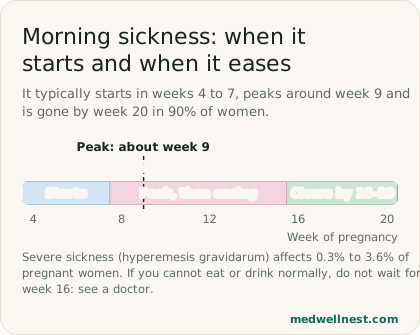
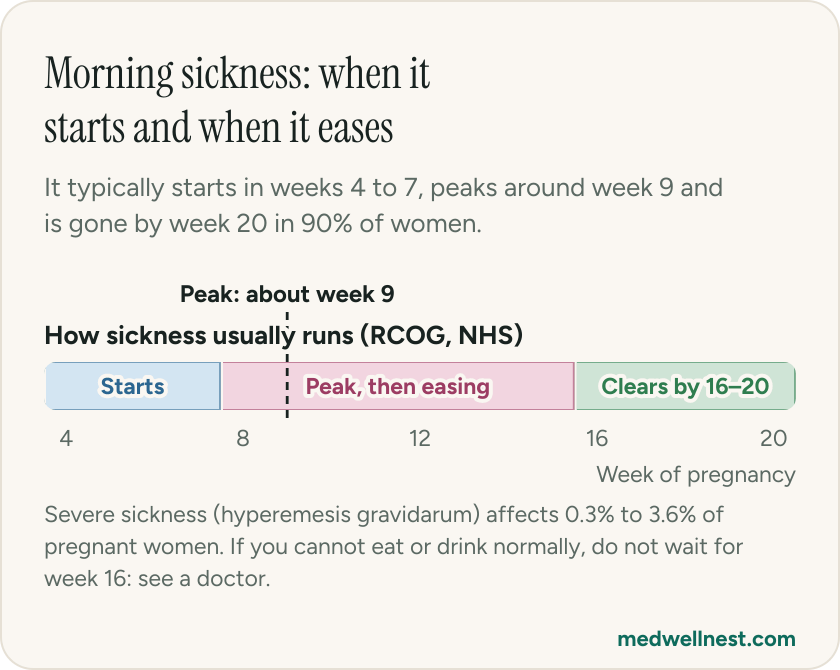
The RCOG's guideline says nausea and vomiting in pregnancy typically start between weeks 4 and 7, peak at about week 9, and have resolved by week 20 in 90 percent of women. The NHS says it usually clears up by weeks 16 to 20 and does not put your baby at any increased risk. The RCOG says it affects up to 90 percent of pregnant women, and that 'morning' sickness is a misleading name because symptoms occur both before and after noon.
So feeling sick all day, not only in the morning, is normal. The NHS adds that it can affect you at any time of the day or night, and that it can significantly affect your day-to-day life even when it is not dangerous.
02
How can I stop vomiting in pregnancy? What can I eat and drink?
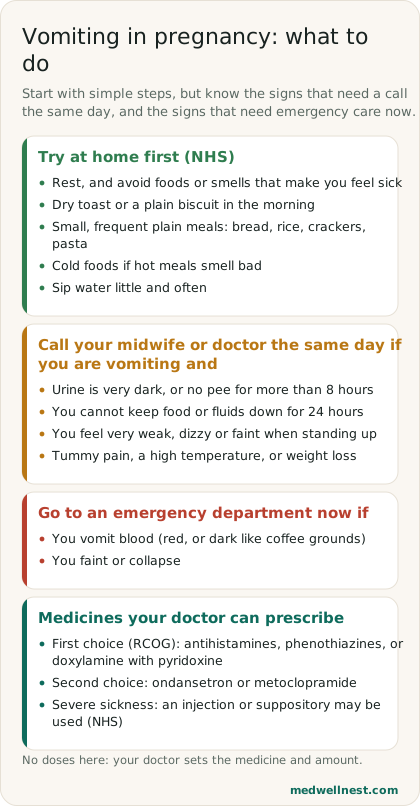
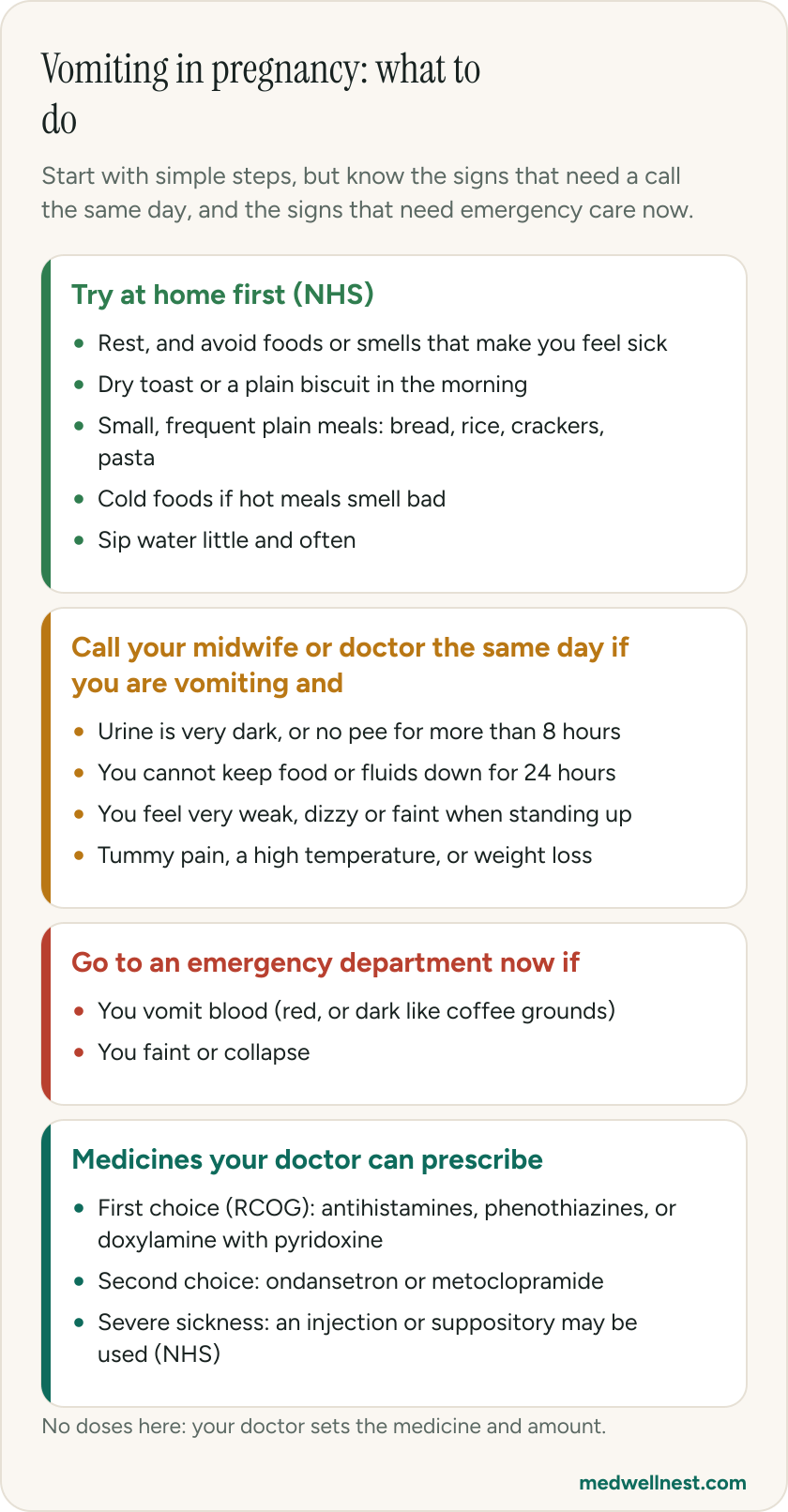
No single fix works for everyone, but the NHS suggests starting with changes to food and daily life. Get plenty of rest, because tiredness can make nausea worse. Avoid foods or smells that make you feel sick. Eat something like dry toast or a plain biscuit in the morning. Eat small, frequent meals of plain foods high in carbohydrate and low in fat, such as bread, rice, crackers and pasta. Choose cold foods rather than hot ones if the smell of hot meals bothers you.
Drink plenty of fluids, such as water, and sip them little and often, which may help prevent vomiting. The NHS says there is some evidence that ginger and acupressure on the wrist may help, and to check with a pharmacist before taking ginger supplements. The RCOG is more cautious about ginger for severe sickness: in a survey of 512 women with hyperemesis, ginger had little or no effect, and doctors are advised not to suggest it for hyperemesis. Try it for mild sickness if you like, but never let it delay getting help.
A urine infection can also cause nausea and vomiting, as the NHS notes, so tummy pain, burning when you pee or a temperature with sickness should be checked.
03
Is there a medicine for vomiting in pregnancy?
Yes. If sickness is severe and does not improve with the steps above, the NHS says a doctor may recommend a short-term anti-sickness medicine, called an antiemetic, that is safe to use in pregnancy. It says this is often a type of antihistamine, usually given as tablets, and that for severe sickness the doctor may suggest an injection or a suppository. Do not buy tablets for this on your own; ask your doctor or midwife.
The RCOG's guideline sets out the order. First choice are antihistamines, phenothiazines, or doxylamine with pyridoxine (a form of vitamin B6), which have safety and effectiveness data and no increased risk of birth defects in the reviews it cites. Second choice are ondansetron, which the RCOG says is safe and effective, with a very small increase in the absolute risk of cleft lip or palate when used in the first 3 months, to be weighed against the risks of badly controlled sickness, and metoclopramide, which can cause movement side effects. Your doctor chooses the medicine and the amount. Our ondansetron page has more on that medicine.
04
What is hyperemesis gravidarum and how do I know if I have it?
Hyperemesis gravidarum (HG) is the severe form of pregnancy sickness. The RCOG says it affects between 0.3 and 3.6 percent of pregnant women, and defines it as severe nausea and vomiting that begins before 16 weeks, with inability to eat and drink normally and strong limits on daily life. The NHS says it can leave you short of fluids (dehydrated) or of nutrients from your diet, and may need specialist treatment, sometimes in hospital.
Doctors may use a short questionnaire called the PUQE score. It asks three questions about the last 24 hours: how many hours you felt sick, how many times you vomited and how many times you retched. Each is scored from 1 to 5, so the total runs from 3 to 15: 3 to 6 is mild, 7 to 12 moderate and 13 to 15 severe. It is a tool for your doctor, not a reason to wait at home.
The RCOG says hospital care should be considered if you cannot keep down anti-sickness tablets, if you are dehydrated or have lost more than 5 percent of your body weight despite tablets, or if a urine infection cannot be treated with tablets. It also says a ketone result on a urine test should not be used to judge dehydration.
05
When should I call the doctor for vomiting in pregnancy?
The NHS says to call your midwife or doctor if you are vomiting and have very dark urine or have not passed urine for more than 8 hours, cannot keep food or fluids down for 24 hours, feel very weak, dizzy or faint when standing up, have tummy pain, have a high temperature, vomit blood, or have lost weight. Call them too if you are unsure, and do not wait for week 16 to pass. If you vomit blood and also feel faint, dizzy or unwell, or have tummy pain, or you faint, go to an emergency department now.
While you wait, keep sipping fluids; our guide to oral rehydration solutions explains what they are, and your doctor can say whether one suits you. If sickness makes you lose weight, tell your doctor: our pregnancy weight gain guide gives the usual targets for the later months, but a drop in weight during severe sickness is something to report, not to manage alone.
When to act
Emergency — act now
You vomit blood (red, or dark like coffee grounds), especially if you also feel faint, dizzy or unwell or have tummy pain, or you faint or collapse: go to an emergency department now. The NHS says vomiting blood with feeling faint, dizzy or unwell, or with tummy pain, needs emergency care.
Same-day — call promptly
You are vomiting and your urine is very dark or you have not passed urine for more than 8 hours, you cannot keep food or fluids down for 24 hours, you feel very weak, dizzy or faint when standing up, or you have tummy pain, a high temperature or weight loss: call your midwife or doctor today. The NHS gives these as the signs for that call.
Routine — see a doctor
Sickness is wearing you down but you can keep fluids down: see your doctor or midwife about anti-sickness medicine, which can be prescribed for use in pregnancy. Also see a doctor if the sickness starts only after week 16: the RCOG says that should be investigated for other causes.
Values mentioned in this story
Each one opens a visual guide with its normal range and what moves it — upload a report and we place your own numbers on the same scale.
Sources
- Vomiting and morning sickness — NHSnhs.uk
- The Management of Nausea and Vomiting in Pregnancy and Hyperemesis Gravidarum (Green-top Guideline No. 69) — RCOG, BJOG 2024rcog.org.uk
- Norwegian PUQE (Pregnancy-Unique Quantification of Emesis and Nausea) identifies patients with hyperemesis gravidarum and poor nutritional intake — PLoS One 2015pmc.ncbi.nlm.nih.gov
- Pregnancy symptoms you need to get help for — NHSnhs.uk
- Vomiting blood — NHSnhs.uk
Share this story
Curious where your own values stand?
Two minutes from upload to a full visual picture. Free to analyze.