In short
Prolactin is the pituitary hormone that makes milk. A high result can come from pregnancy, breastfeeding, blood-draw stress, medicines, an underactive thyroid, kidney disease, a pituitary growth (prolactinoma), or macroprolactin, an inactive large form that reads falsely high.
Emergency if: You have a sudden, extremely painful headache, loss of vision, double vision, or a severe headache with vomiting, especially if you have a known pituitary tumour or prolactinoma: go to an emergency department now. The NHS lists a headache that started suddenly and is extremely painful, and loss of vision, as emergencies, and the Society for Endocrinology says pituitary apoplexy is a medical emergency where acute severe headache is the earliest sign.
On your report
Prolactin, TSH, Free T4
On this page
01
What is prolactin, and what does it do in the body?
Prolactin is a hormone made by the pituitary gland, a small gland at the base of the brain. MedlinePlus says its main role is to signal breast tissue to grow during pregnancy and to make milk for breastfeeding after birth, so levels are normally high in pregnant women and new mothers. In non-pregnant women and in men, prolactin levels are normally low.
A prolactin test measures the level in a blood sample. MedlinePlus says it is most often used with other tests to help diagnose a prolactinoma, find the cause of irregular periods, find the cause of infertility in men and women, or find the cause of a man's low sex drive or erectile dysfunction. It cannot show the cause of a high level by itself.
02
What is the normal prolactin range, and why does my lab's range look different?
There is no single normal number that every lab uses. The Endocrine Society guideline treats a level above the upper limit of normal as confirming hyperprolactinemia, and that limit is set by each laboratory for its own method. Always compare your result with the range printed on your own report; our prolactin page shows a typical range for non-pregnant adults, but the report in your hand rules.
Prolactin changes through the day, so timing matters. MedlinePlus says the sample is usually taken three to four hours after you wake, and you may be asked to fast for several hours. Levels are high in pregnancy and after birth, and a 2022 review adds that basal levels fluctuate, especially in women, so multiple measurements may be needed to be sure of a result.
03
What are the symptoms of high prolactin in women and in men?
In women, MedlinePlus lists irregular or absent periods, milk production when not pregnant or breastfeeding, nipple discharge and infertility. In men it lists nipple discharge, erectile dysfunction, enlarged breasts, decreased facial and body hair and a low sex drive. The Endocrine Society guideline summarises this as hypogonadism, infertility and galactorrhoea, with women developing galactorrhoea and amenorrhoea and men presenting with low libido and erectile dysfunction; it may also cause no symptoms at all.
A prolactinoma that is not treated can grow large enough to press on nearby structures. MedlinePlus lists headaches, changes in vision when the growth presses on the optic nerve, and low levels of other pituitary hormones such as thyroid hormones and cortisol. A 2022 review notes that men often go unrecognised because decreased libido is easy to miss, so headache and visual field problems from a large tumour are frequently their main complaints.
04
Why is my prolactin high? Stress, medicines, thyroid and other causes
Start with the harmless causes. The Endocrine Society guideline says physiological states including pregnancy, breastfeeding, stress, exercise and sleep can raise prolactin, and it recommends a sample taken without excessive stress from the needle. MedlinePlus adds that small rises can come from stress, exercise and even sex, and that diets high in protein and certain medicines can raise levels, so a repeat test is often suggested.
Then the medical causes. The guideline says the most frequent cause of non-tumour hyperprolactinemia is medicines, that some people with underactive thyroid (primary hypothyroidism) have moderate rises, and that kidney disease can do the same. The 2022 review lists the medicine groups: dopamine blockers such as metoclopramide, antipsychotics and antidepressants, some blood pressure medicines (reserpine, verapamil), H2 blockers such as cimetidine, and oestrogens. MedlinePlus also lists cirrhosis, polycystic ovary syndrome (PCOS), chest injuries and other pituitary tumours. The guideline's advice is to exclude medicines, kidney failure, hypothyroidism and pituitary or nearby tumours.
05
Does a high prolactin level mean a pituitary tumour? What do the numbers suggest?
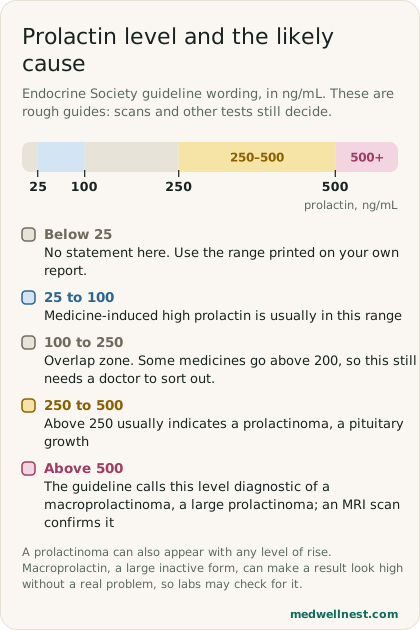
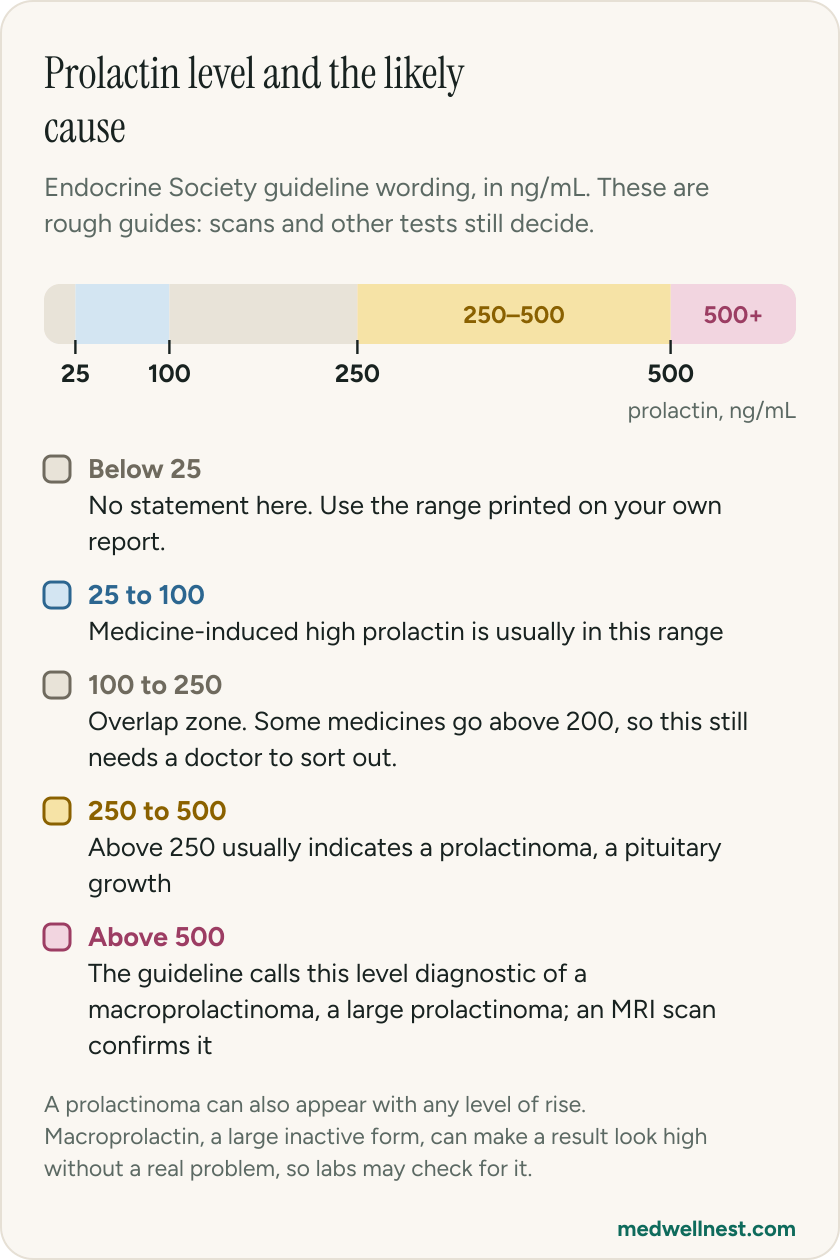
Not necessarily. The Endocrine Society guideline gives rough guides. It says medicine-induced hyperprolactinemia is usually associated with levels of 25 to 100 ng/mL (the guideline writes the unit as micrograms per litre, which is the same), that some medicines (metoclopramide, risperidone and phenothiazines) can lead to levels above 200, that a level above 250 usually indicates a prolactinoma, and that a level above 500 is, in its words, "diagnostic of a macroprolactinoma", a large one, though an MRI scan is still what confirms it. A 2022 review says a prolactinoma should be considered above 200 but can appear with any level of rise.
These numbers help a doctor, but they do not decide anything alone. A prolactinoma is confirmed by imaging: the 2022 review says MRI is warranted when one is suspected. MedlinePlus says treatment is usually medicine, and surgery may be needed for certain pituitary tumours. A mildly raised level with no symptoms is far more often something else, so do not assume a tumour from one report.
06
What is macroprolactin, and could my high prolactin report be false?
Macroprolactin is prolactin bound into large molecules. A 2020 review says it is in most cases a complex of prolactin bound to an antibody (IgG), that it is confined to the bloodstream and has limited access to the body's prolactin receptors, so it usually causes no symptoms, yet it is measured by almost all prolactin blood tests. This can make a result read high when little active prolactin is present, and lead to unnecessary tests or treatment.
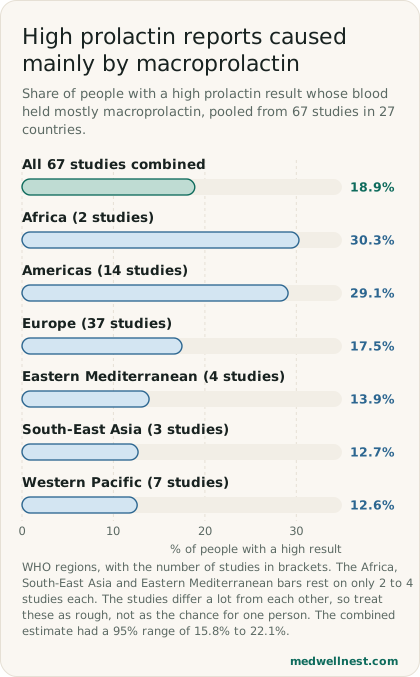
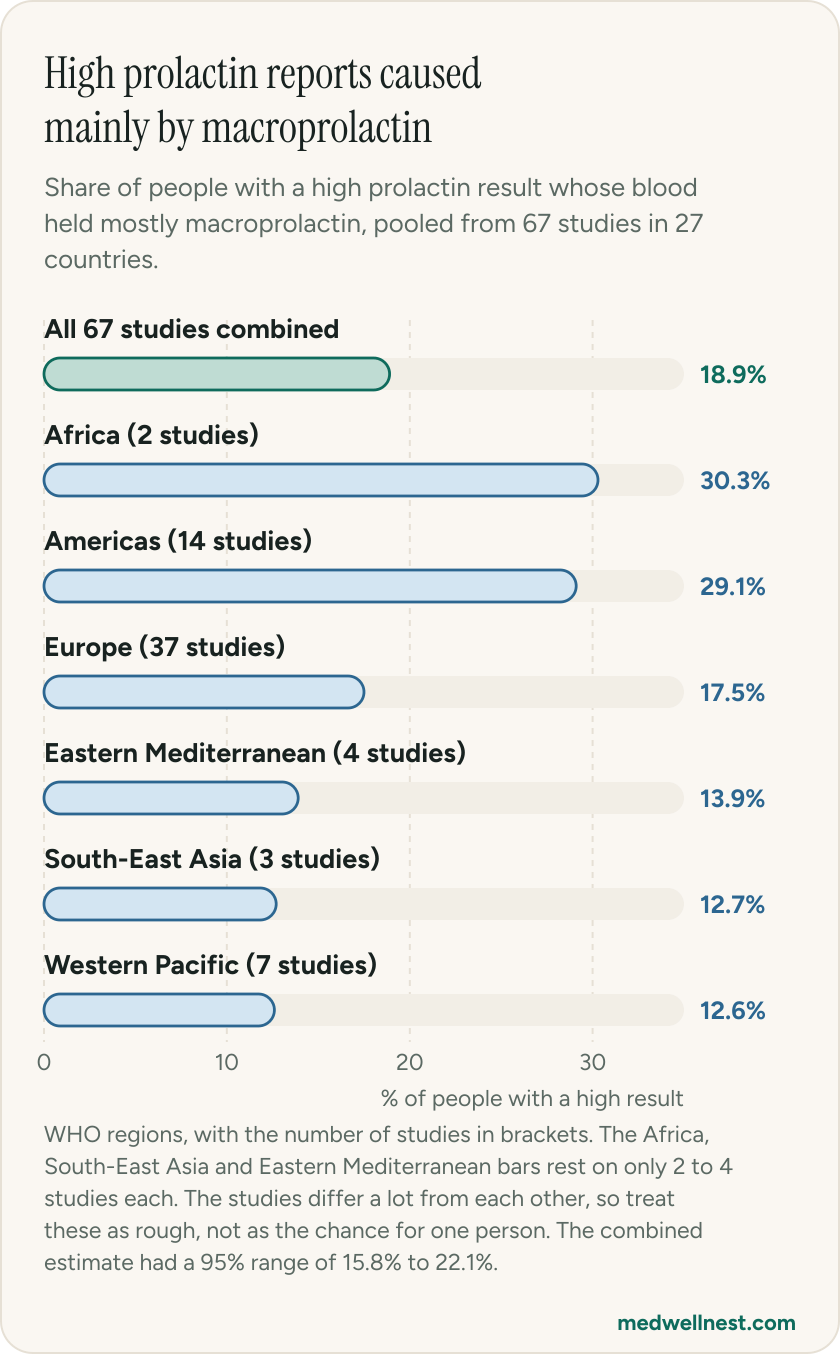
The Endocrine Society guideline suggests assessing for macroprolactin in people with high prolactin and no symptoms, and the 2020 review says true high prolactin and macroprolactin cannot be told apart on symptoms alone. The lab can check by treating the blood with polyethylene glycol and measuring again. That review pooled 67 studies from 27 countries and found macroprolactin was the main form in 18.9% of people with a high result, ranging by WHO region from 12.6% to 30.3% (some regions had only 2 to 4 studies), with large differences between studies. The guideline cites an earlier, higher figure of about 40%, so the true share is uncertain: ask whether your lab screens for it.
07
Should I repeat the prolactin test, and how should I prepare?
Often yes, if the rise is mild. MedlinePlus says that, depending on your symptoms and history, your provider may suggest testing again to see whether levels stay high, and the 2022 review says multiple measurements help ensure reproducibility. Try to be relaxed, go at the time your doctor suggests (usually a few hours after waking), ask whether to fast, and tell the lab about every medicine and supplement you take.
If a medicine may be the cause, do not stop it on your own: MedlinePlus says never stop taking a medicine without talking to your provider. The guideline says a doctor may stop the suspected medicine for about 3 days or switch to another, then measure again, and the 2022 review gives a similar 48 to 96 hours. If it cannot be changed, or the prolactin stays high, an MRI of the pituitary is the next step. Thyroid tests are often checked too, since an underactive thyroid can raise prolactin.
08
When is a high prolactin report or its symptoms an emergency?
A sudden bleed or loss of blood supply in a pituitary tumour is rare but serious. The Society for Endocrinology guidance calls classical pituitary apoplexy a medical emergency, where rapid replacement with hydrocortisone may be lifesaving. Acute severe headache is the most common and earliest sign and may come with nausea and vomiting; reduced vision and loss of the field of vision can follow. About 80% of people have no known pituitary problem beforehand, and it can look like other brain conditions.
The NHS says to go to an emergency department immediately if you have a headache that started suddenly and is extremely painful, or you have loss of vision. The Endocrine Society guideline says new or worsening headache, or a change in vision, in a pregnant woman with a prolactinoma needs urgent assessment. A slowly worsening headache or gradual changes in vision are not an emergency, but need prompt medical review.
When to act
Emergency — act now
You have a sudden, extremely painful headache, loss of vision, double vision, or a severe headache with vomiting, especially if you have a known pituitary tumour or prolactinoma: go to an emergency department now. The NHS lists a headache that started suddenly and is extremely painful, and loss of vision, as emergencies, and the Society for Endocrinology says pituitary apoplexy is a medical emergency where acute severe headache is the earliest sign.
Same-day — call promptly
You have a new headache that keeps getting worse, a gradual change in your vision, or, if you are pregnant with a known prolactinoma, any new or worsening headache or change in vision: see a doctor today. The Endocrine Society guideline says new or worsening headache or a change in vision in this situation needs urgent assessment, and MedlinePlus lists headaches and vision change as signs of a large prolactinoma.
Routine — see a doctor
Your report says prolactin is high and you have missed periods, milk or nipple discharge, trouble conceiving, a low sex drive or erectile dysfunction: book a visit and ask whether to repeat the test, whether your medicines could be the cause, whether macroprolactin should be checked and whether thyroid and kidney tests are needed. Do not stop a medicine on your own.
Values mentioned in this story
Each one opens a visual guide with its normal range and what moves it — upload a report and we place your own numbers on the same scale.
Sources
- Diagnosis and treatment of hyperprolactinemia: an Endocrine Society clinical practice guideline (Melmed et al.) — Journal of Clinical Endocrinology and Metabolism, 2011academic.oup.com
- Prolactin Levels — MedlinePlusmedlineplus.gov
- Global Prevalence of Macroprolactinemia among Patients with Hyperprolactinemia: A Systematic Review and Meta-Analysis — International Journal of Environmental Research and Public Health, 2020pmc.ncbi.nlm.nih.gov
- Update in Pathogenesis, Diagnosis, and Therapy of Prolactinoma — Cancers, 2022pmc.ncbi.nlm.nih.gov
- Society for Endocrinology Endocrine Emergency Guidance: Emergency management of pituitary apoplexy in adult patients — Endocrine Connections, 2016pmc.ncbi.nlm.nih.gov
- Headaches — NHSnhs.uk
Share this story
Curious where your own values stand?
Two minutes from upload to a full visual picture. Free to analyze.