In short
A positive RA factor does not mean rheumatoid arthritis: the NHS says about 1 in 20 people without it also test positive. Anti-CCP is more specific, and doing both tests gives a more accurate picture than RF alone. No blood test proves or rules RA out, so joint swelling still needs a doctor.
On your report
Rheumatoid Factor (RA Factor), Anti-CCP Antibodies, ESR, CRP
On this page
01
What does a positive RA factor mean?
RA factor (rheumatoid factor, RF) is a protein the immune system makes by mistake, or when it is overactive fighting an infection. MedlinePlus says it attacks healthy cells, usually a common germ-fighting antibody called IgG. A positive result means a higher level of RF was found in your blood. By itself it cannot diagnose anything: MedlinePlus says "The results of an RF test alone cannot diagnose a condition", and doctors read it with your symptoms, history and other tests to decide whether the cause is rheumatoid arthritis (RA), another autoimmune disease, a chronic infection or certain cancers.
Some reports print a number, others only positive or negative. MedlinePlus says a result may give a normal range for that laboratory, so compare your number with the range on your own report. In general, the higher the RF level, the more likely a linked condition is, but people with RA can have little or no RF, and people without RA can have a lot.
02
Can RA factor be positive without rheumatoid arthritis?
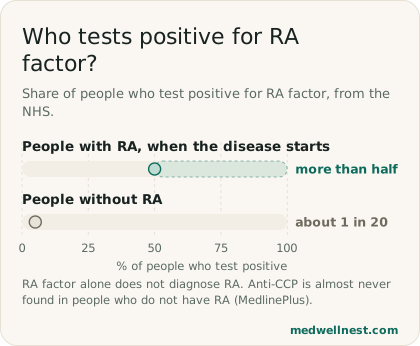
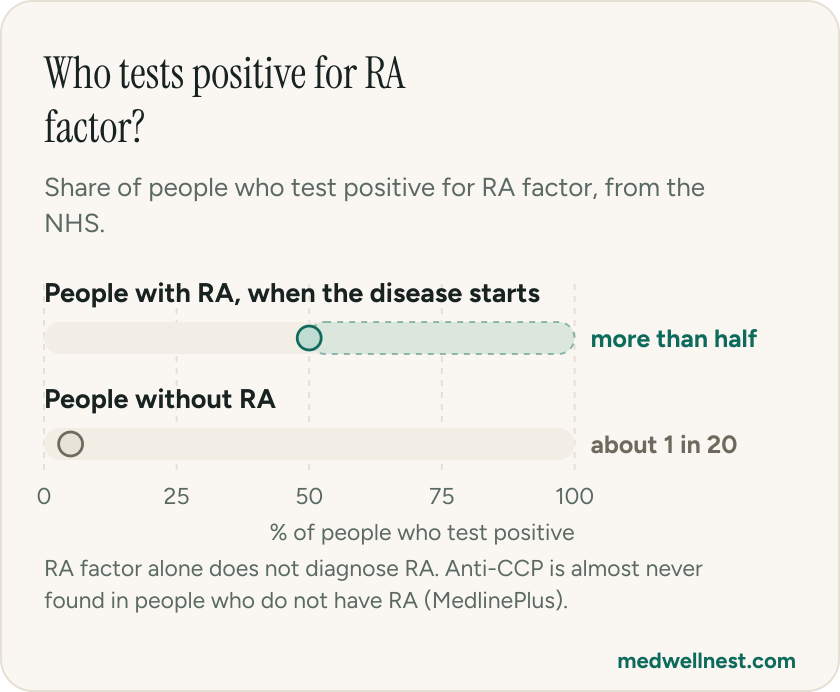
Yes. The NHS says more than half of all people with RA have high levels of RF when the disease starts, but about 1 in 20 people without RA also test positive. MedlinePlus adds that many people have small amounts of RF and are healthy, and that even high amounts are not always a sign of a health condition.
Other conditions that can raise RF, according to MedlinePlus, are other autoimmune disorders (Sjögren syndrome, lupus, scleroderma, and juvenile idiopathic arthritis in children and teens), chronic infections (hepatitis C, tuberculosis, and endocarditis, an infection of the heart) and certain cancers such as leukaemia. MedlinePlus also says people are rarely tested for RF unless they have symptoms of RA or of one of these conditions. So a positive RF in a person with no joint symptoms is not a diagnosis of RA. Show the report to a doctor, who can decide whether anything more is needed.
03
What is the anti-CCP test, and is it better than RA factor?
Anti-CCP (cyclic citrullinated peptide antibody, also called ACPA) is an autoantibody that targets healthy tissue in the joints. MedlinePlus says CCP antibodies are found in most people who have RA and are almost never found in people who do not have the disease, which is why a positive anti-CCP points to RA more strongly than a positive RF. The NHS says people who test positive for anti-CCP are very likely to develop RA, but not everybody with RA has this antibody.
It is not perfectly specific: MedlinePlus says CCP antibodies may sometimes be found in other conditions such as Sjögren's syndrome, lupus, active tuberculosis and chronic lung disease. It also says that doing both tests gives a more accurate diagnosis than RF alone, and the NHS says people who test positive for both may be more likely to have severe RA needing higher levels of treatment. Your lab prints its own cut-off and unit for anti-CCP, so use those, not a number from the internet.
04
What do RA factor and anti-CCP results mean together?
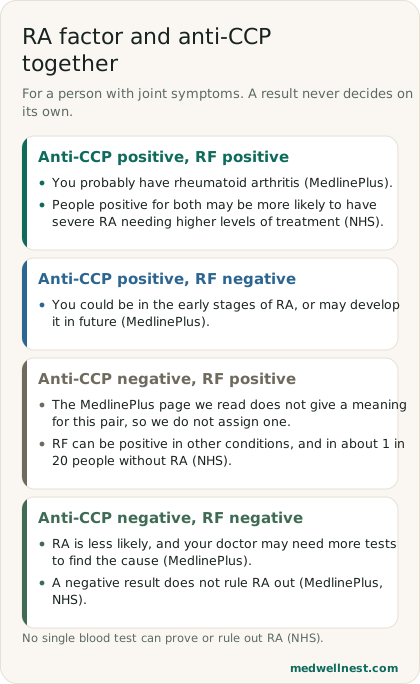
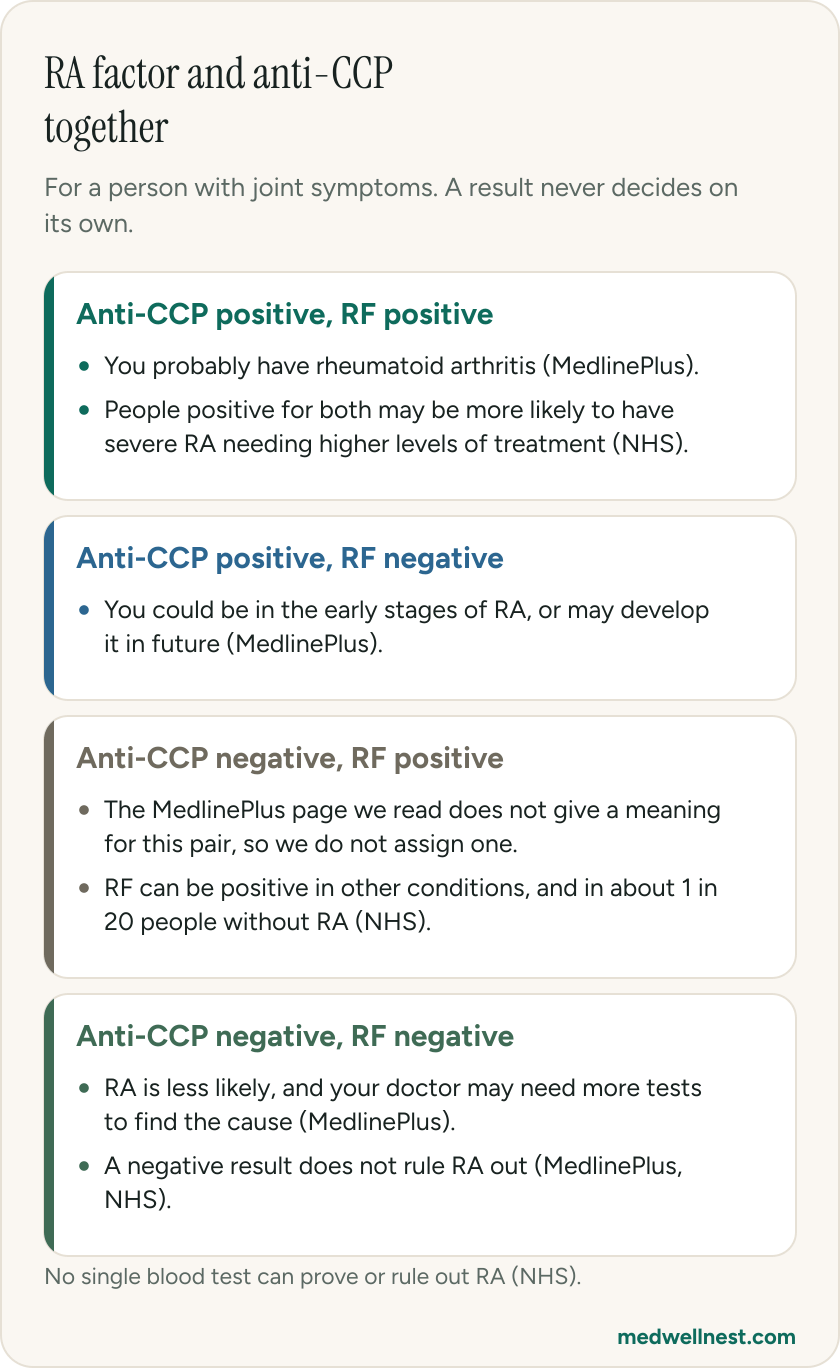
MedlinePlus gives three combinations, for people who have symptoms of RA. Positive anti-CCP with positive RF: you probably have RA. Positive anti-CCP with negative RF: you could be in the early stages of RA, or may develop it in future. Negative anti-CCP with negative RF: RA is less likely, and your doctor may need more tests to find what is causing your symptoms. The chart sets out all four combinations.
The fourth combination, positive RF with negative anti-CCP, is not covered by the MedlinePlus page we read, so we do not assign it a meaning. What the sources do say is that RF can be positive for many reasons other than RA, and that no single blood test settles the question: the NHS says no blood test can definitively prove or rule out RA.
05
I have joint pain but my RA factor is negative. Can it still be RA?
Yes. MedlinePlus says a negative RF "doesn't rule out rheumatoid arthritis or another health problem", and people with RA can have little or no RF. The NHS says no blood test can definitively prove or rule out RA. If you have symptoms and a negative RF, MedlinePlus says your doctor may order more tests to make a diagnosis.
Other tests the sources name are ESR and CRP (markers of inflammation), a full blood count (anaemia is common in RA, but the NHS says having anaemia does not prove you have it), an antinuclear antibody test, joint fluid analysis, and X-rays or MRI scans of the joints. The doctor also examines the joints for swelling and checks how easily they move. Our ESR and CRP story explains the inflammation tests.
06
When should I see a doctor about joint swelling or morning stiffness?
See a doctor if you think you have symptoms of RA, the NHS says, because diagnosing it quickly is important: early treatment can prevent it getting worse and reduce the risk of joint damage. The main symptoms are joint pain, swelling and stiffness, and affected joints can become hot and tender. The small joints of the hands and feet are often affected first, and RA typically affects both sides of the body at once, though not always.
Morning stiffness is a useful clue. The NHS says morning stiffness from osteoarthritis usually wears off within 30 minutes of getting up, while morning stiffness in RA often lasts longer than this. Symptoms often develop gradually over several weeks, but some cases progress quickly over a number of days. Take your report with you: it is one part of the picture the doctor builds from your joints and symptoms.
One situation is different. A joint that suddenly becomes very painful and swollen, especially with a very high temperature, shivering or feeling sick, can mean an infection inside the joint rather than RA or gout. The NHS says you need urgent medical help if you think you have septic arthritis (a joint infection), so see a doctor today.
RA factor or anti-CCP report and joint symptoms: how fast to act
Same-day — call promptly
A joint that has suddenly become very painful and swollen, with pain that is getting worse, a very high temperature or feeling hot, cold or shivery, or feeling sick or unable to eat: see a doctor today, without waiting for a routine appointment. The NHS says these signs can mean an infection inside the joint, which needs urgent medical help. If you cannot be seen today, or you feel very unwell, go to an emergency department.
Routine — see a doctor
Joint pain, swelling or stiffness that is lasting, especially morning stiffness longer than 30 minutes, with or without a positive RA factor or anti-CCP: see a doctor soon rather than waiting for it to settle, and take your report. The NHS says diagnosing RA quickly is important because early treatment can prevent it getting worse and reduce the risk of joint damage. A positive RA factor with no joint symptoms is not a diagnosis, but show the report to a doctor.
Values mentioned in this story
Each one opens a visual guide with its normal range and what moves it — upload a report and we place your own numbers on the same scale.
Sources
- Rheumatoid factor (RF) test — MedlinePlusmedlineplus.gov
- CCP antibody test — MedlinePlusmedlineplus.gov
- Rheumatoid arthritis: overview — NHSnhs.uk
- Rheumatoid arthritis: symptoms — NHSnhs.uk
- Rheumatoid arthritis: diagnosis — NHSnhs.uk
- Septic arthritis — NHSnhs.uk
Share this story
Curious where your own values stand?
Two minutes from upload to a full visual picture. Free to analyze.