In short
WHO says adults should keep to less than 5 g of salt a day, which is less than 2 g of sodium; the global average is about 11 g. Much of it can hide in processed foods, rock and pink salt are still sodium chloride, and potassium salt is not safe for everyone.
Emergency if: You have sudden pain or discomfort in your chest that does not go away, which can feel like squeezing, pressure, burning or indigestion; pain that spreads to your arm, neck, jaw, stomach or back; or chest pain with sweating, feeling sick, light headed or short of breath: call emergency services now. These can be signs of a heart attack. Do not drive yourself; ask someone to drive you or call an ambulance. These are the NHS immediate-action signs for high blood pressure. If you use a potassium salt substitute and have kidney disease, or take an ACE inhibitor, an ARB, spironolactone or another potassium-sparing medicine, or potassium supplements, and develop palpitations, marked muscle weakness or fainting, go to an emergency department now; our high potassium story explains why.
On your report
Sodium, Potassium
On this page
01
How much salt should I eat in a day (namak kitna khana chahiye)?
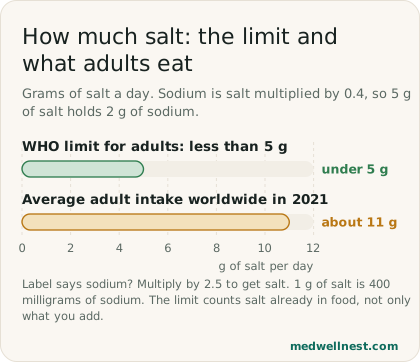
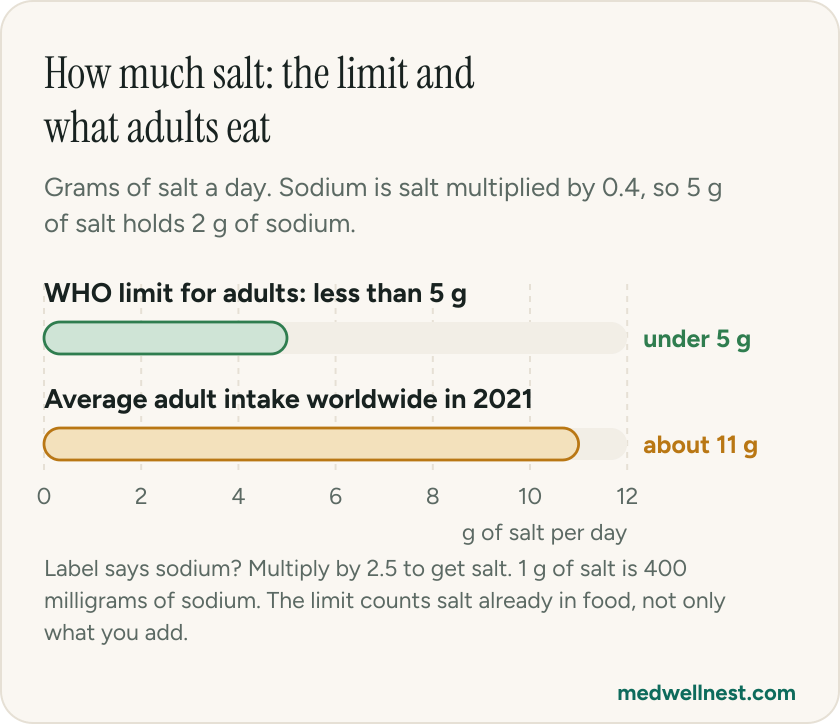
WHO recommends that adults have less than 2 g of sodium a day, which is the same as less than 5 g of salt, or just under one teaspoon. It calls this a strong recommendation. For children aged 2 to 15, WHO says to adjust the adult limit downward based on their energy needs; the advice does not cover babies in the first 2 years, who are breastfed or on complementary feeding.
WHO says the global average adult intake was 4.3 g of sodium a day, equal to 11 g of salt, in 2021, which is more than double its limit. The limit counts all the sodium you eat, including what is already in packaged and cooked food, not only the salt you add at the table. WHO also says sodium deficiency is extremely unlikely in healthy people, so this is a ceiling to stay under rather than a target to reach.
02
What is the difference between salt and sodium, and how do I read a label?
Table salt is sodium chloride, and Harvard's Nutrition Source says it is about 40% sodium and 60% chloride. WHO's converter gives the same figures: 1 g of salt contains 400 milligrams of sodium, and 5 g of salt contains 2,000 milligrams. So to turn sodium into salt, multiply by 2.5; to turn salt into sodium, multiply by 0.4.
This matters because many labels list sodium, not salt. A label showing 0.8 g, or 800 milligrams, of sodium in a serving means 2 g of salt, which is 40% of the WHO daily limit in one serving. Sodium also comes from sources other than table salt: WHO notes that it is in sodium glutamate (monosodium glutamate, or MSG), which is used as a food ingredient and additive, and that sodium occurs naturally in milk, meat and shellfish. Use the sodium total on the label, and do not compare it with the 5 g salt figure without converting.
04
Is sendha namak or pink salt better than regular salt?
Harvard's Nutrition Source says salt is harvested from salt mines or by evaporating seawater, that all types of salt are made of sodium chloride, and that the nutrient content varies minimally. Less processed salts contain small amounts of minerals, but it says the amount is not enough to offer substantial nutritional benefit, and that different salts are chosen mainly for flavour. It describes Himalayan pink salt as mined, with its pink colour coming from small amounts of iron oxide. It does not name sendha namak (rock salt) or kala namak, so we cannot quote a figure for them; sendha namak is mined salt, and the page says to check the sodium on the label.
Harvard's table gives the approximate sodium in one teaspoon: about 2.3 g for fine iodised table salt, 2.2 g for pink Himalayan salt, 2.1 g for fine sea salt and 1.6 g for coarse sea salt, and 1.15 to 2.2 g for what it calls black salt. The differences come mainly from grain size, because finely ground salt packs more into a teaspoon than coarse crystals do, not because one salt has less sodium by weight. WHO also says that all salt consumed should be iodised, so check the packet for iodine before switching to a mined or sea salt.
05
Does eating less salt really lower blood pressure?
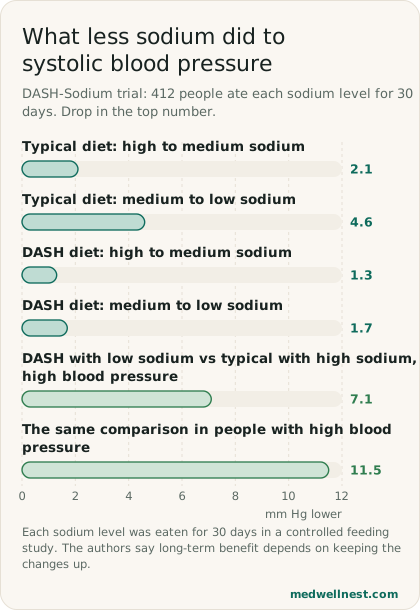
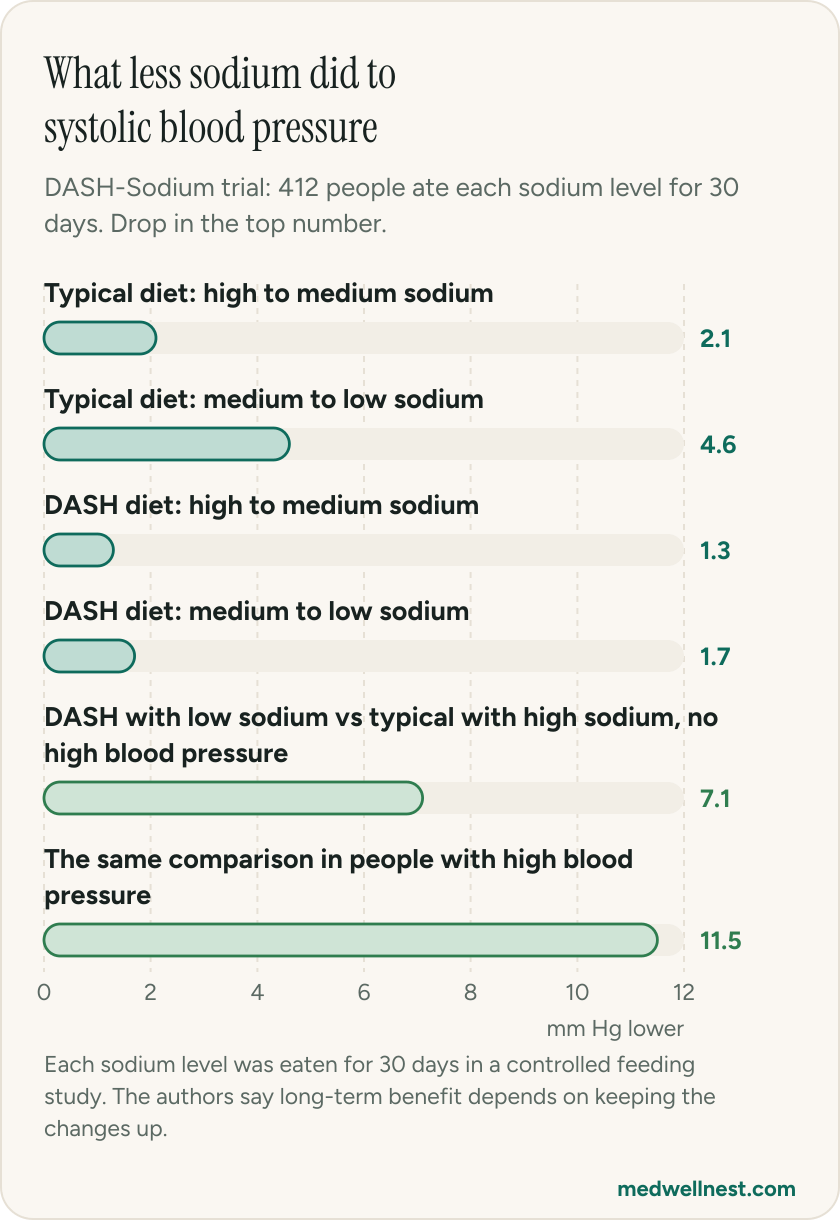
WHO says the primary health effect of a high-sodium diet is raised blood pressure, which increases the risk of cardiovascular disease, and that it is also linked to gastric cancer, kidney disease and other conditions. The best-known controlled test is the DASH-Sodium trial in the New England Journal of Medicine. It randomly assigned 412 people to one of two diets: a control diet modelled on typical everyday eating, or the DASH diet, which is rich in vegetables, fruit and low-fat dairy. Each person stayed on their assigned diet throughout and ate it at three sodium levels, high, medium and low, for 30 days in a row at each level, in random order.
On the control diet, cutting sodium from the high to the medium level lowered systolic blood pressure by 2.1 mm Hg, and from medium to low by a further 4.6 mm Hg. On the DASH diet the drops were 1.3 and 1.7 mm Hg. The effect was seen in people with and without high blood pressure. The DASH diet with low sodium gave a systolic pressure 7.1 mm Hg lower than the control diet with high sodium in people without high blood pressure, and 11.5 mm Hg lower in people with it.
These were short, controlled feeding periods, and the authors note that long-term benefit depends on people making lasting changes. Harvard adds that people differ in how much their blood pressure responds to salt. If you take blood pressure medicines, cutting salt is an addition to them, not a reason to stop; ask your doctor before changing any medicine.
06
Is potassium salt (low-sodium salt) a safe swap?
WHO suggests that, if you use table salt, you replace regular salt with a lower-sodium salt substitute that contains potassium. This is a conditional recommendation, meant for adults in general populations, not pregnant women or children, and it excludes people with kidney impairment or other conditions that may reduce the body's ability to clear potassium, such as people taking potassium-sparing diuretics or potassium supplements. WHO's review covered 26 trials; in them the substitutes lowered systolic blood pressure by 4.76 mm Hg on average and raised blood potassium by 0.12 mmol/L, with little or no difference in high potassium (hyperkalaemia).
The largest trial, SSaSS, put 20,995 people in 600 villages, all with a history of stroke or aged 60 or older with high blood pressure, on either regular salt or a substitute that was 75% sodium chloride and 25% potassium chloride. After an average of 4.74 years, stroke was lower with the substitute (29.14 against 33.65 events per 1000 person-years, rate ratio 0.86, 95% confidence interval 0.77 to 0.96), and so was death from any cause (rate ratio 0.88, 0.82 to 0.95). Serious adverse events from high potassium were not significantly different (rate ratio 1.04, 0.80 to 1.37).
The caution matters. WHO says every trial in its review excluded people with kidney disease or on potassium-sparing medicines, so the results do not tell us it is safe for them, and some trials also excluded people with diabetes. WHO says the overall certainty of evidence was low, which is why the recommendation is conditional, and that people with undiagnosed kidney disease, for whom a higher potassium intake over the long term might be a concern, may not know they are affected. Most substitutes in WHO's review still contained 41% to 75% sodium chloride, and the WHO advice covers salt you add yourself, not packaged food. Do not switch without asking your doctor first if you have kidney disease, heart failure or diabetes, or take a blood pressure or heart medicine. Many common ones, such as ACE inhibitors, angiotensin receptor blockers (ARBs) and spironolactone, also raise blood potassium, as do potassium supplements; our high potassium story explains why.
Salt, blood pressure and potassium salt: how fast to act
Emergency — act now
You have sudden pain or discomfort in your chest that does not go away, which can feel like squeezing, pressure, burning or indigestion; pain that spreads to your arm, neck, jaw, stomach or back; or chest pain with sweating, feeling sick, light headed or short of breath: call emergency services now. These can be signs of a heart attack. Do not drive yourself; ask someone to drive you or call an ambulance. These are the NHS immediate-action signs for high blood pressure. If you use a potassium salt substitute and have kidney disease, or take an ACE inhibitor, an ARB, spironolactone or another potassium-sparing medicine, or potassium supplements, and develop palpitations, marked muscle weakness or fainting, go to an emergency department now; our high potassium story explains why.
Same-day — call promptly
You often have headaches or blurred vision, or you have chest pain that comes and goes: contact a doctor the same day. The NHS tells people with these symptoms to get urgent advice, because they can be caused by high blood pressure.
Routine — see a doctor
You have kidney disease, heart failure or diabetes, take a blood pressure or heart medicine such as an ACE inhibitor, an ARB, spironolactone or another potassium-sparing diuretic, take potassium supplements, or are pregnant, and want to use a potassium salt substitute: ask your doctor first. WHO's advice does not cover these groups, and these medicines can raise blood potassium. If you have not had your blood pressure checked, check it at home or at a clinic.
Values mentioned in this story
Each one opens a visual guide with its normal range and what moves it — upload a report and we place your own numbers on the same scale.
Sources
- Sodium reduction — WHO fact sheetwho.int
- Salt and Sodium — Harvard T.H. Chan School of Public Health, The Nutrition Sourcenutritionsource.hsph.harvard.edu
- Effects on blood pressure of reduced dietary sodium and the DASH diet (DASH-Sodium) — New England Journal of Medicine, 2001pubmed.ncbi.nlm.nih.gov
- Use of lower-sodium salt substitutes — WHO guideline (2025)who.int
- Effect of Salt Substitution on Cardiovascular Events and Death (SSaSS) — New England Journal of Medicine, 2021pubmed.ncbi.nlm.nih.gov
- High blood pressure (hypertension) — NHSnhs.uk
Share this story
Curious where your own values stand?
Two minutes from upload to a full visual picture. Free to analyze.