In short
Read your calcium against the range and unit on your own report. A high result is often found on a routine test; the usual next steps are a repeat and a PTH level. As our precaution, treat new confusion, a seizure, fainting or a racing or irregular heartbeat with an abnormal calcium as an emergency.
Emergency if: A seizure; new confusion; fainting; or a racing, very fast or irregular heartbeat, together with an abnormal calcium result: call emergency services now or go to an emergency department now. The NHS says to call for a first seizure, one that lasts longer than is usual for the person, or one that lasts longer than 5 minutes if you do not know how long theirs usually last, and lists confusion and an irregular heartbeat as more serious symptoms of low calcium. NIDDK lists confusion among the signs of more severe high calcium. No source we read gives a calcium level for an emergency, so this follows the symptoms, not a number; fainting and a racing heartbeat are on the list as our precaution.
On your report
Calcium, Parathyroid Hormone, Vitamin D (25-OH), Albumin
On this page
01
What is a normal serum calcium level, and what is albumin-adjusted calcium?
A serum calcium test measures calcium in the blood. MedlinePlus says only about 1% of the body's calcium is in the blood and the rest is stored in bones and teeth, so the test does not show how much calcium is in your bones: that needs a bone density (DEXA) scan. Neither MedlinePlus nor the other sources we read print a normal range, so compare your number with the range and unit printed on your own report. Some reports use mmol/L, as the NICE numbers below do, and others use mg/dL, as NIDDK does.
About half of blood calcium travels attached to proteins, mainly albumin. Lab Tests Online explains that when albumin is unusually high or low, total calcium can change even though the active (free) calcium has not, so labs often report an adjusted, or corrected, calcium calculated from the total calcium and the albumin. It says adjusted calcium gives a better indication of the active form. NICE says to use albumin-adjusted serum calcium, and not to measure ionised calcium, when testing for primary hyperparathyroidism. MedlinePlus says an ionised calcium test is usually ordered if the total calcium is not normal, and may also be used if someone is seriously ill or having surgery.
02
What does a high calcium report mean?
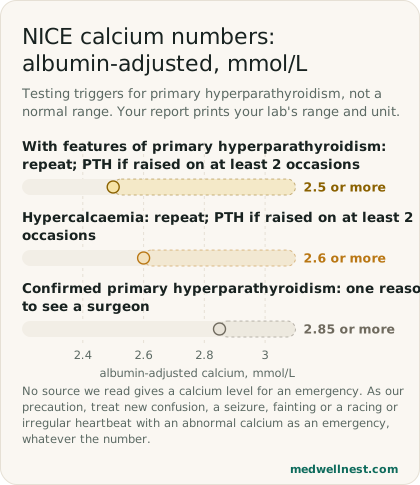
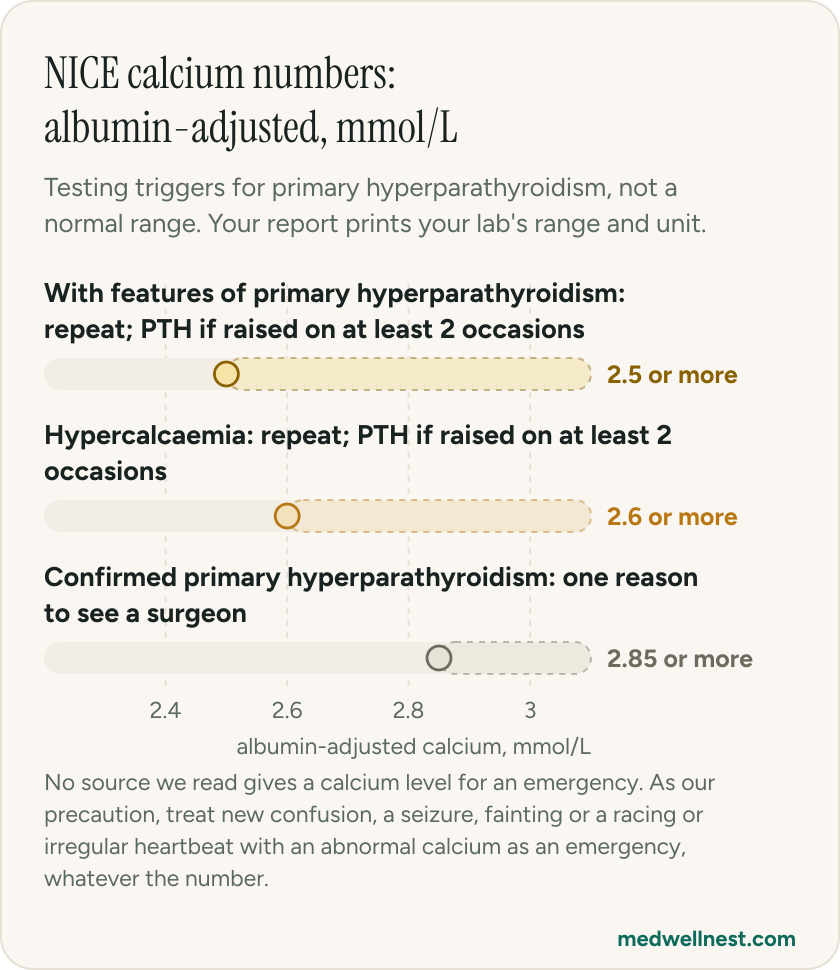
A high calcium result (hypercalcaemia) is often found on a routine blood test. NICE defines it as an albumin-adjusted calcium of 2.6 mmol/L or above, and says it often causes few or no symptoms. NIDDK says doctors usually catch primary hyperparathyroidism, an overactive parathyroid gland, early through routine blood tests, and Lab Tests Online says this form of high calcium is usually mild and can be present for many years before being noticed.
MedlinePlus lists these causes of a high calcium: overactive parathyroid glands, certain cancers including cancer that has spread to bone, bone disorders such as Paget's disease, and taking too much vitamin D over a long period. Lab Tests Online adds an overactive thyroid, sarcoidosis, tuberculosis, lithium treatment, long periods of immobility and acute kidney injury. NIDDK says that in about 8 out of 10 people with primary hyperparathyroidism the cause is a noncancerous growth (an adenoma) on one gland.
MedlinePlus also says a result outside the normal range does not always mean a condition that needs treatment, because diet and some medicines can affect calcium levels. That is one reason a high result is repeated: NICE says to repeat the albumin-adjusted calcium at least once if it is 2.6 mmol/L or above, or 2.5 mmol/L or above with features of primary hyperparathyroidism.
03
Why do doctors order PTH and vitamin D after a high calcium?
PTH (parathyroid hormone) is made by the four pea-sized parathyroid glands in the neck and controls the calcium level in the blood. MedlinePlus says doctors usually order a calcium test and a PTH test together, because comparing the two shows whether the glands are working properly. NICE says to measure PTH when albumin-adjusted calcium is 2.6 mmol/L or above on at least 2 separate occasions, or 2.5 mmol/L or above on at least 2 separate occasions when primary hyperparathyroidism is suspected.
Vitamin D is checked because low levels are common in primary hyperparathyroidism, NIDDK says, and NICE says to measure vitamin D in people with a probable diagnosis. Other tests the sources mention are a urine calcium test (NICE uses it to tell primary hyperparathyroidism from a rare inherited condition, familial hypocalciuric hypercalcaemia), tests for kidney problems, and a bone density scan to look for bone weakness. Our vitamin D report story explains that test.
04
What do calcium and PTH results mean together?
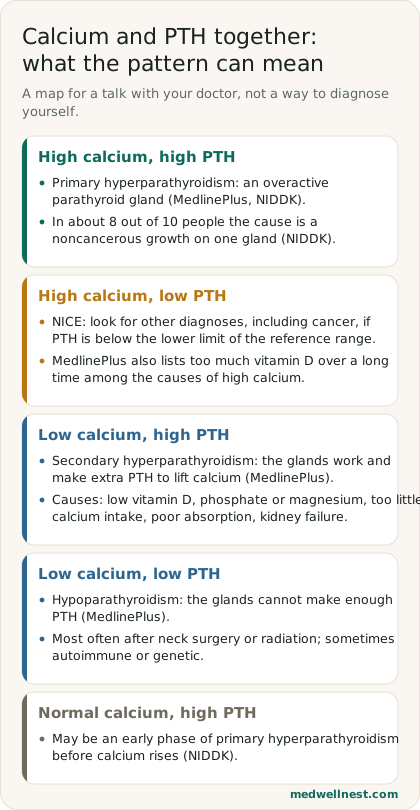
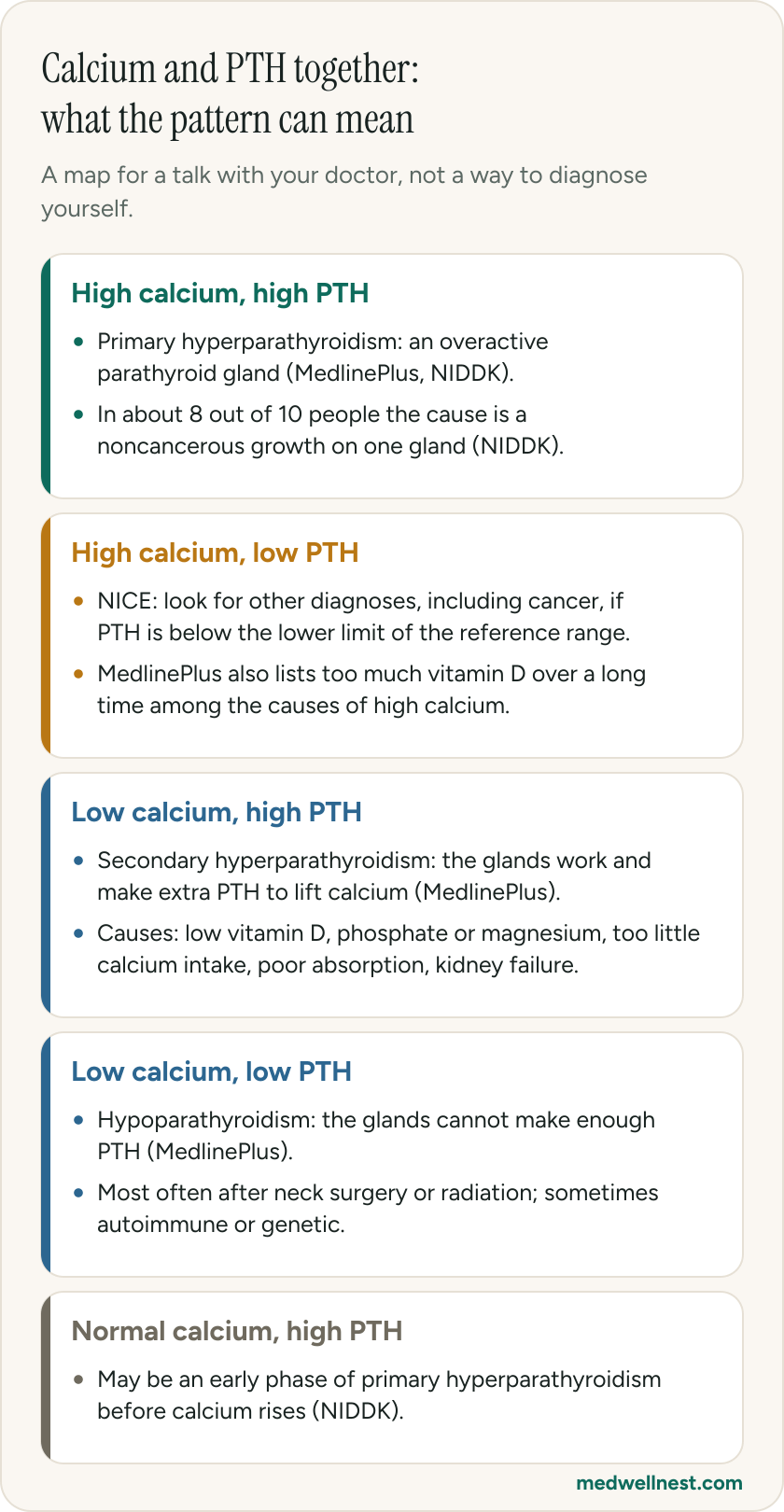
MedlinePlus: high calcium with high PTH is primary hyperparathyroidism, usually from a noncancerous growth on a gland. High PTH with low calcium is secondary hyperparathyroidism: the glands are working properly and making extra PTH because something else is keeping calcium low, such as low vitamin D, phosphate or magnesium, too little calcium in the diet, poor absorption from the gut or kidney failure. Low PTH with low calcium suggests hypoparathyroidism, where the glands cannot make enough PTH, most often after neck surgery or radiation, or from an autoimmune or genetic cause.
Other patterns: NIDDK says PTH may sit in the upper part of the normal range when it should be low-normal or lower in response to high calcium, and it still points to primary hyperparathyroidism, and that PTH can be high with a normal calcium, which may be an early phase before calcium rises. NICE says that if calcium is high but PTH is below the lower limit of the reference range, doctors should look for other diagnoses, including cancer. The chart shows the main combinations. It is a map for a conversation with your doctor, not a way to diagnose yourself.
05
What are the symptoms of high or low calcium?
High calcium: MedlinePlus lists constipation, nausea and vomiting, belly pain, loss of appetite, increased thirst, passing more urine than usual, kidney stones, weakness, aches and pains, fatigue, and changes such as depression or confusion. NICE names thirst, frequent urination and constipation. MedlinePlus and NIDDK both stress that many people have no symptoms; NIDDK says loss of appetite, nausea, vomiting, constipation, confusion and increased thirst and urination are signs of more severe disease.
Low calcium: MedlinePlus lists muscle cramps, spasms or stiffness, tingling in the lips, tongue, fingers and feet, an irregular heartbeat, and seizures if calcium is extremely low; after a long period of low levels, dry skin, coarse hair and nails that break easily. The NHS describes a tingling or burning feeling in the fingers, toes and face and muscle spasms in hypoparathyroidism, with confusion, an irregular heartbeat and seizures as the less common and more serious symptoms. Lab Tests Online adds numbness around the mouth.
06
Should I take or stop calcium or vitamin D tablets because of this report?
This page cannot tell you to take, stop or change a supplement. What the sources say is that supplements and medicines can affect results: MedlinePlus says taking too much vitamin D over a long period can raise calcium, and that you may be asked to stop certain medicines or supplements, such as vitamin D, before the test, but you should not stop any medicine unless your provider tells you to. Lab Tests Online says eating calcium-rich foods will generally not change your calcium result. If you take calcium or vitamin D tablets, tell the doctor who ordered the test, and show them the report before changing anything.
People with hypoparathyroidism are treated with calcium and vitamin D supplements, usually for the rest of their lives and with regular blood tests, the NHS says. That is treatment set by a specialist after tests, not something to start from a report.
07
When is an abnormal calcium result an emergency?
None of the sources we read gives a calcium number at which a result becomes an emergency, so this page does not invent one. What they give are the signs they call serious. The NHS says to call emergency services for a seizure that is the first one, lasts longer than is usual for the person, or lasts longer than 5 minutes if you do not know how long theirs usually last. It lists confusion, an irregular heartbeat and seizures as the more serious symptoms of low calcium, and says that if calcium becomes too low it can cause seizures and serious heart problems that need hospital treatment. NIDDK lists confusion and vomiting among the signs of more severe high calcium.
As our precaution, and not a rule from a guideline, treat new confusion, a seizure, fainting or a very fast or irregular heartbeat together with an abnormal calcium result as an emergency: call emergency services or go to an emergency department now. Persistent vomiting, severe weakness, or intense thirst with passing large amounts of urine, together with a high calcium report, should be seen by a doctor today. If tingling or spasms start after neck or head surgery, the NHS says to try the contact details you were given for complications first.
Abnormal calcium report: how fast to act
Emergency — act now
A seizure; new confusion; fainting; or a racing, very fast or irregular heartbeat, together with an abnormal calcium result: call emergency services now or go to an emergency department now. The NHS says to call for a first seizure, one that lasts longer than is usual for the person, or one that lasts longer than 5 minutes if you do not know how long theirs usually last, and lists confusion and an irregular heartbeat as more serious symptoms of low calcium. NIDDK lists confusion among the signs of more severe high calcium. No source we read gives a calcium level for an emergency, so this follows the symptoms, not a number; fainting and a racing heartbeat are on the list as our precaution.
Same-day — call promptly
A high calcium report with persistent vomiting, severe weakness, or intense thirst with passing large amounts of urine: contact a doctor today, without waiting for a routine appointment. NIDDK lists vomiting, increased thirst and urination among the signs of more severe disease, but the sources give no deadline, so this is our precaution. If you have recently had neck or head surgery and have tingling or spasms, the NHS says to try the contact details you were given first.
Routine — see a doctor
A high or low calcium result with no symptoms, tingling or muscle spasms that are mild, or a result you do not understand: see a doctor soon to have it repeated and to ask whether a PTH and vitamin D test are needed, and take the report. Do not start, stop or change calcium or vitamin D tablets without asking the doctor, as MedlinePlus says about medicines in general. If spasms get worse, or you feel faint or confused, use the emergency tier above.
Values mentioned in this story
Each one opens a visual guide with its normal range and what moves it — upload a report and we place your own numbers on the same scale.
Sources
- Calcium blood test — MedlinePlusmedlineplus.gov
- Parathyroid hormone (PTH) test — MedlinePlusmedlineplus.gov
- Primary hyperparathyroidism — NIDDKniddk.nih.gov
- Hyperparathyroidism (primary): diagnosis, assessment and initial management (NG132) — NICE guidelinenice.org.uk
- Hypoparathyroidism — NHSnhs.uk
- Calcium test — Lab Tests Onlinelabtestsonline.org.uk
Share this story
Curious where your own values stand?
Two minutes from upload to a full visual picture. Free to analyze.