In short
A slight tremor is normal and a tremor itself is not life threatening, but see a doctor if it gets worse or affects daily life. Get emergency help for stroke signs, visible shaking or confusion after stopping alcohol, or unresponsiveness in someone with diabetes. Essential tremor is the most common type.
Emergency if: Face drooping, weakness or numbness in an arm or down 1 side of the body, slurred speech, trouble finding words, sudden confusion, loss of vision or a severe headache, with or without shaking (stroke signs; call even if they have stopped, if they happened in the last 24 hours); after stopping or cutting down alcohol, visible shaking, being unusually restless, irritable or upset, confusion, seeing, hearing or feeling things that are not there, or a seizure; or shaking and sweating in someone with diabetes who is not responding normally or is unconscious: call emergency services now. The NHS lists these as emergencies for a stroke, alcohol withdrawal and very low blood sugar.
On your report
TSH, Free T4, Random Blood Glucose
On this page
01
Why are my hands shaking?
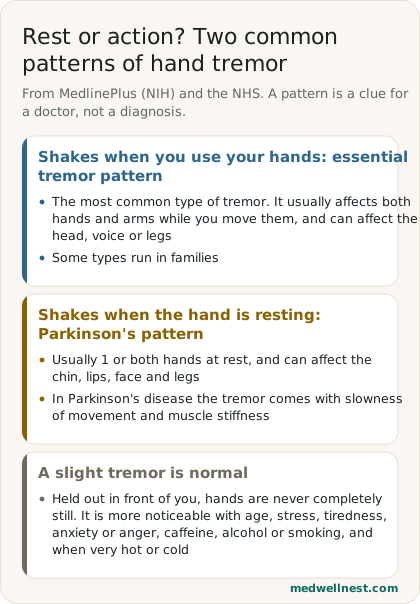
The NHS says it is normal to have a slight tremor: if you hold your hands or arms out in front of you, they will not be completely still. It becomes more noticeable as you get older, when you are stressed, tired, anxious or angry, after caffeine (in tea, coffee or cola), alcohol or smoking, and if you are very hot or cold. MedlinePlus defines a tremor as involuntary, rhythmic shaking, most often in the hands, that may come and go or be constant.
MedlinePlus says a tremor is not life threatening, but it can make writing, typing, eating and dressing hard, and it is most common in middle-aged and older adults. For most types the cause is unknown and some types are inherited and run in families. Other causes are covered below.
02
Are shaky hands a sign of Parkinson's disease?
It can be, but it is only one of several causes. MedlinePlus lists essential tremor as the most common type of tremor and parkinsonian tremor as a common symptom in people who have Parkinson's disease. The NHS says the main symptoms of Parkinson's disease are tremor, slowness of movement and muscle stiffness, and that they usually develop gradually and are mild at first. So a doctor looks at the whole picture, including whether the tremor happens at rest or in action and whether there is slowness or stiffness.
The NHS says the tremor of Parkinson's disease usually begins in the hand or arm and is more likely when the limb is relaxed and resting. The other symptoms it lists include balance problems, a slow, shuffling walk with very small steps, constipation, and sometimes a loss of the sense of smell years before other symptoms. Nobody should diagnose themselves from this list: the NHS says to see a doctor if you are concerned you may have symptoms, and the doctor decides whether to refer you to a specialist.
03
Essential tremor or Parkinson's tremor: what is the difference?
MedlinePlus describes essential tremor, sometimes called benign essential tremor or familial tremor, as the most common type. It usually affects both hands and arms while you are moving them, and can also affect the head, voice or legs. Parkinsonian tremor usually affects one or both hands when they are at rest, though it can affect the chin, lips, face and legs. A third type, dystonic tremor, happens in people who have dystonia, a movement disorder with involuntary muscle contractions.
That is why doctors check whether the tremor happens when the muscles are at rest or in action, where it is, and how often and how strong it is, along with balance, speech and muscle stiffness (MedlinePlus). The NHS says some types of tremor run in families. A pattern is a clue, not a verdict: an examination, and sometimes tests, are needed to tell which type you have.
04
What else can cause shaky hands?
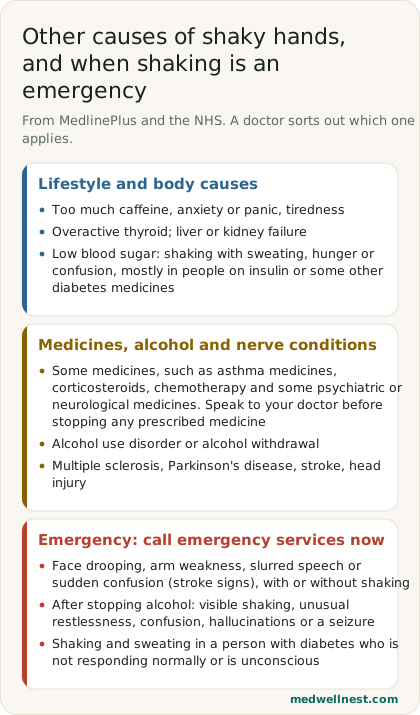
MedlinePlus lists other causes: nerve conditions such as multiple sclerosis, Parkinson's disease, stroke and brain injury; certain medicines, such as asthma medicines, chemotherapy, corticosteroids and some psychiatric or neurological medicines; alcohol use disorder or alcohol withdrawal; poisoning from some toxic substances such as pesticides and heavy metals; an overactive thyroid; liver or kidney failure; anxiety or panic; and too much caffeine.
Low blood sugar can also make you shake. The NHS lists shaking among its symptoms, along with sweating, hunger, dizziness, anxiety and confusion, and says it usually affects people with diabetes who take insulin or some other diabetes medicines and is rare in people without diabetes. If you do not have diabetes and get shaking, sweating, a fast heartbeat and confusion, the NHS says to see a doctor.
05
What should I do about a tremor, and when should I see a doctor?
The NHS says to see a doctor if a tremor is getting worse over time or affecting your daily activities. The doctor may examine you and ask about other symptoms, your medicines, and your and your family's medical history, will want to make sure the tremor is not caused by another condition, and may refer you to a specialist if it could be a symptom of Parkinson's disease or multiple sclerosis. A mild tremor with no other cause does not usually need treatment, though the doctor may monitor it. MedlinePlus says blood or urine tests may be done to look for the cause.
If treatment is needed, the NHS says medicine will not make the tremor go away but often helps reduce the shaking, and some people take it all the time while others take it only when needed, for example before a stressful situation. Injections can help a tremor of the head or voice, and brain surgery is rarely an option for a severe tremor that medicine does not help. MedlinePlus adds that a tremor caused by another condition may get better when that condition is treated, that physical, speech-language and occupational therapy may help, and that if caffeine triggers your tremor it may help to cut it out.
Medicines can cause tremor, but do not stop a prescribed medicine on your own. The NHS says to speak to your doctor before you stop taking any prescribed medicine, and MedlinePlus says that when a medicine is the cause, stopping it usually makes the tremor go away. The safe way to reconcile the two is to ask the prescriber about changing or stopping it.
06
When is shaking an emergency?
Call emergency services now if shaking comes with signs of a stroke. The NHS lists face weakness (one side of the face may droop), arm weakness, speech problems (slurring words or sounding confused), weakness or numbness down 1 side of the body, blurred vision or loss of sight, difficulty finding words, confusion, dizziness or falling over, and a severe headache. It says to call even if the signs have stopped, if they happened within the last 24 hours.
Alcohol withdrawal can also be dangerous. The NHS says withdrawal can cause a racing heartbeat, sweating and shaking, hallucinations, confusion and seizures, begins within 6 to 12 hours of the last drink and usually lasts 3 to 7 days, and that it can be very dangerous to stop drinking suddenly if you are dependent on alcohol, so you should get medical help before you try to stop. It says to call emergency services for visible shaking, being unusually restless, irritable or upset, confusion, seeing, hearing or feeling things that are not there, or a seizure.
In someone with diabetes, shaking and sweating can mean very low blood sugar. The NHS says to call emergency services if the person is not responding normally or is unconscious and a glucagon injection is not available, if they have not recovered within 10 minutes of one, or if they have been drinking alcohol. If a tremor starts soon after a new medicine, contact the prescriber the same day; the sources give no timeframe for this, so that is our cautious choice.
Shaky hands: how fast to act
Emergency — act now
Face drooping, weakness or numbness in an arm or down 1 side of the body, slurred speech, trouble finding words, sudden confusion, loss of vision or a severe headache, with or without shaking (stroke signs; call even if they have stopped, if they happened in the last 24 hours); after stopping or cutting down alcohol, visible shaking, being unusually restless, irritable or upset, confusion, seeing, hearing or feeling things that are not there, or a seizure; or shaking and sweating in someone with diabetes who is not responding normally or is unconscious: call emergency services now. The NHS lists these as emergencies for a stroke, alcohol withdrawal and very low blood sugar.
Same-day — call promptly
A tremor that began soon after you started a new medicine, or shaking with sweating, a fast heartbeat and confusion when you do not have diabetes: contact a doctor today. For shaking, sweating, a fast heartbeat and confusion in someone without diabetes, the NHS says to see a doctor; for a new medicine, it says to speak to a doctor before stopping it. Neither source gives a timeframe, so same-day is our cautious choice. If someone with diabetes is shaking and sweating, treat low blood sugar as their diabetes team has taught them.
Routine — see a doctor
A tremor that is getting worse over time or affecting daily activities such as writing, eating or dressing, a tremor that runs in the family, or a tremor with slowness of movement or stiffness: see a doctor. Tell them about every medicine you take and how much caffeine and alcohol you have. If you are worried about your drinking, or get anxiety, poor sleep, sweating or feeling sick when you cut down, ask a doctor or an alcohol support service for help before you stop. Visible shaking after stopping or cutting down alcohol is an emergency (see above). The NHS gives these as reasons to see a doctor.
Values mentioned in this story
Each one opens a visual guide with its normal range and what moves it — upload a report and we place your own numbers on the same scale.
Sources
- Tremor or shaking hands — NHSnhs.uk
- Tremor — MedlinePlus (NIH)medlineplus.gov
- Parkinson's disease: symptoms — NHSnhs.uk
- Low blood sugar (hypoglycaemia) — NHSnhs.uk
- Symptoms of a stroke — NHSnhs.uk
- Alcohol-use disorder — NHSnhs.uk
Share this story
Curious where your own values stand?
Two minutes from upload to a full visual picture. Free to analyze.