In short
Carbon monoxide has no smell or colour, and burning charcoal, coal, wood or gas in a closed room can release it. People who are asleep can die before they have symptoms. Know the signs, get into fresh air, and call emergency services now if anyone is confused or has collapsed.
Emergency if: Anyone who has been exposed to carbon monoxide is confused, finds it hard to breathe, has fainted or cannot be woken, feels weak, or has chest or muscle pain: get everyone into fresh air and call emergency services now. Do not go back in, and do not drive yourself to hospital. The NHS and MedlinePlus say to seek immediate medical attention.
On this page
01
Is it dangerous to sleep with a sigdi or angithi burning in a closed room?
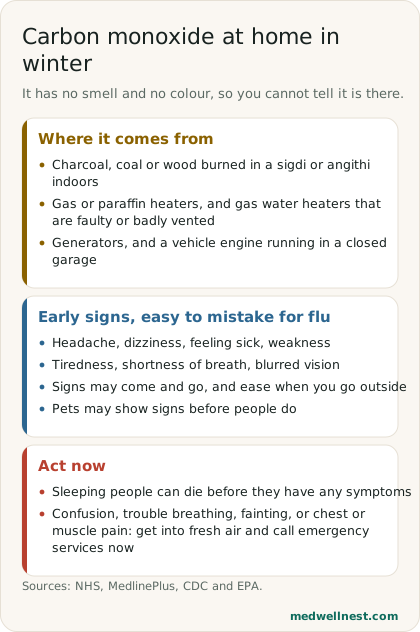
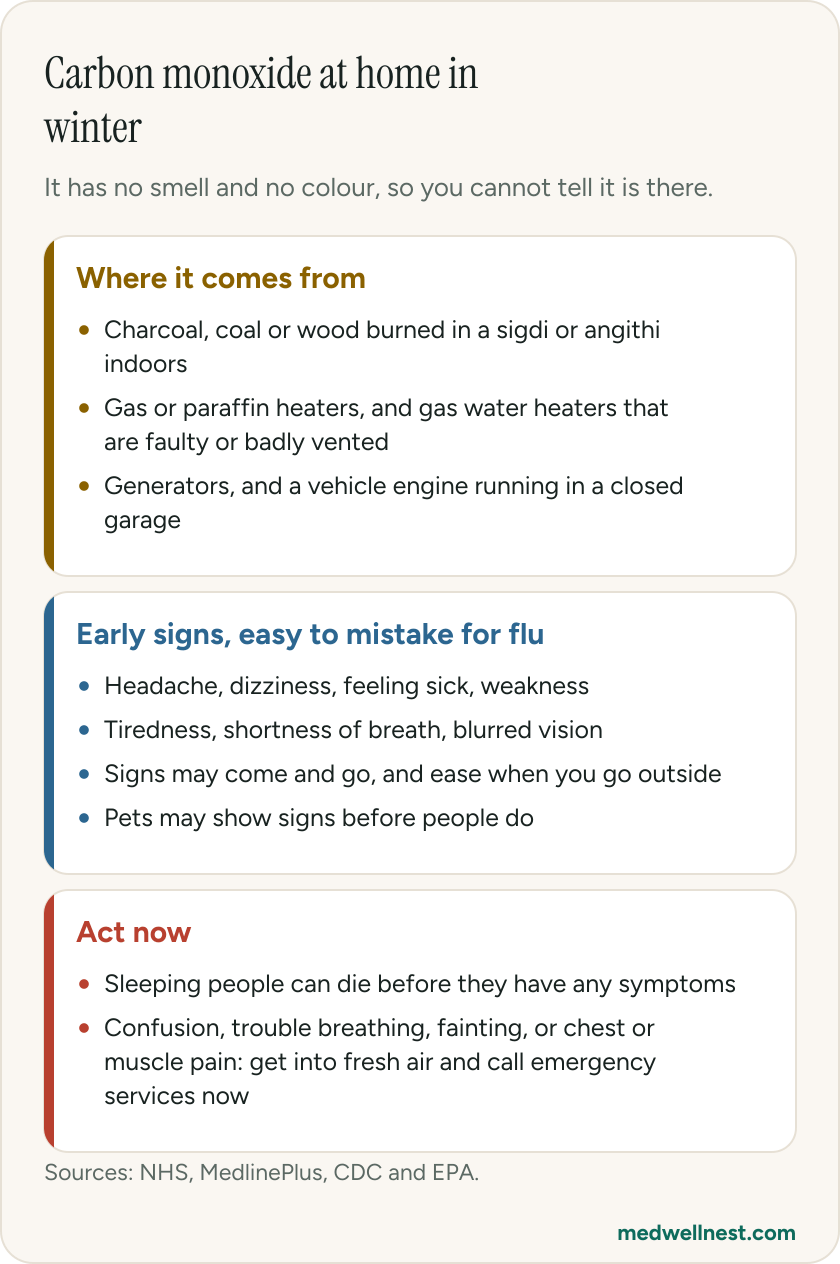
Yes. The CDC says that people who are sleeping, drunk or under the influence of other substances can die from carbon monoxide poisoning before they have symptoms. The EPA says carbon monoxide is odorless, colorless and toxic, and that because you cannot see, taste or smell it, it can kill you before you are aware it is in your home. So a room that does not smell of smoke is not proof of safety.
The CDC says never to burn charcoal indoors, and that burning charcoal of any look, whether red, gray, black or white, gives off carbon monoxide. MedlinePlus lists anything that burns coal, kerosene, oil, propane or wood, and says many poisonings happen in winter, when heaters are in use and windows are closed. The NHS includes wood and coal fires among the sources. A sigdi, an angithi or a coal or wood brazier in a closed room is exactly that.
02
Which heaters and appliances can cause carbon monoxide poisoning?
Carbon monoxide is made when fuel does not burn completely. The NHS lists gas boilers, gas cookers and clay ovens, gas or paraffin heaters, wood, gas and coal fires, and portable generators. It adds that barbecues or camping stoves used indoors, and vehicle engines left running in an enclosed space such as a garage, can also cause a build-up. The EPA lists unvented kerosene and gas space heaters, leaking chimneys and furnaces, and back-drafting from gas water heaters, and MedlinePlus lists water heaters that use natural gas. So a gas geyser counts too: the NHS advice to have gas appliances properly installed and regularly serviced, and to keep rooms well ventilated, applies to it.
The CDC says never to use a generator inside your home or garage, even if the doors and windows are open. The NHS says appliances can produce carbon monoxide if they are not installed properly, are faulty or are poorly maintained. Our guide on air pollution and lung protection covers the different hazard of smoke outdoors.
03
What are the symptoms of carbon monoxide poisoning?
The NHS lists a headache, dizziness, feeling or being sick, feeling weak, tiredness and confusion, chest and muscle pain, shortness of breath, a hot red face (harder to see on brown and black skin) and loss of vision. It says symptoms may come and go, may get worse in an affected room, and may get better when you go outside. MedlinePlus adds drowsiness, fainting, convulsions and coma, and says the poisoning is often mistaken for a viral illness, which can delay help.
MedlinePlus says young children, older adults, people with lung or heart disease and smokers are at higher risk of serious harm, and that carbon monoxide can harm an unborn baby. In small children the signs can be subtle, such as fussiness, feeding difficulty or unusual behaviour. It also says pets often show signs before people do, so a weak or unresponsive pet is a warning. If several people in the house have a headache and feel sick, and it eases outside, think of carbon monoxide.
04
What should I do if I think someone has carbon monoxide poisoning?
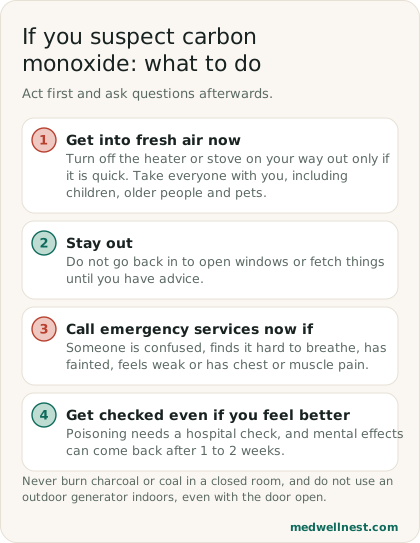
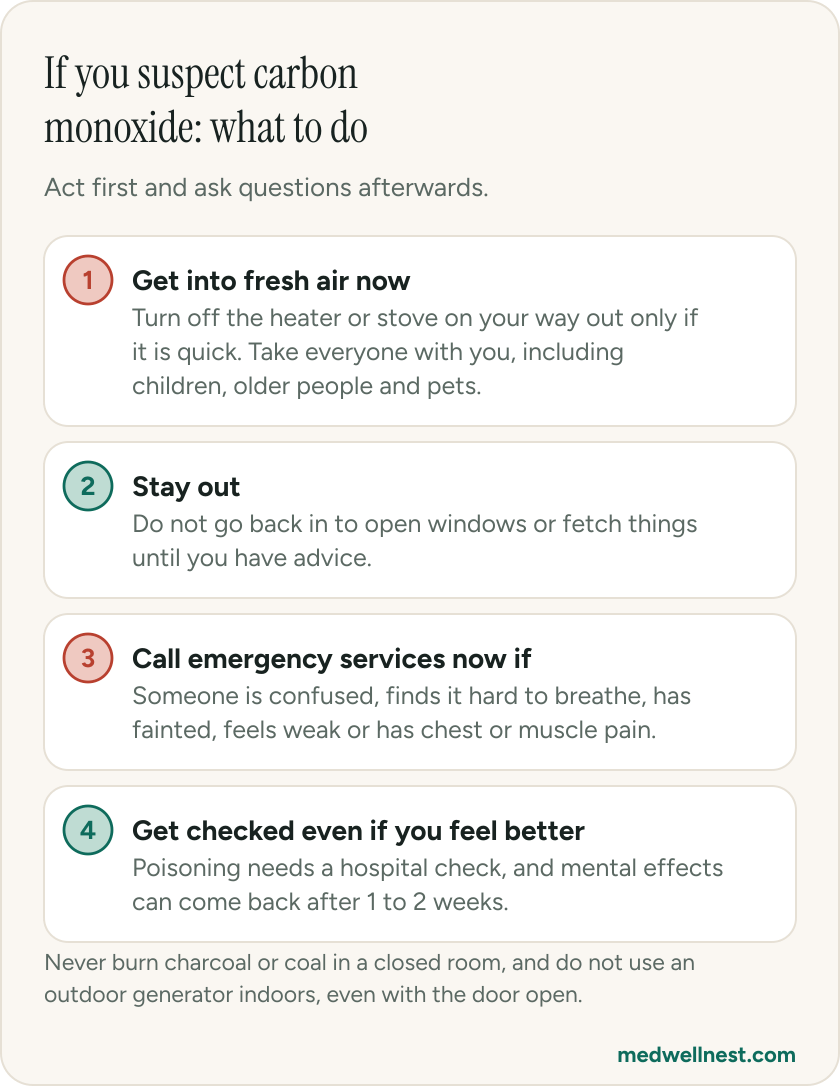
MedlinePlus says to move the person to fresh air immediately and seek immediate medical attention. The NHS says to stop using the appliance you think is making carbon monoxide if you can, go outside, get medical advice as soon as possible, and not go back into the building until you have been advised. It says to call emergency services if someone finds it hard to breathe, has suddenly become confused, has lost consciousness, feels weak, or has chest or muscle pain.
Get checked even if you feel better. The NHS says anyone with carbon monoxide poisoning needs to be checked in hospital, where the carbon monoxide level in the blood is tested and oxygen may be given through a mask. MedlinePlus says recovery can be slow, and that impaired thinking can come back after someone has been free of symptoms for 1 to 2 weeks.
05
How can I keep a room warm safely in winter?
The simplest rule is not to burn charcoal, coal or wood in a closed room, and never in a room where people sleep. The NHS advises a carbon monoxide alarm, one in each room that has an appliance burning gas, oil, coal or wood, and the EPA notes that safety bodies recommend alarms on each level outside sleeping areas. An alarm is a back-up, not a licence to keep a sigdi lit: if you cannot get one, the safe choice is not to burn fuel indoors at all.
The NHS also advises having heating and cooking appliances properly installed and serviced regularly by a qualified engineer, keeping rooms well ventilated, and keeping chimneys and flues clean. Warm clothing, layers, blankets and a hot water bottle are safe ways to keep warm, as the BHF suggests. The same care applies if you have a heart condition, because cold already strains the heart: our guide on winter and the heart explains why.
When to act
Emergency — act now
Anyone who has been exposed to carbon monoxide is confused, finds it hard to breathe, has fainted or cannot be woken, feels weak, or has chest or muscle pain: get everyone into fresh air and call emergency services now. Do not go back in, and do not drive yourself to hospital. The NHS and MedlinePlus say to seek immediate medical attention.
Same-day — call promptly
You or your family have a headache, dizziness or nausea that eases when you go outside, after using a sigdi, heater or gas appliance in a closed room: stop using it, stay outside until it is safe, and get medical advice today. The NHS says to get medical advice as soon as possible.
Routine — see a doctor
You use a gas heater, geyser, sigdi or generator at home: have gas appliances serviced by a qualified engineer, fit a carbon monoxide alarm where you can, and move any fuel-burning to a well-ventilated space away from where people sleep.
Sources
- Carbon monoxide poisoning — NHSnhs.uk
- Carbon monoxide poisoning — MedlinePlus Medical Encyclopediamedlineplus.gov
- Carbon Monoxide Poisoning Basics — CDCcdc.gov
- Carbon Monoxide's Impact on Indoor Air Quality — Environmental Protection Agency (EPA)epa.gov
- How cold weather affects your heart — BHFbhf.org.uk
Share this story
Curious where your own values stand?
Two minutes from upload to a full visual picture. Free to analyze.