In short
Cold makes blood vessels narrow, which raises blood pressure and makes the heart work harder, and heart attacks are more common in winter. How big the effect is remains uncertain: in cold spells, one study of older men found the risk nearly double, and a second study of older adults found no increase.
Emergency if: Chest pain that is tight or squeezing, pain spreading to the arm, neck or jaw, severe difficulty breathing, pale, blue or grey skin, someone has collapsed and is not responding normally, or any sign of stroke (face drooping, arm weakness, slurred speech, sudden confusion): call emergency services now. Do not drive yourself. The NHS says to call even if stroke signs have passed.
On this page
01
Why does cold weather raise blood pressure?
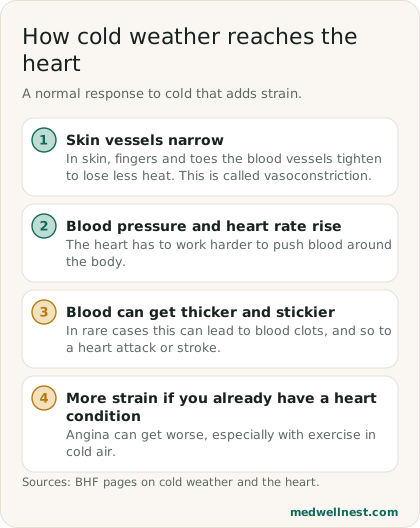
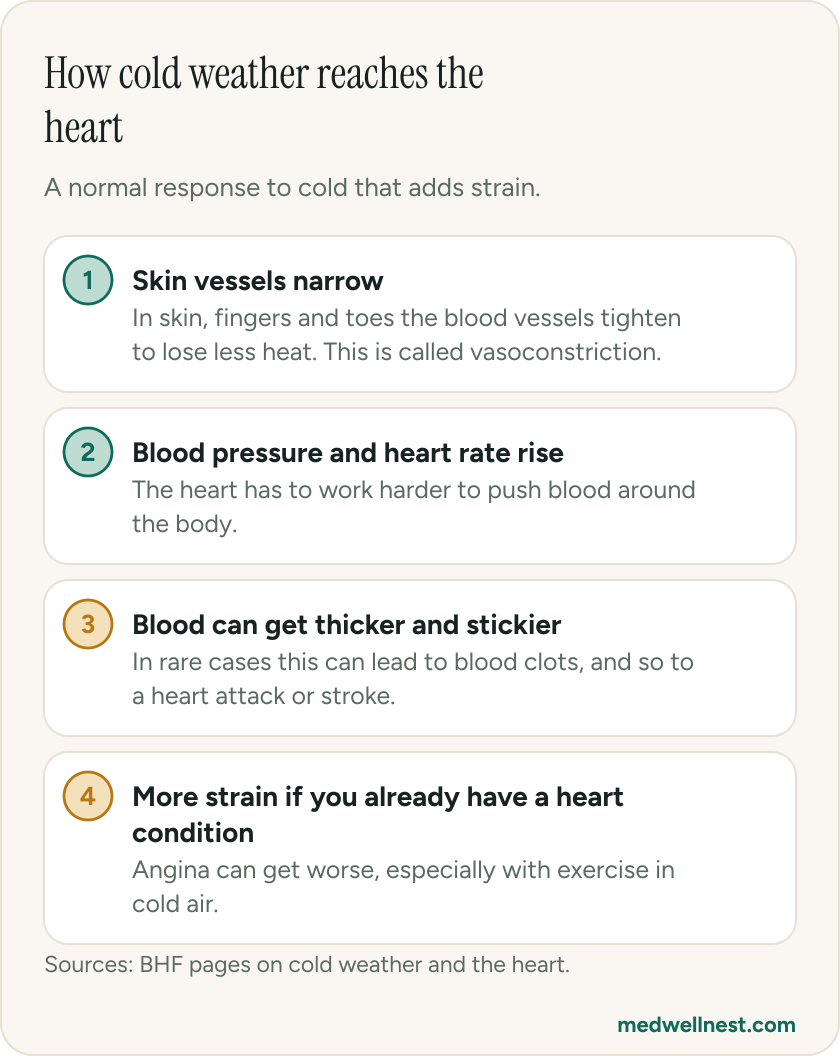
The BHF explains the mechanism. When you are cold, blood vessels in the skin, fingers and toes narrow so that less heat is lost. This narrowing is called vasoconstriction. It creates more pressure in the rest of the circulation, so the heart has to work harder to pump blood around the body, and heart rate and blood pressure go up.
The BHF calls this a normal response to the cold, but says the extra strain can be harder for people with a heart condition, especially during exercise. It adds that cold can make blood thicker and stickier, which in rare cases can lead to blood clots and so to a heart attack or stroke. Our hypertension guide and blood pressure basics page explain what a raised reading means.
02
Are heart attacks and strokes really more common in winter? How strong is the evidence?
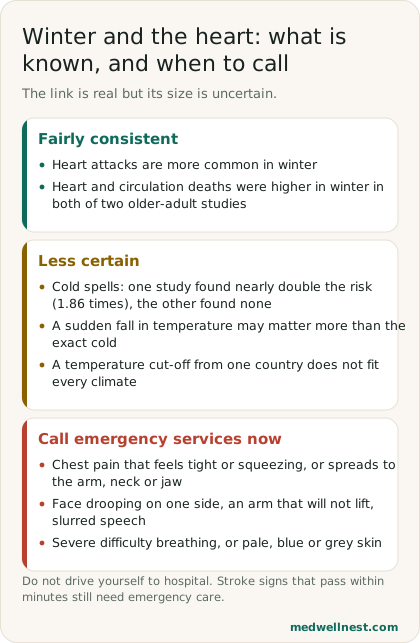
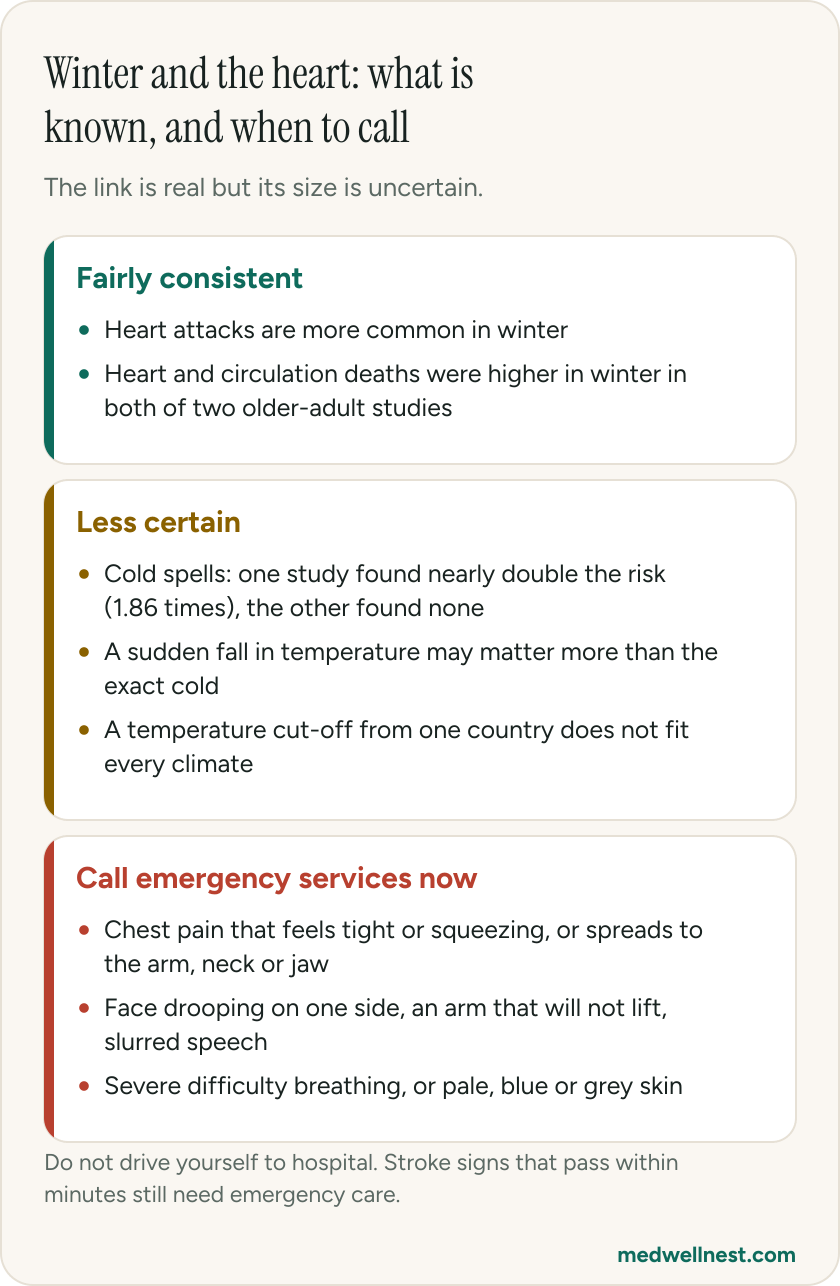
The BHF says heart attacks are more common in winter. In its magazine it summarises BHF-funded research on people over 60 as finding heart attacks and strokes "more than twice as likely" during cold spells, with a fall in temperature compared with the days before mattering more than exactly how cold it was. The published paper behind that summary is more cautious. It followed two groups. In older men, a cold spell (at least 3 days below the local monthly 10th percentile of daily temperature) came with a risk ratio of 1.86 (95% confidence interval 1.30 to 2.65), nearly double, for heart and circulation events. In the second group, men and women aged 70 to 82, no increased risk was found. Both groups did have more deaths from heart and circulation disease in winter: excess winter deaths from cardiovascular disease were 36 percent in the older men and 23 percent in the men and women aged 70 to 82.
So the honest summary is that winter and heart attacks are linked, but the size of the effect of a cold spell is uncertain and may differ between groups. Temperature numbers should also not be copied across places. The BHF quotes official statistics from one country where the rise in winter deaths starts below an average of 12 degrees Celsius, and says even there it varies by area and by home insulation. That figure cannot tell you when a cold day is risky where you live.
03
Who is at higher risk in cold weather?
The BHF says people with angina may find symptoms worse in winter. In a small study of 42 people with chest pain, 32 of whom had blocked coronary arteries, breathing cold air reduced blood flow to the heart in those with blockages, and cold air during exercise reduced it further. The BHF notes it was a small study and that more research is needed.
The BHF also reports that, on average, lower temperatures went with higher blood pressure and cholesterol and lower vitamin D, probably because behaviour changes in the cold. In a cold snap, the risk of dying of heart disease was higher in people who had ever smoked or had more than one alcoholic drink a week. Most of this research is in people over 60, and the BHF stresses people who already have a heart condition. Our guide to cardiac risk numbers explains how to know your own.
04
How can I protect my heart and blood pressure in winter?
The BHF advice is to dress in plenty of thin layers, and to wear a hat, gloves and a scarf when you go out, because thin layers trap heat better than one thick layer. Keep moving indoors, and have warm meals and drinks. If you have angina, a scarf wrapped loosely around your mouth and nose, or a face mask, means you breathe warmer air and may limit symptoms.
On very cold days the BHF says to spend less time outdoors and to avoid exercising outdoors, and to exercise indoors instead. It also suggests a flu vaccine to protect against winter viruses. If you already take blood pressure medicines, keep taking them, and do not change the dose because of the weather unless your doctor says so. If you heat a room, never burn charcoal or coal in a closed room: see our guide to sigdi and carbon monoxide safety.
05
What are the warning signs of a heart attack or stroke, and what should I do?
The NHS says a heart attack may cause chest pain that feels tight or like squeezing, pain spreading to the arm, neck or jaw, shortness of breath, feeling or being sick, sweating, indigestion-like discomfort, or pale, blue or grey skin. It says call emergency services if you have chest pain that is tight or squeezing, pain spreading to the arms, neck or jaw, severe difficulty breathing, or pale, blue or grey lips or skin, and not to drive yourself to hospital.
For stroke, the NHS uses FAST: face drooping on one side, arm weakness with one arm unable to stay lifted, speech problems such as slurred or confused words, and time to call emergency services. Other signs include weakness or numbness down one side, blurred vision or loss of sight, confusion, dizziness, a severe headache and being sick. The NHS says signs that stop after a short time still need help straight away, and that you should call emergency services now if you had signs within the last 24 hours even though they have stopped. Our guides on heart attack warning signs and on stroke give more detail.
When to act
Emergency — act now
Chest pain that is tight or squeezing, pain spreading to the arm, neck or jaw, severe difficulty breathing, pale, blue or grey skin, someone has collapsed and is not responding normally, or any sign of stroke (face drooping, arm weakness, slurred speech, sudden confusion): call emergency services now. Do not drive yourself. The NHS says to call even if stroke signs have passed.
Same-day — call promptly
You are suddenly more short of breath than usual, or you have chest pain with feeling sick, or a racing, slow or fluttering heartbeat: get urgent medical advice today. If the pain is tight or squeezing, treat it as an emergency instead.
Routine — see a doctor
Your angina or home blood pressure readings are worse in the cold, or you want a winter plan: talk to your doctor at your next visit. Do not stop or change blood pressure or heart medicines on your own.
Sources
- How does cold weather affect your heart? — BHFbhf.org.uk
- How cold weather affects your heart — BHFbhf.org.uk
- Effect of cold spells and their modifiers on cardiovascular disease events: evidence from two prospective studies — International Journal of Cardiology (2016)pmc.ncbi.nlm.nih.gov
- Heart attack — NHSnhs.uk
- Stroke symptoms — NHSnhs.uk
Share this story
Curious where your own values stand?
Two minutes from upload to a full visual picture. Free to analyze.