In short
Adults need 7 or more hours a night, teenagers 8 to 10, and school-age children 9 to 12. Here are the ranges for every age, the signs you are running short, how naps fit in, and why teenagers find it so hard to fall asleep early.
Emergency if: A teenager or adult who talks about self-harm or suicide, or has hurt themselves: stay with them and call emergency services now.
On your report
Fasting Glucose, HbA1c, Cortisol (Morning, 8 AM)
On this page
01
The hours, age by age
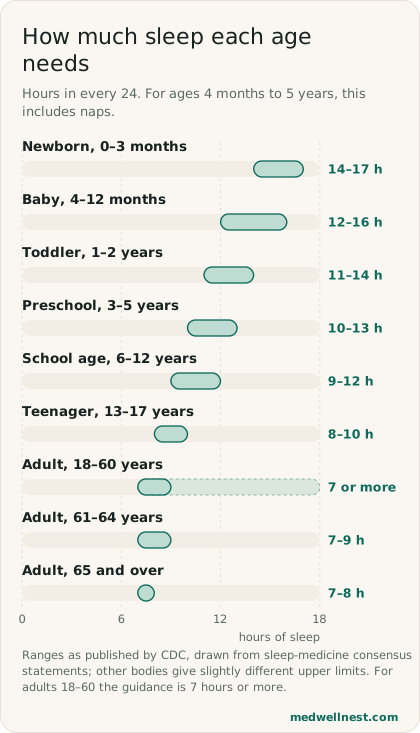
The CDC publishes these ranges, drawn from sleep-medicine expert panels. They are hours in every 24, and for babies and young children they include naps: newborns up to 3 months, 14 to 17 hours; babies 4 to 12 months, 12 to 16 hours; toddlers 1 to 2 years, 11 to 14 hours; children 3 to 5 years, 10 to 13 hours; children 6 to 12 years, 9 to 12 hours; teenagers 13 to 17 years, 8 to 10 hours.
For adults the advice is 7 or more hours a night from 18 to 60, 7 to 9 hours from 61 to 64, and 7 to 8 hours from 65 onwards. Research funded by the National Heart, Lung, and Blood Institute (NHLBI) found that adults who regularly get 7 to 8 hours a night have a lower risk of obesity and high blood pressure.
02
Why different sources give different numbers
If you have seen slightly different figures elsewhere, you are not imagining it. The National Sleep Foundation cuts the age bands differently and gives different upper limits: about 12 to 15 hours for babies 4 to 11 months, rather than 12 to 16; nine to 11 hours for children 6 to 13, rather than 9 to 12; and seven to nine hours for adults 18 to 64.
The American Academy of Sleep Medicine (AASM) sets no range at all for babies under 4 months, because normal sleep at that age varies so widely. The newborn figure of 14 to 17 hours comes from the National Sleep Foundation. The practical message does not change: the ranges overlap far more than they differ.
03
Signs you are not getting enough
NHLBI says too little sleep can leave you very tired during the day and not refreshed when you wake. A useful test is whether you often feel you could doze off while sitting still in a meeting or classroom, or on a car ride of an hour. You may also find it harder to focus, remember things, make decisions and manage your mood, and you may be slower and make more mistakes.
Short nights add up. NHLBI says that after several nights of losing even 1 to 2 hours of sleep a night, you function as if you had not slept at all for a day or two. You may also have microsleeps, brief moments of sleep while you are meant to be awake, which you cannot control and may not notice. Many people who are short of sleep do not realise it and think they are coping.
Over time, too little sleep is linked to heart disease, high blood pressure, diabetes, obesity, stroke and depression. When you are short on sleep, the hormones that control hunger shift so that you feel hungrier, and your blood sugar runs higher than normal.
04
Children and teenagers
Children do not always look sleepy when they are short of sleep. NHLBI says they may instead be overly active, struggle to pay attention, misbehave, have mood swings or seem sad or unmotivated, and their school work can suffer. The AASM links regularly sleeping less than recommended with attention, behaviour and learning problems, and with a higher risk of accidents, injuries, high blood pressure, obesity, diabetes and depression.
Teenagers face a specific problem. In puberty, the CDC notes, the body clock commonly shifts so that teens become sleepy later at night and need to sleep later in the morning. Early school start times then cut the night short. A CDC report found that only about 31% of high school students got 8 or more hours on an average school night, a share that had barely changed since 2007. In teenagers, the AASM links too little sleep with a higher risk of self-harm, suicidal thoughts and suicide attempts.
The same report points to televisions, computers and phones in the bedroom and irregular bedtimes as part of the problem. NHLBI suggests a set bedtime and routine for children, and keeping weekend sleep times within about an hour of weekdays. The advice itself has moved over time: a 2014 statement from the American Academy of Pediatrics cited 8.5 to 9.5 hours for teenagers, while the current AASM range, which the academy has endorsed, is 8 to 10.
05
Where naps fit in
For babies, toddlers and preschoolers, naps are part of the total: the ranges above include daytime sleep. NHLBI says napping is normal in preschool children and supports healthy growth and development. The AASM ranges for school-age children and teenagers do not mention naps, and simply give hours per 24.
For adults, a short nap can boost alertness and performance. NHLBI suggests keeping adult naps to no more than 20 minutes. If you have trouble falling asleep at night, limit naps or take them earlier in the afternoon. And if you regularly feel you could nod off during the day, that sleepiness is itself one of the signs of too little sleep.
06
Getting more sleep, and when to get help
NHLBI suggests going to bed and getting up at the same time every day, keeping the difference between weekdays and weekends to about an hour, and using the hour before bed as quiet time away from bright screens. The effects of caffeine can last up to 8 hours, so tea or coffee late in the afternoon can keep you awake. Avoid heavy meals and alcohol close to bedtime, keep the bedroom quiet, cool and dark, and get outside and active during the day.
Too little sleep is not only about hours. NHLBI counts poor-quality sleep and sleep disorders as part of the same problem. If you or your child sleep the recommended hours but still wake unrefreshed or feel sleepy by day, see a doctor. The AASM advises parents who are worried that a child sleeps too little or too much to ask a doctor to check for a possible sleep disorder.
When to act
Routine — see a doctor
Falling short of your age range now and then: fix a regular bedtime and wake time, cut caffeine after midday, keep screens out of the bedroom, and give it a few weeks.
Same-day — call promptly
Feeling you could doze off while driving, at work or sitting still, or sleeping the recommended hours and still waking unrefreshed: do not drive while drowsy, and see a doctor about a possible sleep disorder.
Emergency — act now
A teenager or adult who talks about self-harm or suicide, or has hurt themselves: stay with them and call emergency services now.
Values mentioned in this story
Each one opens a visual guide with its normal range and what moves it — upload a report and we place your own numbers on the same scale.
Sources
- About Sleep — CDCcdc.gov
- Recommended Amount of Sleep for Pediatric Populations — American Academy of Sleep Medicineaasm.org
- How Sleep Affects Your Health — NHLBInhlbi.nih.gov
- How Many Hours of Sleep Do You Really Need? — National Sleep Foundationthensf.org
- Healthy Sleep Habits — NHLBInhlbi.nih.gov
- School Start Times for Middle School and High School Students — CDC MMWRpmc.ncbi.nlm.nih.gov
Share this story
Curious where your own values stand?
Two minutes from upload to a full visual picture. Free to analyze.