In short
Sleep paralysis is being awake but unable to move or speak as you fall asleep or wake up. The NHS calls it harmless: it happens when REM-sleep muscle paralysis carries on after the brain wakes. It is linked to poor or broken sleep, and worth a doctor's visit if it is frequent or frightening.
Emergency if: One side of your face droops, an arm or leg on one side is weak or numb, or your speech is slurred or confused, whether you notice it on waking or at any other time, or weakness does not wear off within a few minutes once you are fully awake: call emergency services now. The NHS lists these as stroke signs that need help straight away, even if they stop. Sleep paralysis affects the whole body, happens only as you fall asleep or wake up, and ends on its own within seconds to minutes, as the American Academy of Sleep Medicine describes.
On this page
01
What is sleep paralysis, and why can't I move my body when I wake up?
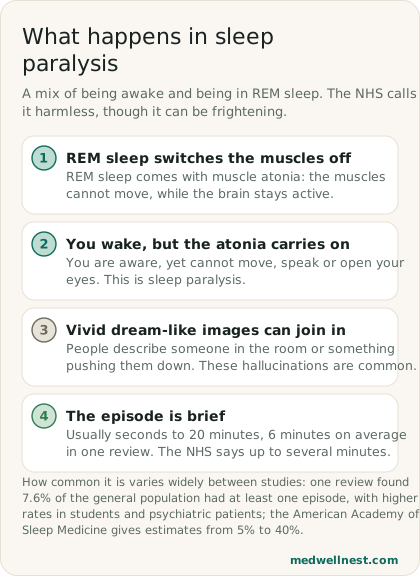
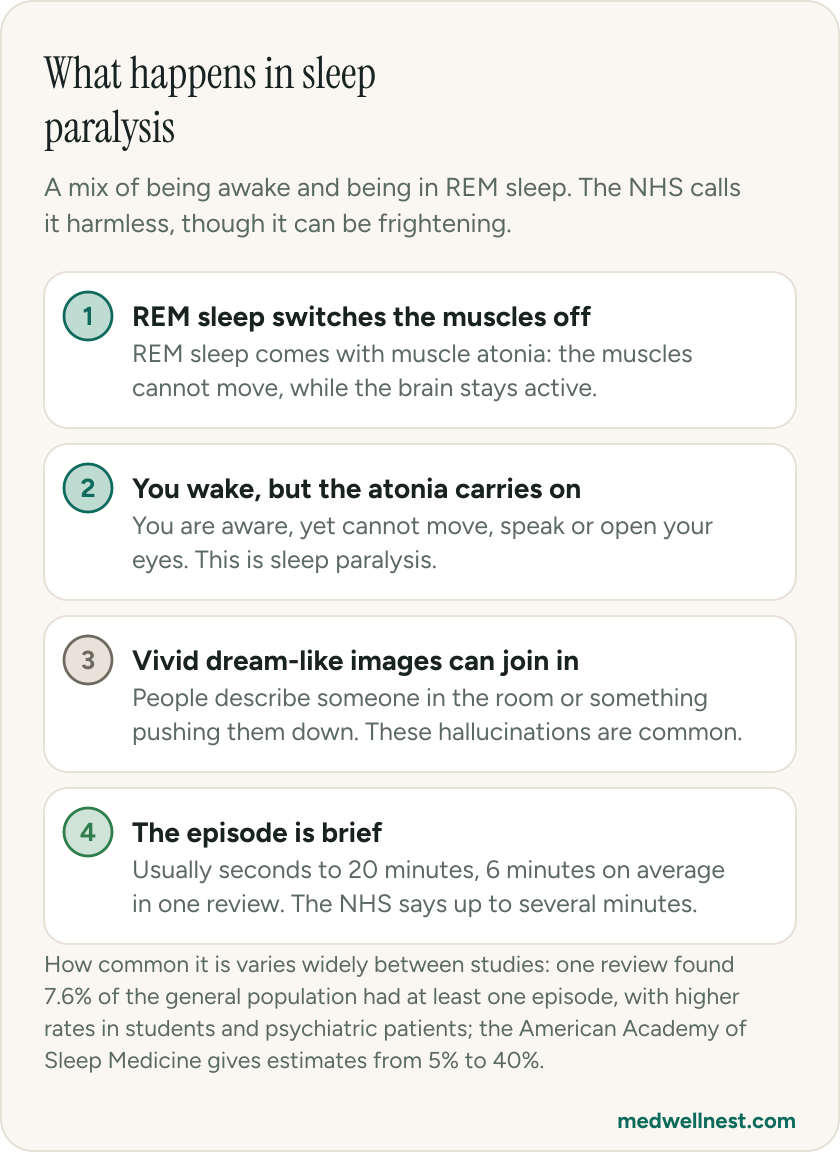
Sleep paralysis is when you cannot move or speak as you are waking up or falling asleep. The NHS says it can be scary but it is harmless. During an episode you may feel awake but unable to move, speak or open your eyes, frightened, and as if someone is in the room or something is pushing you down. The NHS says these feelings can last up to several minutes.
The cause is a timing mismatch. During REM sleep the brain is active but the muscles are switched off, a state called muscle atonia. A clinician's guide in Neuropsychiatric Disease and Treatment describes sleep paralysis as REM-based atonia that carries on into wakefulness: you become aware, but the muscles have not yet switched back on. The NHS puts it simply: you are in sleep mode but your brain is active. The same guide says eye movements stay intact, you may have some control over breathing, and feelings of suffocation are common.
02
Is the feeling of someone pressing on my chest, or a presence in the room, real? Is it a bhoot or a spirit?
Many families explain these experiences as a spirit or a ghost pressing on the sleeper, and the feelings are real and frightening. What medical sources describe is a brain caught between sleep and waking. The NHS lists the usual feelings: someone in the room, something pushing you down, fear. The clinician's guide says episodes are often accompanied by vivid, waking dream-like images, which it calls hallucinations.
The guide says people often feel shame or put the cause down to going mad or to paranormal events, and that beliefs in the paranormal have been linked to sleep paralysis, with the cause probably running in both directions. It also says that, unlike in psychotic illness, hallucinations in sleep paralysis are limited to the moments between sleep and waking, and the person's grip on reality is otherwise intact. Having an episode does not mean you are being haunted or losing your mind.
03
How long does sleep paralysis last, and is it dangerous?
The NHS says the feelings can last up to several minutes and that sleep paralysis is harmless. The clinician's guide describes episodes as usually brief, usually seconds to 20 minutes, with a mean of 6 minutes in the study it cites. The experience can feel much longer because you are frightened and cannot move.
Sleep paralysis itself is not described as harmful by the NHS, and the American Academy of Sleep Medicine says that, although an episode may be frightening, it is not a serious medical risk on its own. What matters is what it may be a sign of. It can be tied to broken sleep, to anxiety conditions, or to narcolepsy, which can cause sudden sleeping or falling, so the pattern of your episodes and how you feel in the day is what a doctor will ask about.
04
Why does sleep paralysis happen? What are the triggers?
The NHS says it is not clear why sleep paralysis happens, but it has been linked with insomnia, disrupted sleeping patterns such as shift work or jet lag, narcolepsy, post-traumatic stress disorder (PTSD), generalised anxiety disorder, panic disorder and a family history of sleep paralysis. The clinician's guide adds that poor or disrupted sleep is associated with it, that it is common in shift workers, and that it is most likely when people sleep on their backs.
The same guide lists medical conditions reported alongside sleep paralysis: narcolepsy, obstructive sleep apnoea, idiopathic hypersomnia, insufficient sleep syndrome, high blood pressure, alcohol use and Wilson's disease. These are associations, not proof that one causes the other, and many people who have a single episode have none of them.
05
How common is sleep paralysis? Why do studies give different numbers?
Studies disagree widely. The American Academy of Sleep Medicine calls sleep paralysis a fairly common sleep problem and says estimates of how many people have it vary widely, from 5% to 40%. The clinician's guide cites a review of 35 studies with 36,533 people that found 7.6 percent of the general population had at least one episode in their lifetime, with higher rates in students (28.3 percent) and psychiatric patients (31.9 percent).
The guide explains why: studies define sleep paralysis differently and use different questionnaires or interviews. It also says people are often reluctant to mention episodes because of embarrassment. So the safest reading is that sleep paralysis is common, that the true share is uncertain, and that you are far from alone.
06
How do I stop sleep paralysis? What can I do at night?
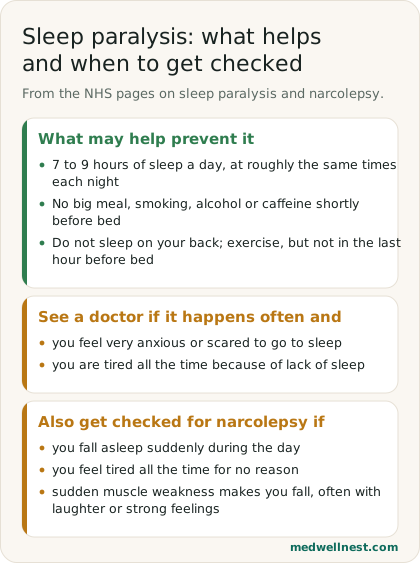
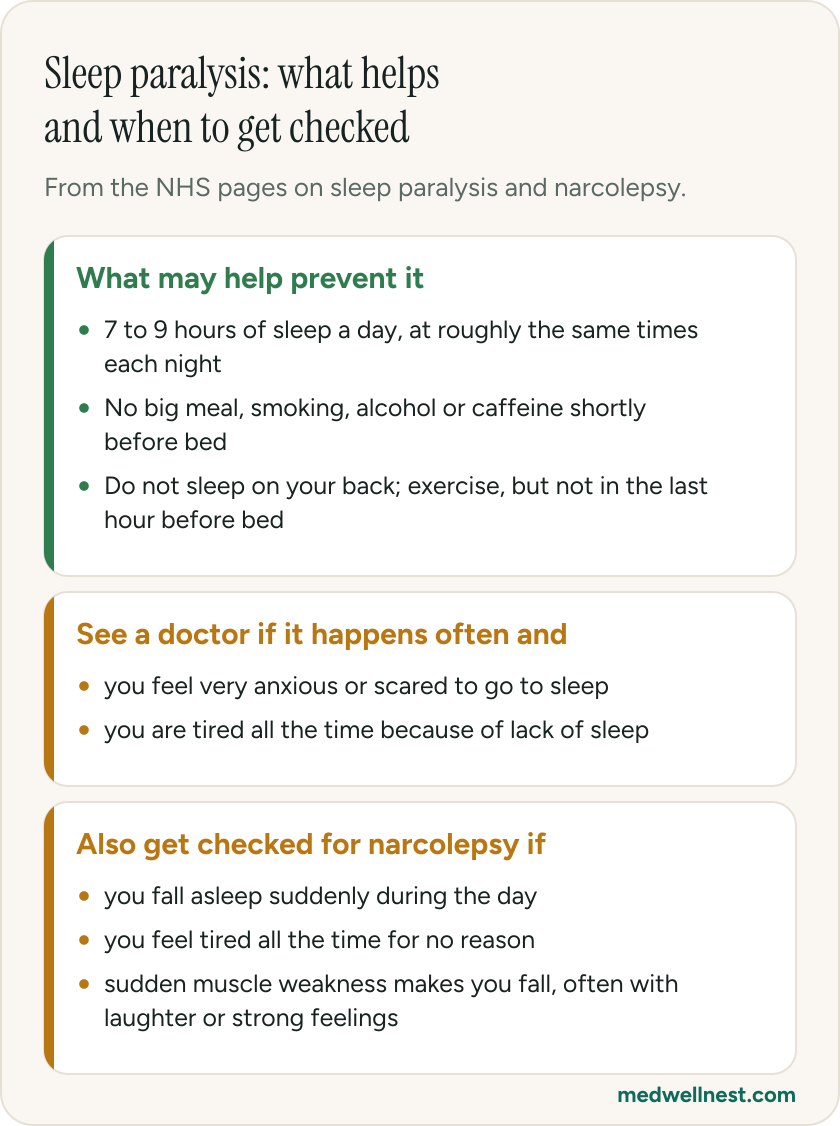
The NHS says you may be able to prevent it by changing your sleeping habits. Try to get 7 to 9 hours of sleep a day, go to bed at roughly the same time each night and get up at the same time each morning, and exercise regularly but not in the last hour before bed. Do not eat a big meal, smoke, or drink alcohol or caffeine shortly before bed, and do not sleep on your back, which can make sleep paralysis more likely.
If it keeps happening, treating a trigger can help: the NHS says a doctor may treat an underlying condition such as insomnia or PTSD, and may refer you to a sleep specialist, who might offer a medicine usually used for depression, taken at a lower dose, or cognitive behavioural therapy (CBT). The clinician's guide notes that no randomised trial has yet tested treatments for recurrent isolated sleep paralysis, so advice rests on smaller studies and expert experience.
07
Could it be narcolepsy? When should I see a doctor for sleep paralysis?
You do not normally need medical help for sleep paralysis, says the NHS, unless it is affecting your mental health or your sleep. See a doctor if you often have it and you feel very anxious or scared to go to sleep, or you are tired all the time because of lack of sleep.
Sleep paralysis on its own does not mean narcolepsy, which the NHS calls rare. Get checked if you also fall asleep suddenly during the day, feel tired all the time for no reason, or have sudden muscle weakness that makes you fall, often set off by laughter or strong feelings (cataplexy). The clinician's guide says cataplexy and excessive daytime sleepiness are the features that separate narcolepsy from isolated sleep paralysis. The NHS adds that narcolepsy is not usually harmful but can cause accidents or injuries, so tell the doctor about any sudden sleep attacks. Weakness on one side of the body, a drooping face or slurred speech is not sleep paralysis: call emergency services.
When to act
Emergency — act now
One side of your face droops, an arm or leg on one side is weak or numb, or your speech is slurred or confused, whether you notice it on waking or at any other time, or weakness does not wear off within a few minutes once you are fully awake: call emergency services now. The NHS lists these as stroke signs that need help straight away, even if they stop. Sleep paralysis affects the whole body, happens only as you fall asleep or wake up, and ends on its own within seconds to minutes, as the American Academy of Sleep Medicine describes.
Routine — see a doctor
You often have sleep paralysis and you feel very anxious or scared to go to sleep, or you are tired all the time because of lack of sleep: see a doctor. The NHS says a doctor can treat a trigger such as insomnia or PTSD and may refer you to a sleep specialist. Keep a short diary of when episodes happen to bring with you.
Along with sleep paralysis you fall asleep suddenly during the day, feel tired all the time for no reason, or have sudden muscle weakness that makes you fall: get checked for narcolepsy. The NHS says narcolepsy can cause accidents or injuries and may call for extra safety measures, so mention it before driving or doing risky work if sudden sleep attacks are happening.
Sources
Share this story
Curious where your own values stand?
Two minutes from upload to a full visual picture. Free to analyze.