In short
Most children say at least 1 word by 1 year and about 50 to 100 words with several 2-word phrases by 2 years, yet 1 in 5 talk later. Tell a doctor if your child loses words or skills, does not babble by 1 year or has no words by 2 years, and ask for a hearing test.
On this page
01
At what age do babies start talking?
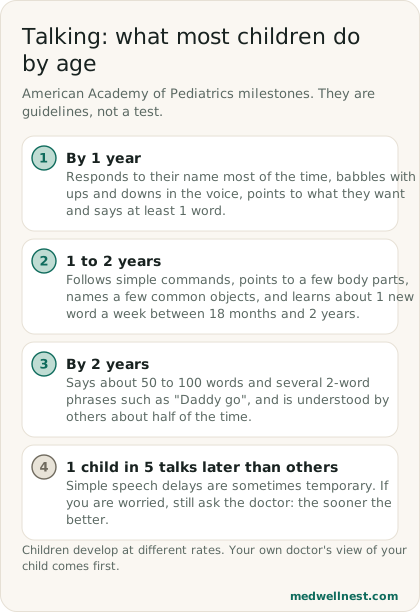
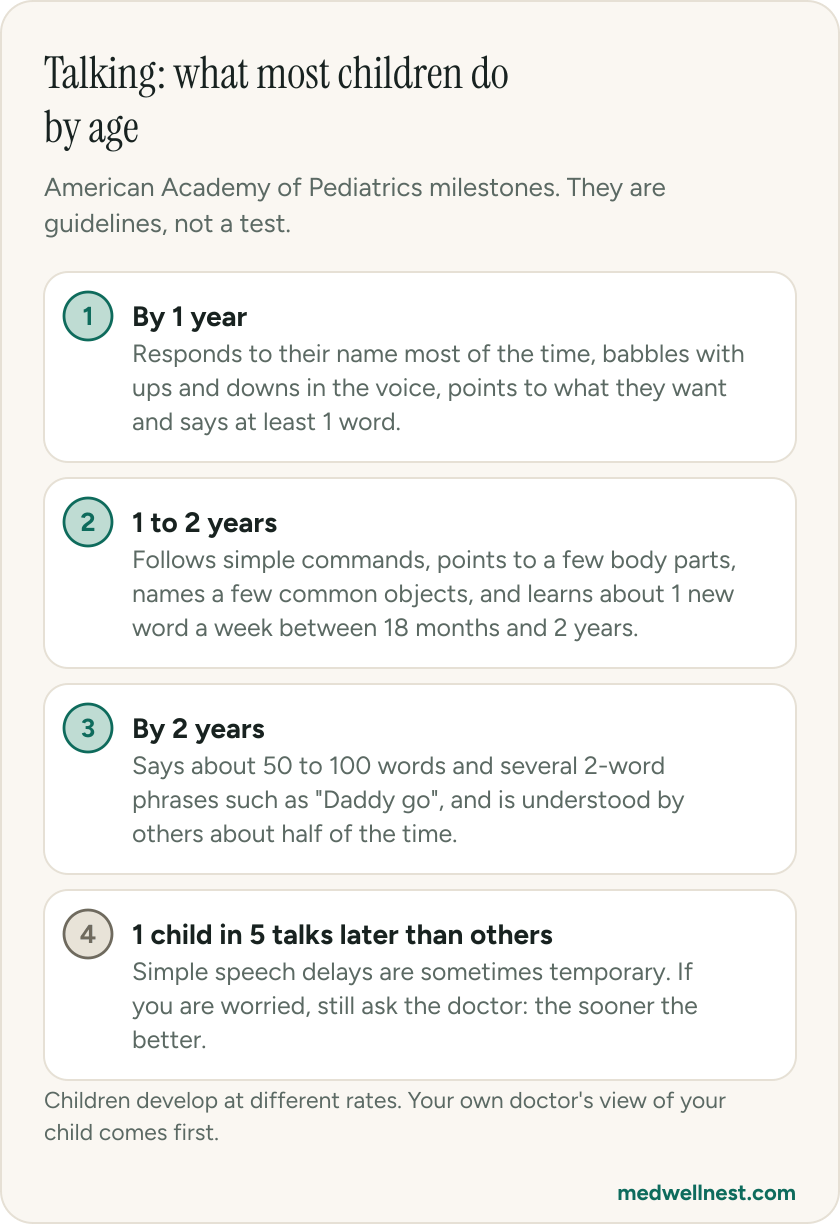
The American Academy of Pediatrics gives these as general milestones and stresses that children develop at different rates and that they are only guidelines. By 1 year most babies respond to their name most of the time, wave goodbye, babble with the voice rising and falling as if speaking in sentences, say "da-da" and "ma-ma", say at least 1 word, and point to things they want. Between 1 and 2 years most toddlers follow simple commands, point to a few body parts, name a few common objects and learn about 1 new word a week between 18 months and 2 years.
By 2 years the Academy says most toddlers say about 50 to 100 words, say several 2-word phrases such as "Daddy go" and "All gone", perhaps say a few 3-word sentences, and are understood by others about half the time. It also says delays in language are the most common type of developmental delay, that 1 child in 5 learns to talk or use words later than other children their age, and that simple speech delays are sometimes temporary.
02
My child is 2 and says only mummy and papa. Is that normal?
It is below what the American Academy of Pediatrics describes for most 2-year-olds, which is about 50 to 100 words and several 2-word phrases. That does not mean something is wrong, because it says 1 in 5 children talk later and some catch up on their own or with a little help from family. It does mean the child is worth having checked, and the Academy says that if you have any question about your child's development you should ask the doctor, the sooner the better.
NHS speech and language therapists give a similar marker. A children's hospital service in the NHS says to refer by 2 years if a child is not attempting to use any words, is not interacting with familiar adults, or needs a lot of extra cues such as gestures to understand simple naming words. Sources differ on word counts: another hospital leaflet says that around age 2 a child will probably have a core vocabulary of about one to two hundred words. That is why this story gives the American Academy of Pediatrics range and says it is a guide, not a cut-off.
03
What are the warning signs of a speech delay?
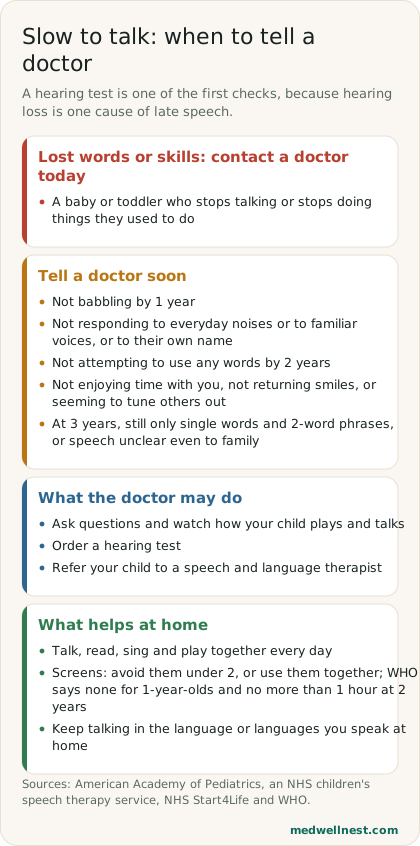
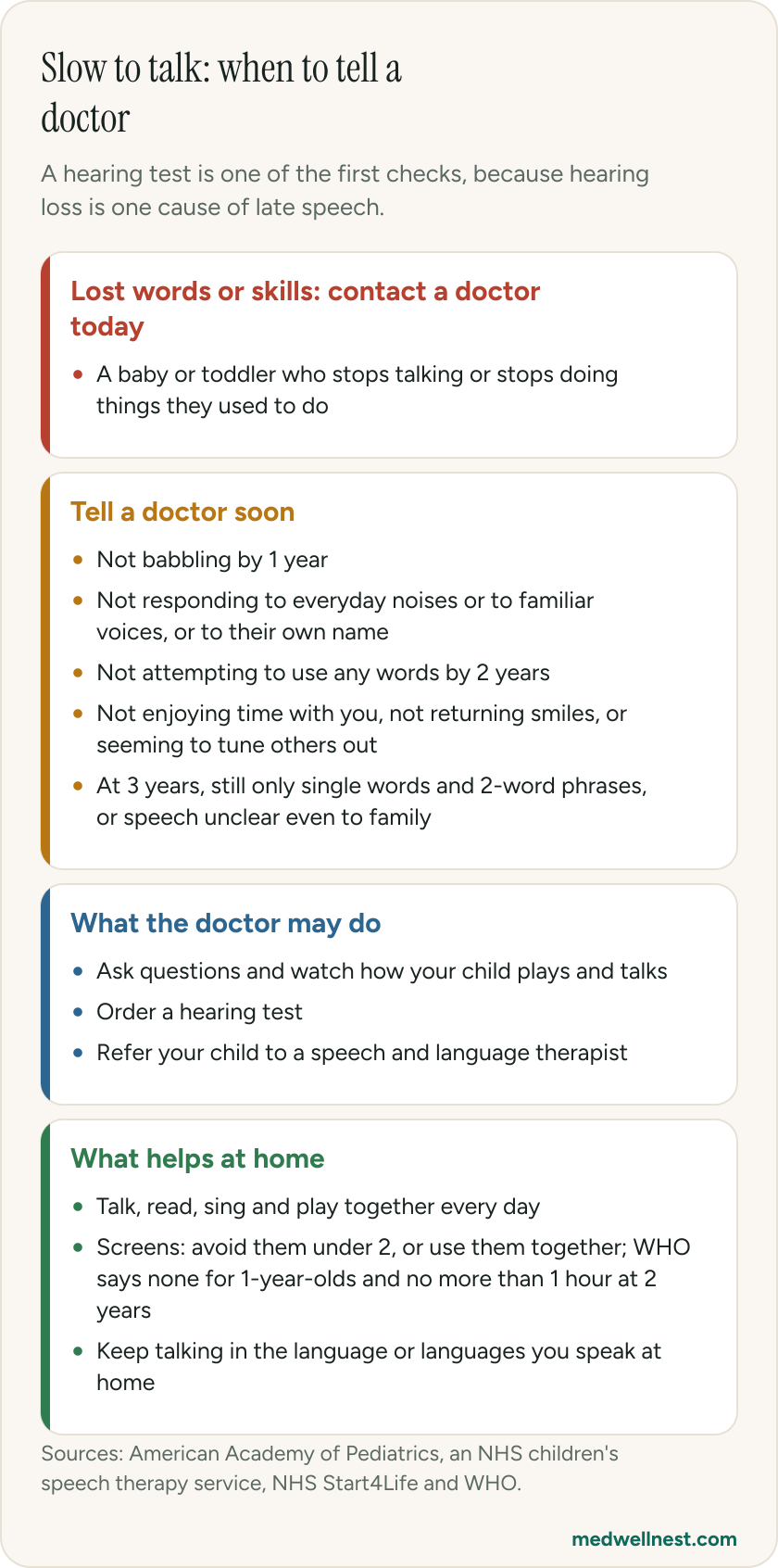
Some signs matter whatever the child's age. The American Academy of Pediatrics says to tell your child's doctor if your baby stops talking or doing things he or she used to do, and its list of behaviours to mention also includes not cuddling like other babies, not returning a happy smile, not seeming to notice if you are in the room, not seeming to notice certain noises such as the sound of their own name, preferring to play alone as if tuning others out, being able to say the alphabet or TV jingles but not use words to ask for things, and repeating scripts from TV.
The NHS hospital service gives age checkpoints. It says to refer by 1 year if a child is not babbling, which it describes as playing with sounds, is not responding to everyday noises and familiar voices, is not enjoying interacting with a parent, or has difficulties with eating or drinking. By 3 years it says to refer if a child is using only single words and 2-word phrases, or if speech is unclear even to familiar adults. The American Academy of Pediatrics says sometimes delays go with hearing loss, delay in other areas of development, an autism spectrum disorder, or a learning problem that shows later, so it is important to have your child evaluated if you are concerned.
04
Should my child's hearing be tested first?
Hearing is checked early because it is a treatable reason for late speech. The American Academy of Pediatrics says the doctor may order a hearing test and refer you to a speech and language therapist, who looks both at what your child says and at what your child understands. If both understanding and speech are delayed and the hearing test is normal, it says further evaluation is needed to find out whether the cause is a communication disorder, general developmental delay, autism or something else.
The NHS hospital service says that a baby who is not responding to everyday noises and familiar voices should be referred to audiology as well as speech therapy. If your child often seems not to hear you, or you already worry about hearing, say so at the first visit. Our story on hearing loss explains what a hearing test shows.
05
Do screens or speaking two languages cause a speech delay?
The sources we read do not say that screens cause a speech delay, but they do set limits. The NHS says to avoid screen time for a baby or toddler under 2 and, if you do use screens, to use them for shared activities that encourage bonding and interaction. WHO says sedentary screen time is not recommended for 1-year-olds, should be no more than 1 hour for 2-year-olds with less being better, and that interactive time with a caregiver, such as reading, storytelling and singing, is very important for child development.
On two languages, the American Speech-Language-Hearing Association says being multilingual is not a communication disorder, and that signs of a communication disorder show up across all the languages a person uses. The NHS says to keep chatting with your child in the language or languages you speak at home. We did not find a fetched source that gives word counts for children learning two languages, so this story gives no separate figure; if you are unsure how to count, ask the doctor or therapist.
06
What can I do at home, and what happens at the doctor?
The NHS suggests simple daily routines: name what you are doing at meals and while dressing, describe things with describing words, look at picture books and let your child point, sing songs and rhymes with actions, and follow your child's gaze and talk about what they notice. These are ways to give your child more language, not tests to pass. The American Academy of Pediatrics says to encourage your child to talk with gestures or sounds and to spend lots of time playing with, reading to and talking with your child.
At the doctor, expect questions, a questionnaire or watching your child play, a hearing test and possibly a referral to a speech and language therapist. The American Academy of Pediatrics says that even when there are delays, early help can make a significant difference. If a doctor tells you not to worry but you still are, it says it is fine to get a second opinion.
When to act
Same-day — call promptly
Your child has lost words or skills that were there before, such as babbling, waving, pointing, responding to their name or using words: contact a doctor today to arrange a visit. The American Academy of Pediatrics says to tell your child's doctor if a baby stops talking or doing things they used to do, and that for any developmental worry the sooner the better. If the loss is sudden and comes with a fit, unusual drowsiness, weakness or a fever, go to an emergency department now.
Routine — see a doctor
Your child is not babbling by 1 year, is not attempting any words by 2 years, uses only single words and 2-word phrases at 3 years, does not respond to noises or to their name, or you are simply worried about their speech: book a doctor's visit and ask for a hearing test and, if the doctor agrees, a speech and language assessment. You do not need to wait until your child is older to ask.
Sources
- Language Delays in Toddlers: Information for Parents — American Academy of Pediatrics (HealthyChildren.org)healthychildren.org
- When to be concerned about your child's speech and language development — Evelina London Children's Hospital (NHS)evelinalondon.nhs.uk
- Speech and language development from 12 to 24 months — Great Ormond Street Hospital (NHS)gosh.nhs.uk
- First words and little sentences: 1 to 2 years — NHS Start4Lifenhs.uk
- To grow up healthy, children need to sit less and play more — WHOwho.int
- Bilingual service delivery — American Speech-Language-Hearing Associationasha.org
Share this story
Curious where your own values stand?
Two minutes from upload to a full visual picture. Free to analyze.