In short
WHO advises against sweeteners for weight control but says that does not apply to people with diabetes. The ADA says they can replace sugar in moderation and for the short term. Aspartame is classed possibly carcinogenic (IARC 2B) while its daily intake limit was unchanged.
Emergency if: High sugar in someone with diabetes, with feeling or being sick, stomach pain, breathing faster than usual or a fast heartbeat, drowsiness or struggling to stay awake, a fruity smell on the breath, confusion or a high ketone level: call emergency services now or go to an emergency department now. The NHS says not to drive yourself.
On your report
HbA1c, Fasting Glucose
On this page
01
Is sugar-free safe for people with diabetes?
For most people, the main authorities say sweeteners can be used with care, and none of them says they are a health food. The American Diabetes Association (ADA) 2026 Standards say non-nutritive sweeteners can be used in place of sugar-sweetened products if consumed in moderation and for the short term, to reduce overall calorie and carbohydrate intake. The NHS says approved sweeteners go through a rigorous safety assessment and are considered a safe and acceptable alternative to sugar.
The same sources are cautious about what sweeteners cannot do. The NHS says lower and no-calorie sweeteners will not necessarily make a food or drink healthy, and the ADA says water is the healthiest drink and recommends choosing water over other beverages. Sweeteners are a swap for sugar, not a goal.
02
What does the WHO advice on sweeteners say, and does it apply to people with diabetes?
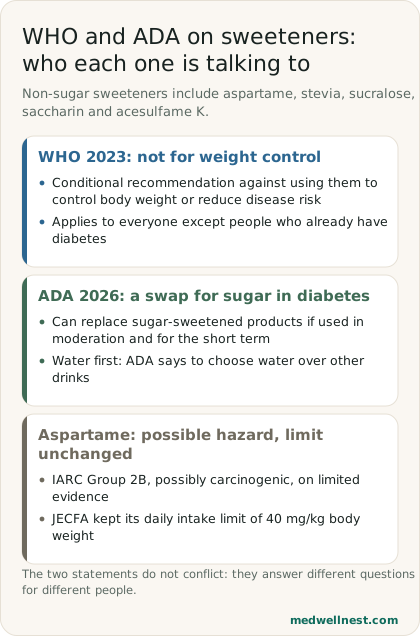
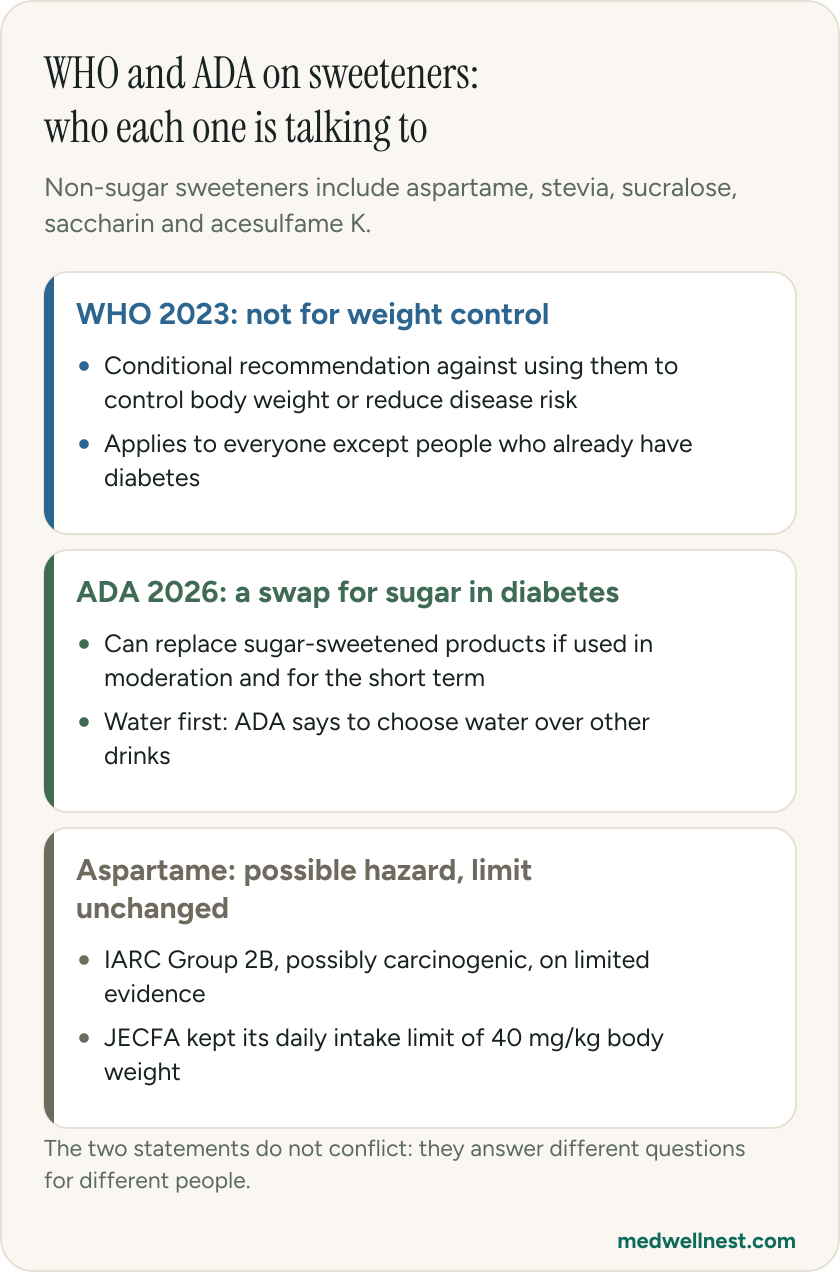
In May 2023 the World Health Organization (WHO) issued a conditional recommendation against using non-sugar sweeteners to control body weight or reduce the risk of noncommunicable diseases. It was based on a systematic review that found no long-term benefit for reducing body fat in adults or children, and possible undesirable effects from long-term use, such as a higher risk of type 2 diabetes, cardiovascular disease and death in adults.
The recommendation applies to all people except those with pre-existing diabetes. WHO also says the link seen between sweeteners and disease might be confounded by the characteristics of the people studied and by complicated patterns of use, which is why the recommendation is conditional. It covers acesulfame K, aspartame, advantame, cyclamates, neotame, saccharin, sucralose, stevia and stevia derivatives, and does not cover low-calorie sugars and sugar alcohols (polyols). WHO's wider message is to reduce the sweetness of the diet altogether, for example by choosing fruit or unsweetened food and drinks.
03
What does the ADA say people with diabetes can do?
The ADA's recommendation 5.22 says to counsel people with diabetes and those at risk that sweeteners can replace sugar-sweetened products if used in moderation and for the short term. Its text says they do not appear to have a significant effect on glycaemic management, and that they can reduce overall calorie and carbohydrate intake as long as people do not make up the calories from other foods. Moderation, it says, means no more than the acceptable daily intake.
The ADA also says adding sweeteners to an eating plan brings no benefit for weight loss or for limiting weight gain unless energy intake is also cut, and that evidence on weight is mixed. Recommendation 5.25 says to replace sugar-sweetened drinks, including any juices, with water or low-calorie or no-calorie drinks and to minimise foods with added sugar. So WHO and the ADA do not disagree: WHO speaks to the general public about weight control and disease prevention, and the ADA speaks to people with diabetes about swapping out sugar.
04
Does aspartame cause cancer? What did IARC and JECFA say in 2023?
In July 2023 two WHO-linked bodies published separate assessments. The International Agency for Research on Cancer (IARC) classified aspartame as possibly carcinogenic to humans (Group 2B), citing limited evidence for cancer in humans, specifically a type of liver cancer, and limited evidence in animals. Group 2B is the third highest of 4 levels. IARC says its classes reflect how strong the evidence is that something can cause cancer, not the risk of getting cancer at a given exposure.
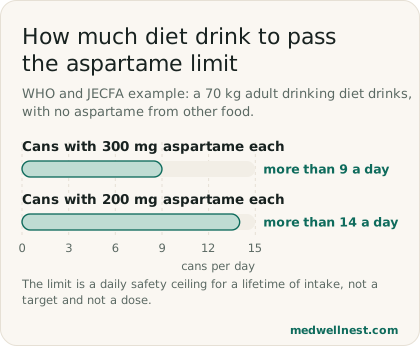
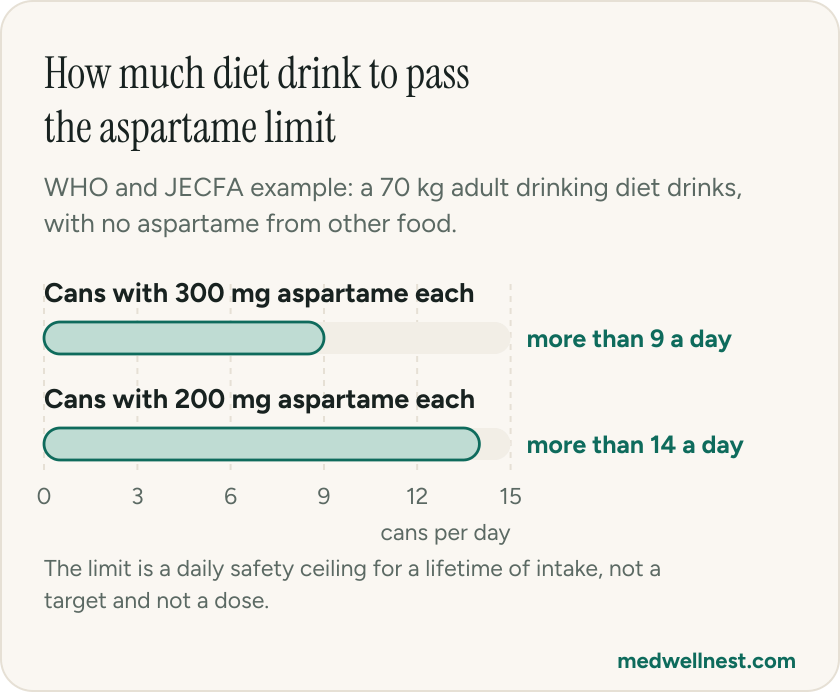
The Joint FAO/WHO Expert Committee on Food Additives (JECFA) looked at risk and found no sufficient reason to change the acceptable daily intake of 40 mg/kg body weight. JECFA said the evidence of an association between aspartame and cancer in humans is not convincing. WHO's example is for an adult weighing 70 kg who gets no aspartame from other foods: if each can of diet soft drink contains 200 milligrams of aspartame, it would take more than 14 cans a day to go over the limit, and if each can contains 300 milligrams, more than 9 cans a day. The limit is a safety ceiling for a lifetime of daily intake, not a target and not a dose, and WHO called for better and longer studies.
People with phenylketonuria (PKU), a rare inherited condition, should not take aspartame, the NHS says, because it contains phenylalanine. Products with aspartame carry a separate label warning about a source of phenylalanine.
05
Are stevia, sucralose and sugar alcohols different?
WHO groups stevia, sucralose, saccharin, acesulfame K and the others together as non-sugar sweeteners. The sources we read give no separate advice for stevia, so we cannot rank one sweetener above another. Sugar alcohols such as sorbitol, xylitol and erythritol are outside WHO's recommendation because they contain calories, and the NHS says they can have a laxative effect in large amounts.
A sweetener on the label does not tell you the rest of the product. The NHS says sweeteners will not necessarily make a food or drink healthy, and Diabetes UK says food labels are the best way to see how much sugar a product has. Read the ingredients and the rest of the label, not only the words sugar-free.
06
What should I do in practice?
Start with water. The ADA recommends water over other drinks. If you currently drink sugary drinks, Diabetes UK suggests diet fizzy drinks or no-added-sugar squash instead, or water with mint or lemon, and the ADA says people with overweight or obesity and diabetes may use low-calorie or no-calorie products so they do not feel deprived. Keep that for everyday drinks. Diabetes UK says sugary drinks are best used as a treatment for low blood sugar, and that for some people with diabetes sugary drinks or glucose tablets are essential to treat a low. Our hypoglycaemia story explains how.
WHO's advice to reduce sweetness overall is worth taking seriously, because it points to a habit that sweeteners can keep alive. If you want to cut back, do it slowly, and ask your doctor or dietitian what fits your diabetes, medicines and weight goals. A craving for sweets together with being very thirsty, passing a lot of urine or losing weight is not a sweetener question: it needs a blood sugar check.
Sweeteners, sugar and diabetes: how fast to act
Emergency — act now
High sugar in someone with diabetes, with feeling or being sick, stomach pain, breathing faster than usual or a fast heartbeat, drowsiness or struggling to stay awake, a fruity smell on the breath, confusion or a high ketone level: call emergency services now or go to an emergency department now. The NHS says not to drive yourself.
Same-day — call promptly
Feeling very thirsty, peeing a lot, feeling weak or tired, blurred vision or losing weight, especially if you have not been diagnosed with diabetes, or if sugar stays high despite trying to lower it: see a doctor today for a blood sugar test.
Routine — see a doctor
You have phenylketonuria, or you get loose stools after sugar-free sweets or gum that contain sugar alcohols, or you want to switch sweeteners or cut back: check labels and ask your doctor or dietitian.
Values mentioned in this story
Each one opens a visual guide with its normal range and what moves it — upload a report and we place your own numbers on the same scale.
Sources
- WHO advises not to use non-sugar sweeteners for weight control in newly released guideline — WHOwho.int
- Aspartame hazard and risk assessment results released — WHO, IARC and JECFAwho.int
- Standards of Care in Diabetes 2026, section 5: Facilitating Positive Health Behaviors — American Diabetes Associationpmc.ncbi.nlm.nih.gov
- The truth about sweeteners — NHSnhs.uk
- Sugar and diabetes — Diabetes UKdiabetes.org.uk
- High blood sugar (hyperglycaemia) — NHSnhs.uk
Share this story
Curious where your own values stand?
Two minutes from upload to a full visual picture. Free to analyze.