In short
A Mantoux or IGRA asks whether you have ever been infected. A sputum test asks whether you have TB now, and CBNAAT or Truenat also asks whether the usual medicines will work. Here is how to read each result and when a cough needs testing.
Emergency if: Coughing up more than a few spots or streaks of blood, or coughing blood with difficulty breathing, a very fast heartbeat, or pain in your chest or upper back: get emergency care now.
On your report
HbA1c
On this page
01
Infection is not the same as disease
The WHO estimates that about a quarter of the world's population has been infected with TB bacteria. Most of them never fall ill: people with TB infection do not feel sick and cannot spread it, and about 5% to 10% eventually develop TB disease. Diabetes, HIV and other causes of weak immunity, undernutrition, smoking and heavy drinking raise that risk.
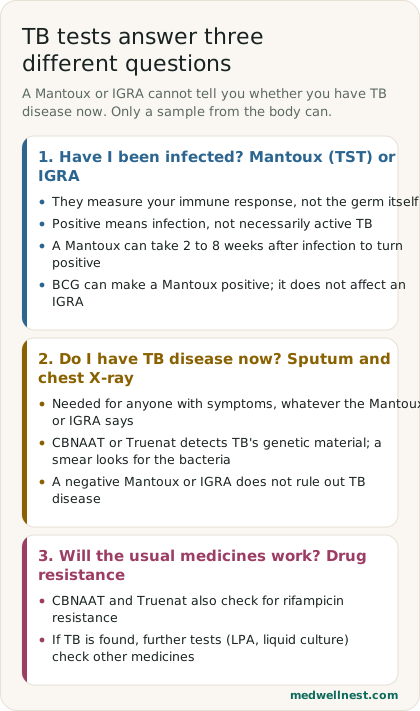
This is why TB tests confuse people. A Mantoux or IGRA looks for your immune system's memory of the bacteria, so it answers whether you have ever been infected. It cannot say whether you have active TB now. Only a sample from the body, usually sputum, plus a chest X-ray can answer that. And a third question, whether the usual medicines will work, needs a test for drug resistance. For the disease itself and its treatment, see Tuberculosis: A Global Disease That Responds Well When the Full Course Is Finished.
02
The Mantoux test: reading the millimetres
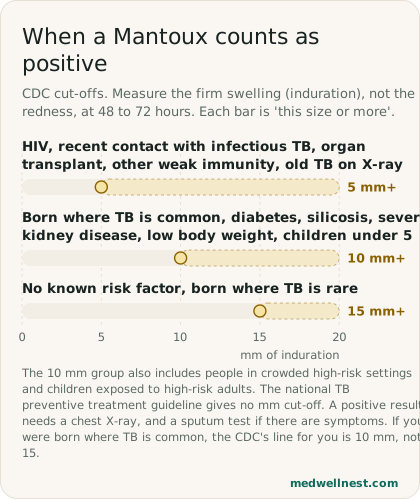
A small amount of tuberculin is injected into the skin of the forearm, and a trained reader checks it 48 to 72 hours later. The CDC says to measure the induration, the firm, raised swelling across the arm, in millimetres, and not the redness. If you miss the reading window, the test has to be repeated.
What counts as positive depends on your risk. The CDC uses 5 mm or more for people with HIV, recent contacts of someone with infectious TB, people with an organ transplant or other weak immunity, and people whose X-ray shows old TB. It uses 10 mm or more for people born in countries where TB is common, and for diabetes, silicosis, severe kidney disease, low body weight, children under 5 and people in crowded high-risk settings. For someone with no risk factor, the line is 15 mm, but being born where TB is common is itself a 10 mm risk factor, so for most readers here the line is 10 mm. The national TB preventive treatment guideline does not set a millimetre cut-off of its own.
The CDC lists the traps. BCG vaccination can make a Mantoux positive, and there is no reliable way to tell a BCG reaction from infection. A test done within 8 to 10 weeks of infection, in a baby under 6 months, after a live vaccine such as measles, or in someone very ill with TB itself can be falsely negative.
03
IGRA: the blood test
An interferon-gamma release assay (IGRA) mixes your blood with proteins from TB bacteria and measures the immune response. It needs one visit instead of two, and the CDC says BCG vaccination does not make it positive, which is why it prefers IGRA for people who have had BCG. The national preventive treatment guideline agrees that IGRA is specific even in BCG-vaccinated people, but notes it needs a laboratory and costs more than a Mantoux.
The limits are much the same as the skin test's. A positive result means infection rather than disease. The national guideline warns that a negative result from either test can miss infection in young children and in people infected recently, and that a positive result does not reliably predict who will go on to develop TB. The CDC adds that a negative test does not rule out TB disease. Once either test has been positive, repeating it adds little, because most people stay positive.
The national programme does not require either test before offering TB preventive treatment to people living with HIV or to children under 5 who live with someone with lung TB.
04
CBNAAT and Truenat: active TB and drug resistance
Under the national TB elimination programme, anyone with a cough of more than 2 weeks, with or without other symptoms, counts as presumptive TB and should have their sputum tested. Where laboratories have been upgraded, a rapid molecular test called a nucleic acid amplification test (NAAT), such as CBNAAT or Truenat, is offered upfront. People with HIV, children after an X-ray, and people with TB outside the lungs are sent straight for NAAT. The WHO recommends rapid tests like these as the first test for anyone with TB symptoms, with results within 48 hours.
A NAAT does two jobs at once. It reports whether TB was detected and, if so, whether the bacteria resist rifampicin, one of the two main TB medicines. The programme offers this rifampicin check to every newly notified patient. If TB is found, the second sample goes on for further tests, line probe assay (LPA) and liquid culture, to check other medicines. TB that resists both rifampicin and isoniazid is called multidrug-resistant TB (MDR-TB).
A negative sputum test is not always the end. If both the chest X-ray and sputum are negative but your doctor still suspects TB, the programme's algorithm refers you to a chest physician.
05
Giving a good sputum sample
The test is only as good as the sample. The programme's guidance describes a good specimen as material coughed up from deep in the chest, not saliva or mucus from the nose and throat, and 2 to 5 ml in volume. Rinse your mouth with clean water first, then cough up phlegm from deep in your chest into the sterile container you are given. The sample should reach the laboratory as soon as possible after it is collected.
You will usually be asked for two samples, because under upfront NAAT one is tested straight away and the other is kept for the follow-up tests if TB is found.
06
The 2-week cough rule and the warning signs
The WHO lists the common symptoms of TB: a long-lasting cough, sometimes with blood, chest pain, weakness, tiredness, weight loss, fever and night sweats. They can stay mild for months, which is how TB spreads before anyone notices. Under the national programme, a cough of more than 2 weeks is the trigger for testing.
Coughing up blood always needs checking. The NHS says a few spots or streaks of blood in phlegm need a doctor the same day, while coughing up more than a few spots or streaks, or blood with difficulty breathing, a very fast heartbeat, or pain in the chest or upper back, needs emergency care.
If TB is confirmed, treatment usually means taking medicines every day for 4 to 6 months. The WHO warns that stopping early is dangerous, because it can make the bacteria resistant.
When to act
Emergency — act now
Coughing up more than a few spots or streaks of blood, or coughing blood with difficulty breathing, a very fast heartbeat, or pain in your chest or upper back: get emergency care now.
Same-day — call promptly
A few small spots, flecks or streaks of blood in your phlegm: see a doctor today.
Routine — see a doctor
A cough of more than 2 weeks, or weight loss, fever or night sweats that do not go away: see a doctor and ask for a sputum test. If you live with someone who has lung TB, ask about screening and preventive treatment.
Values mentioned in this story
Each one opens a visual guide with its normal range and what moves it — upload a report and we place your own numbers on the same scale.
Sources
- Clinical Testing Guidance for Tuberculosis: Tuberculin Skin Test — CDCcdc.gov
- Tuberculosis — WHO fact sheetwho.int
- Guidelines for Programmatic Management of TB Preventive Treatment, 2021 (listed on the Central TB Division guidelines page)tbcindia.mohfw.gov.in
- Diagnostic Algorithm for TB Disease in NTEP — NTEP Knowledge Basentep.in
- Principles of TB Diagnosis under NTEP — NTEP Knowledge Basentep.in
- Coughing up blood — NHSnhs.uk
Share this story
Curious where your own values stand?
Two minutes from upload to a full visual picture. Free to analyze.