In short
A sputum AFB smear counts TB-type bacteria under a microscope, and the grade tells how many were seen. Here is what negative, scanty, 1+, 2+ and 3+ mean, why a negative smear does not rule out TB, why a molecular test such as CBNAAT comes next, and where testing and treatment are free.
Emergency if: Coughing up more than a few teaspoons of blood, or blood in the cough with severe breathlessness, chest pain, dizziness, light-headedness, fever, or blood in the urine or stools: go to an emergency department now.
On your report
HbA1c
On this page
01
What the sputum AFB test looks for
AFB stands for acid-fast bacilli, the group of rod-shaped germs that TB bacteria belong to. The lab spreads your sputum, the phlegm you cough up from deep in the chest, on a glass slide, stains it and counts the bacilli under a microscope. The test is often written as sputum for AFB or sputum smear.
Under the national TB programme, a cough of more than 2 weeks, with or without other TB symptoms, makes a person presumptive TB, and they are referred for a sputum test. WHO lists the common symptoms of TB as a prolonged cough, sometimes with blood, chest pain, weakness, tiredness, weight loss, fever and night sweats. It also lists diabetes, HIV, undernutrition, tobacco and alcohol as things that raise the risk of TB disease, so if you have diabetes, keep it checked while you are being tested and treated.
02
Two samples, and one of them early in the morning
The programme's standard is two sputum samples. One is a spot sample, given at the testing centre. For the other you are given a labelled container to take home: early in the morning, rinse your mouth with water, cough sputum into it, and bring it to the centre, where the spot sample can also be collected.
What you cough up matters: the lab needs phlegm from deep in the chest, not saliva from the mouth. The programme asks for samples to be collected in an open, well-ventilated area, so cough outdoors or near an open window, away from other people.
03
Reading the grade: scanty, 1+, 2+, 3+
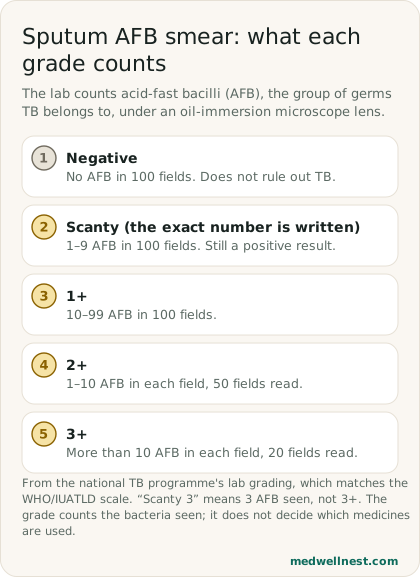
The lab reports how many bacilli it saw and in how many microscope fields. The national TB programme's grading, which matches the WHO and IUATLD scale, is: negative, no AFB in 100 fields; scanty, 1–9 AFB in 100 fields, with the exact number written; 1+, 10–99 AFB in 100 fields; 2+, 1–10 AFB in each field, with 50 fields examined; and 3+, more than 10 AFB in each field, with 20 fields examined.
Scanty is still positive. A report of scanty 3 means 3 bacilli were seen in 100 fields; it is not the same as 3+. A higher grade means more bacteria were seen in that sample. The grade does not tell you which medicines are needed or whether they will work; that takes a molecular test and, for some medicines, further resistance tests.
04
A negative smear does not rule out TB
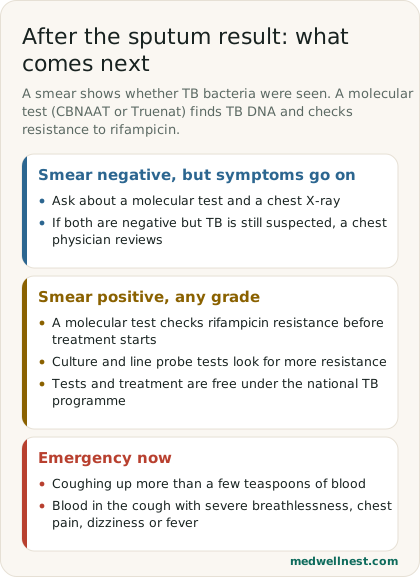
A smear only finds TB when there are enough bacteria in the sample to see, so a negative result does not settle the question if the cough goes on. The programme's diagnostic algorithm says that if both the chest X-ray and the sputum test are negative but the doctor still suspects TB, the patient should be referred to a chest physician for further evaluation.
That is why molecular tests now come first where they are available. WHO recommends rapid tests as the initial test for everyone with signs and symptoms of TB, and says they can give results to guide treatment within 48 hours. The national algorithm says that where labs have been upgraded, a nucleic acid amplification test (NAAT), such as CBNAAT or Truenat, can be offered upfront to everyone with presumed TB, and is offered directly to children, people living with HIV and people with TB outside the lungs.
05
After a positive smear: resistance tests and free treatment
A positive smear is the start of the work-up, not the end. The national algorithm says a NAAT is done to check for rifampicin resistance before treatment starts, and that when TB is detected, the sample goes on for line probe assays and liquid culture with drug susceptibility testing, which look for resistance to other medicines. WHO says detecting multidrug-resistant TB (MDR-TB) needs confirmation of TB and testing for resistance with rapid molecular tests or culture.
The programme provides TB diagnosis and treatment free of cost across the country. WHO describes TB as preventable and treatable, with medicines taken daily for 4–6 months. It warns that stopping them early or without medical advice can make the bacteria resistant, and that drug-resistant TB is treatable with other medicines. Our TB guide covers treatment and protecting the people you live with.
When to act
Emergency — act now
Coughing up more than a few teaspoons of blood, or blood in the cough with severe breathlessness, chest pain, dizziness, light-headedness, fever, or blood in the urine or stools: go to an emergency department now.
Same-day — call promptly
Any blood in your phlegm, even streaks, or breathlessness that is getting worse: see a doctor today.
Routine — see a doctor
A cough of more than 2 weeks, or a negative smear while the cough, fever, night sweats or weight loss go on: see a doctor and ask for a molecular test such as CBNAAT or Truenat and a chest X-ray.
Values mentioned in this story
Each one opens a visual guide with its normal range and what moves it — upload a report and we place your own numbers on the same scale.
Sources
- Smear Microscopic Examination: Different Grades of Smear Findings — NTEP Knowledge Basentep.in
- Sputum Collection Process — NTEP Knowledge Basentep.in
- Diagnostic Algorithm for TB Disease in NTEP — NTEP Knowledge Basentep.in
- National TB Elimination Program [NTEP] — NTEP Knowledge Basentep.in
- Tuberculosis — WHO fact sheetwho.int
- Coughing up blood — MedlinePlus Medical Encyclopediamedlineplus.gov
Share this story
Curious where your own values stand?
Two minutes from upload to a full visual picture. Free to analyze.