In short
Most healthy people read 95 to 100%. Two trusted sources draw their action lines in different places, the reading can be falsely high on darker skin, and how you feel matters more than any single number.
Emergency if: 92% or less on re-check (the NHS England line), 88% or less (the MedlinePlus line), or any reading with blue lips, struggling to finish a sentence, chest pain, confusion or collapse — or, if you are pregnant, 94% or less: call emergency services now.
On your report
Hemoglobin, Hematocrit / PCV, RBC Count, Bicarbonate (CO2) +1 more
On this page
01
What the number on the screen is
A pulse oximeter is the small clip that goes on your fingertip. It shines red and infrared light through your finger, and a sensor measures how much gets through. From that it estimates your oxygen saturation, shown as SpO2: roughly, how full of oxygen the blood in your arteries is. After a few seconds it also shows your pulse.
Doctors may ask people with lung or heart conditions, such as COPD, asthma or heart failure, to check at home. Doctors may also suggest one for home use during illnesses such as pneumonia, flu or COVID-19. It is useful as long as you know what it can and cannot tell you. The rest of this guide is about reading it well.
02
The normal range, and who runs lower
MedlinePlus, from the National Library of Medicine, gives a normal oxygen saturation of 95% to 100%. NHS England's home-care leaflet uses the same band and calls it normal for most people.
Some people sit lower and that can be acceptable for them. MedlinePlus says levels may be somewhat lower with a lung disease such as COPD or pneumonia, and lower for people living at higher altitude, where there is less oxygen in the air. If your doctor has told you your usual reading, that personal number is the one to compare against.
03
Two sets of action lines, side by side
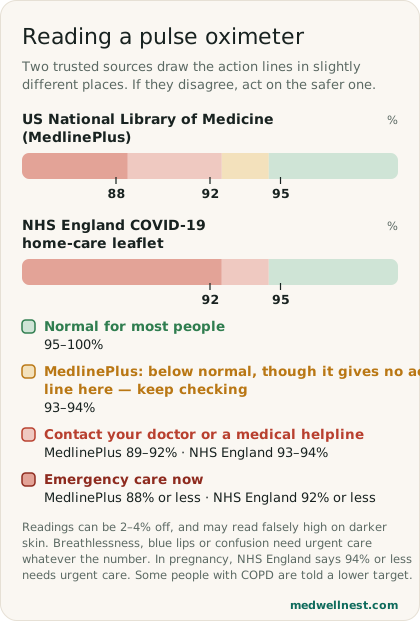
MedlinePlus says to contact your doctor if your oxygen saturation is 92% or lower, and to seek immediate medical attention if it falls to 88% or lower. It gives no specific instruction for 93% or 94%; that is below its normal range, so keep checking and mention it to your doctor.
NHS England's leaflet was written for adults with COVID-19 being looked after at home, and it draws the lines higher. At 93% or 94%, or if your reading keeps being lower than your usual when your normal is below 95%, re-take it within an hour and then contact your doctor or a medical helpline. At 92% or less, re-take it straight away, and if it is still there go to an emergency department straight away or call emergency services. During pregnancy the same leaflet says 94% or less needs a call to your hospital or emergency services immediately.
We have not merged these into one scale, because they were written for different situations. The emergency lines are four points apart: 88% versus 92%. If you are not sure which applies to you, act on the line that sends you for help sooner, and ask your own doctor which numbers they want you to use.
04
How to take a reading you can trust
Read the maker's instructions first. Take off nail polish or a false nail on the finger you will use. Make sure your hand is warm; the NHS England guide suggests resting it on your chest for five minutes before you start. MedlinePlus Magazine advises keeping the hand relaxed and resting below the level of your heart.
Switch the oximeter on and clip it to your middle finger or the finger next to your thumb. Keep still and watch the numbers. When they stop changing, write down the reading with the date and time. NHS England's easy-read guide asks people who have been given an oximeter to record readings three times a day at the same times, and to check again whenever they feel worse.
A written record helps more than any single reading. The NHS points out that the important thing is whether your readings are going down, and a log makes that easy to see and to show a doctor.
05
What makes a reading wrong
Readings are estimates. MedlinePlus says results may be 2% to 4% higher or lower than your actual blood oxygen. MedlinePlus Magazine adds that oximeters are most accurate between 90% and 100%, less accurate between 80% and 90%, and least accurate below 80%. Its example: a medically cleared oximeter reading 90% usually means a true level between 86% and 94%.
Skin colour matters. Melanin absorbs the device's light, and MedlinePlus Magazine reports that this can lead some devices to give falsely high readings in people with darker skin. NHS England's leaflet says oximeters may be less accurate on brown or black skin and may show readings higher than the real oxygen level. It still advises using one if you have been given it, and watching whether your readings are going down. On darker skin, a reading that looks reassuring should not talk you out of acting on symptoms.
Other things that can throw the number off include cold skin, poor circulation, dark nail polish or artificial nails, tobacco use and moving during the reading. MedlinePlus Magazine also notes that over-the-counter oximeters sold for fitness or general wellness are not reviewed by the Food and Drug Administration, so treat a cheap device's number with extra caution.
06
COPD, and symptoms that outrank the number
If you have COPD, your safe range may be different. The British Thoracic Society suggests a target of 88% to 92% for people with known COPD, or other risk factors for carbon dioxide build-up, while they are being treated for acute illness. That is a target for clinicians giving oxygen, not a home threshold. Ask your own team what readings are normal for you and what should prompt a call.
Whatever the screen says, get help for how someone looks and feels. MedlinePlus lists bluish lips, nails or face, trouble breathing, chest pain or tightness, and a fast heart rate as signs of low oxygen. NHS England treats being unable to finish a short sentence at rest, breathing that suddenly gets worse, coughing up blood, cold and sweaty pale or blotchy skin, collapse or fainting, a rash that does not fade under a glass, or becoming confused or very drowsy as reasons to go to an emergency department or call for an ambulance. The NHS also warns that oxygen can be low even when you do not feel breathless, which is why the log matters.
When to act
Routine — see a doctor
Readings of 95 to 100% in someone who feels well, or a steady reading at the personal level your doctor has told you is normal for you: keep your log and share it at your next visit.
Same-day — call promptly
A reading of 93 or 94%, or one that keeps falling below your usual: re-check within the hour and contact your doctor or a helpline today.
Emergency — act now
92% or less on re-check (the NHS England line), 88% or less (the MedlinePlus line), or any reading with blue lips, struggling to finish a sentence, chest pain, confusion or collapse — or, if you are pregnant, 94% or less: call emergency services now.
Values mentioned in this story
Each one opens a visual guide with its normal range and what moves it — upload a report and we place your own numbers on the same scale.
Sources
- Pulse Oximetry — MedlinePlusmedlineplus.gov
- Getting an accurate read on pulse oximeters — NIH MedlinePlus Magazinemagazine.medlineplus.gov
- Suspected coronavirus: keeping you safe at home (leaflet C1634) — NHS Englandengland.nhs.uk
- Using a pulse oximeter to check you are OK (easy read) — NHS Englandengland.nhs.uk
- Emergency oxygen guideline — British Thoracic Societybrit-thoracic.org.uk
Share this story
Curious where your own values stand?
Two minutes from upload to a full visual picture. Free to analyze.