In short
WHO counts anaemia from below 12.0 g/dL in women who are not pregnant, below 13.0 in men and below 11.0 in most of pregnancy, with lower lines for young children. Here are the 2024 bands, how altitude and smoking shift them, and why your lab's range still decides your report.
Emergency if: Fainting, chest pain, severe breathlessness, or heavy bleeding that will not stop: go to emergency care now.
On your report
Hemoglobin, Ferritin, Hematocrit / PCV, MCV +1 more
On this page
01
What the haemoglobin line on your report measures
Haemoglobin is the iron-rich protein inside red blood cells that carries oxygen from your lungs to the rest of your body. It is part of a complete blood count, and on most reports it appears near the top, printed in grams per decilitre (g/dL). Some reports and most WHO documents use grams per litre (g/L) instead. The two differ by a factor of 10: MedlinePlus writes the same female range as 12.1 to 15.1 g/dL or 121 to 151 g/L. So 120 g/L is 12.0 g/dL.
Anaemia is diagnosed when haemoglobin falls below a cut-off that depends on age, sex and pregnancy. WHO treats it as a sign of an underlying problem rather than a diagnosis in itself, and MedlinePlus is plain that the test cannot tell you what is causing an abnormal level. The number tells you how low; finding out why is the next step with your doctor.
02
The WHO 2024 cut-offs for children
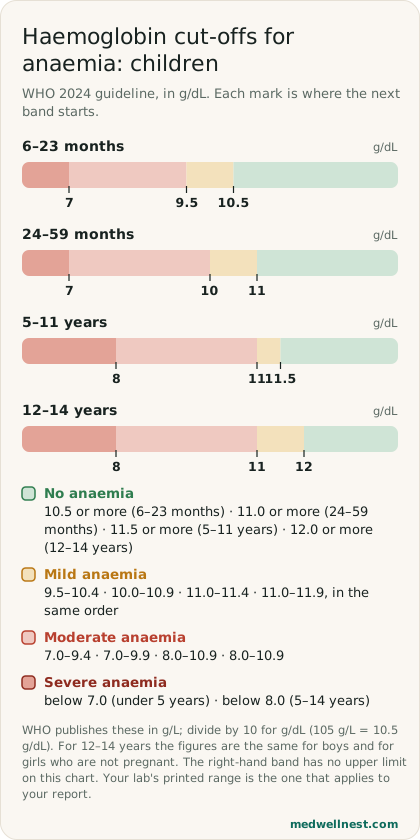
In 2024 WHO published a new guideline on haemoglobin cut-offs. It changed the line for only one group. Children aged 6 to 23 months now count as anaemic below 10.5 g/dL, where the older guidance used 11.0 g/dL for all children from 6 to 59 months. Children aged 24 to 59 months keep the 11.0 line. Children aged 5 to 11 years are anaemic below 11.5 g/dL, and those aged 12 to 14 below 12.0 g/dL, with the same figure for boys and for girls who are not pregnant.
The mild, moderate and severe bands sit underneath each line. For a child aged 6 to 23 months, mild is 9.5 to 10.4, moderate 7.0 to 9.4 and severe below 7.0. From 24 to 59 months, mild is 10.0 to 10.9, moderate 7.0 to 9.9 and severe below 7.0. From 5 to 14 years the severe line moves up to 8.0, and moderate runs from 8.0 to 10.9.
03
The cut-offs for adults and in pregnancy
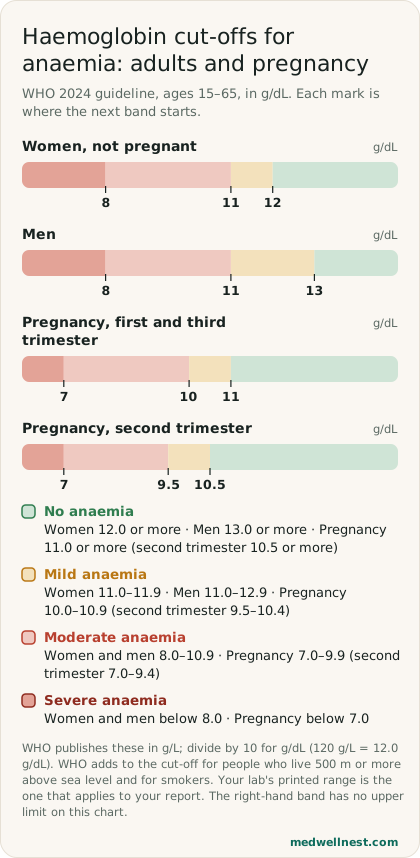
For adults aged 15 to 65, WHO counts anaemia below 12.0 g/dL in women who are not pregnant and below 13.0 g/dL in men. In both, severe anaemia is below 8.0 and moderate is 8.0 to 10.9. Mild anaemia is 11.0 to 11.9 in women and a wider 11.0 to 12.9 in men. WHO noted that some data point to a higher line for men, 13.5 g/dL, but kept 13.0 because the evidence was uncertain.
Pregnancy is now split by trimester. In the first and third trimesters the line is 11.0 g/dL, with mild at 10.0 to 10.9, moderate at 7.0 to 9.9 and severe below 7.0. In the second trimester the line is lower, at 10.5 g/dL, with mild at 9.5 to 10.4 and moderate at 7.0 to 9.4. The 2011 table listed a single 11.0 line for pregnancy; the 2024 guideline sets out a separate second-trimester line of 10.5, which WHO describes as the existing cut-off for that stage.
Two limits on these figures are worth knowing. WHO describes the mild, moderate and severe groupings as arbitrary, and says how anaemia is managed depends on the situation and the cause, not the band alone. And the cut-offs were built from data on people aged 6 months to 65 years; WHO lists older adults and infants as groups that still need their own studies.
04
Altitude and smoking move the line
WHO explains that haemoglobin rises in response to lower oxygen, as happens when you live well above sea level or smoke, so a normal-looking number can hide anaemia. WHO recommends adjusting for both. The adjustment is either subtracted from the measured value or added to the cut-off, which comes to the same thing.
For altitude, nothing changes below 500 metres. From 500 to 999 m, add 0.4 g/dL to the cut-off; from 1,000 to 1,499 m, 0.8; from 1,500 to 1,999 m, 1.1; from 2,000 to 2,499 m, 1.4; and from 2,500 to 2,999 m, 1.8. So a woman who is not pregnant and lives at 1,200 m would count as anaemic below 12.8 g/dL rather than 12.0. WHO gives larger figures for higher places but says the data above 3,000 m come mainly from a limited set of regions, and that above 2,500 m local adjustments may be needed.
For smoking, WHO adds 0.3 g/dL for fewer than 10 cigarettes a day or an unknown amount, 0.5 for 10 to 19 a day, and 0.6 for more than 20 a day. WHO itself says it is unclear whether the smoking adjustment matters for an individual, and that it is most important for counting anaemia across a population. WHO does not adjust for infection, inflammation or ethnicity.
05
Why your lab's range is the one that counts
Your report will print its own reference range next to your result, and that range is the one that applies to your report. MedlinePlus explains that the range can vary with the laboratory, and with your age, sex and race, and that labs may use different measurements or test different samples. The WHO lines are built for diagnosing anaemia across the world; a lab range describes what its own method reads in healthy people.
The two often do not match exactly. MedlinePlus, for example, gives typical normal results of 13.8 to 17.2 g/dL for men and 12.1 to 15.1 g/dL for women, a little above the WHO anaemia lines of 13.0 and 12.0. A woman at 12.0 g/dL can be flagged low by a lab using a range like that one and still sit just on the no-anaemia side of the WHO line. Neither is wrong; they answer different questions, and your doctor will read the result alongside your symptoms and your other blood counts.
How the blood was taken matters too. WHO recommends venous blood and an automated analyser, and notes that finger-prick samples give different values by an amount no one has pinned down. A finger-prick screening number is a prompt for a proper test, not a final answer.
06
Symptoms, and when a number needs action
WHO lists tiredness, dizziness or feeling light-headed, cold hands and feet, headache, and shortness of breath, especially on exertion, as common symptoms. More severe anaemia can bring pale skin, paleness inside the mouth and nose and under the fingernails, fast breathing and heart rate, dizziness on standing and easier bruising.
A result in the mild or moderate band, or a flag from your lab, is a reason to see your doctor soon rather than to start iron on your own, because the cause decides the treatment. WHO says a lack of iron is the most common nutritional cause, but heavy periods, pregnancy, infections, chronic disease and inherited conditions such as thalassaemia can all lower haemoglobin. A haemoglobin that is high rather than low is also worth discussing: MedlinePlus lists lung disease, heart disease, sleep apnoea and a bone-marrow condition called polycythaemia vera among the causes, along with living at altitude and smoking.
When to act
Routine — see a doctor
A haemoglobin in the mild or moderate band, or flagged low or high against your lab's range, with no worrying symptoms: book an appointment with your doctor to find the cause before starting any supplement.
Same-day — call promptly
A result in the severe band (below 8.0 g/dL for adults who are not pregnant and for children aged 5 to 14, below 7.0 in pregnancy or in children under 5), or anaemia with breathlessness at rest, a racing heart or dizziness on standing: see a doctor today.
Emergency — act now
Fainting, chest pain, severe breathlessness, or heavy bleeding that will not stop: go to emergency care now.
Values mentioned in this story
Each one opens a visual guide with its normal range and what moves it — upload a report and we place your own numbers on the same scale.
Sources
Share this story
Curious where your own values stand?
Two minutes from upload to a full visual picture. Free to analyze.