In short
Remission means HbA1c below 6.5% (48 mmol/mol) at least 3 months after stopping diabetes medicines. In the DiRECT trial 46% reached it at 1 year and 36% at 2 years, with clinician-run weight loss. It is not for everyone and can be lost. Never stop medicines on your own.
Emergency if: Low sugar with a seizure (fit), someone not responding normally or unconscious, or a low they cannot treat themselves: give no food or drink if they cannot swallow safely, give glucagon if available and you know how, and call emergency services now. The NHS says to call if glucagon is not available, if there is no recovery within 10 minutes of glucagon, or if they have been drinking alcohol. High sugar with feeling or being sick, stomach pain, breathing faster than usual or a fast heartbeat, drowsiness or struggling to stay awake, a fruity smell on the breath, confusion or a high ketone level: call emergency services now or go to an emergency department now. Do not drive yourself.
On your report
HbA1c, Fasting Glucose
On this page
01
Can type 2 diabetes go away, and what does remission mean?
Sometimes blood sugar can return to a non-diabetes level, and doctors call that remission. It does not mean the diabetes is gone for good. The NHS says lifestyle changes can sometimes lower blood glucose to a normal level and stop diabetes (remission), and the trial below shows that many people do not reach it and some lose it again.
An international expert group convened by the American Diabetes Association proposed remission as the most appropriate word. Its usual test is an HbA1c below 48 mmol/mol (6.5%), measured at least 3 months after stopping glucose-lowering medicines. By that definition, a good HbA1c while you still take tablets or insulin is control with treatment, not remission.
The same group said the long-term risks and benefits of reaching remission are not well understood, and suggested that people in remission be actively observed. This page is about type 2 diabetes only.
02
What did the DiRECT trial find at 1 year and 2 years?
DiRECT is the best-known remission trial. It ran in 49 primary care practices. It enrolled 306 adults aged 20 to 65 who had been diagnosed with type 2 diabetes within the past 6 years, had a body-mass index of 27 to 45 and were not on insulin. Practices were randomly assigned to a weight management programme or to usual best-practice care.
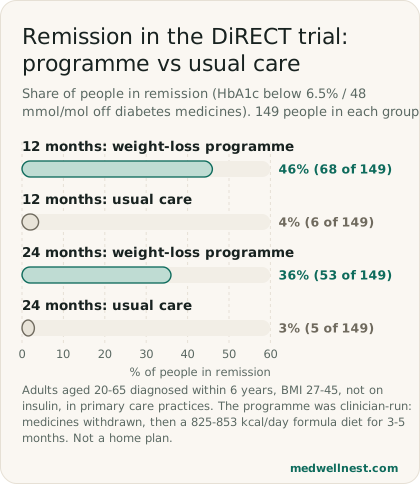
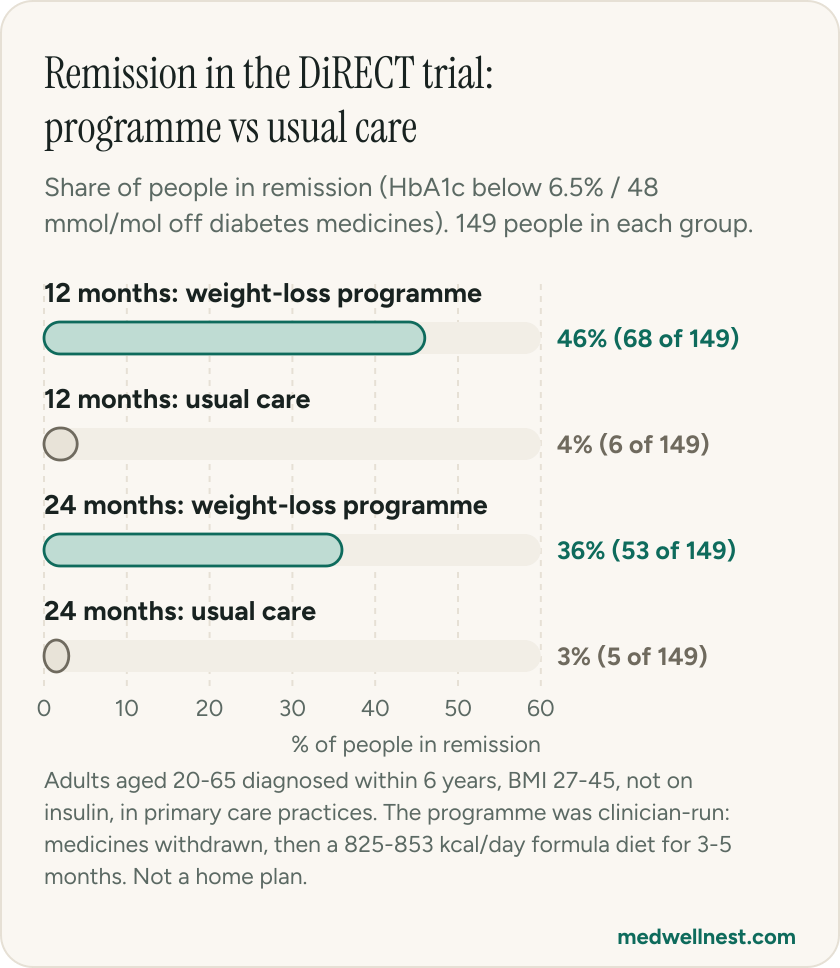
At 12 months, 68 of 149 people in the programme group (46%) were in remission, against 6 of 149 (4%) in the usual-care group. Weight loss of 15 kg or more was seen in 36 of 149 (24%) in the programme group and in none of the 149 in the usual-care group. At 24 months, 53 of 149 (36%) in the programme group were in remission, against 5 of 149 (3%) in the usual-care group, and 17 of 149 (11%) in the programme group had lost at least 15 kg, against 3 of 149 (2%).
Look at the drop from 46% to 36%: the share in remission was smaller at 2 years than at 1. The authors concluded that the programme sustained remission for more than a third of people. The definitions differ slightly. At 12 months the trial counted remission as an HbA1c below 6.5% after at least 2 months off all diabetes medicines, while the expert-group definition above asks for 3 months.
03
Does losing weight really make diabetes go away?
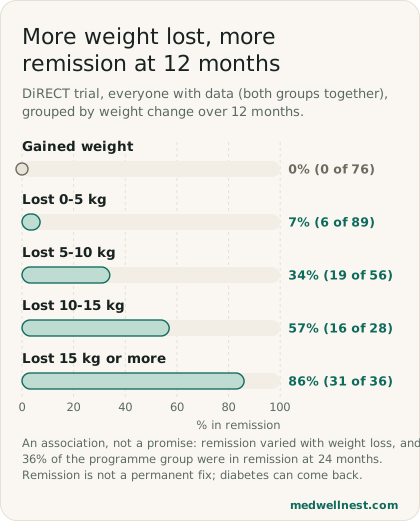
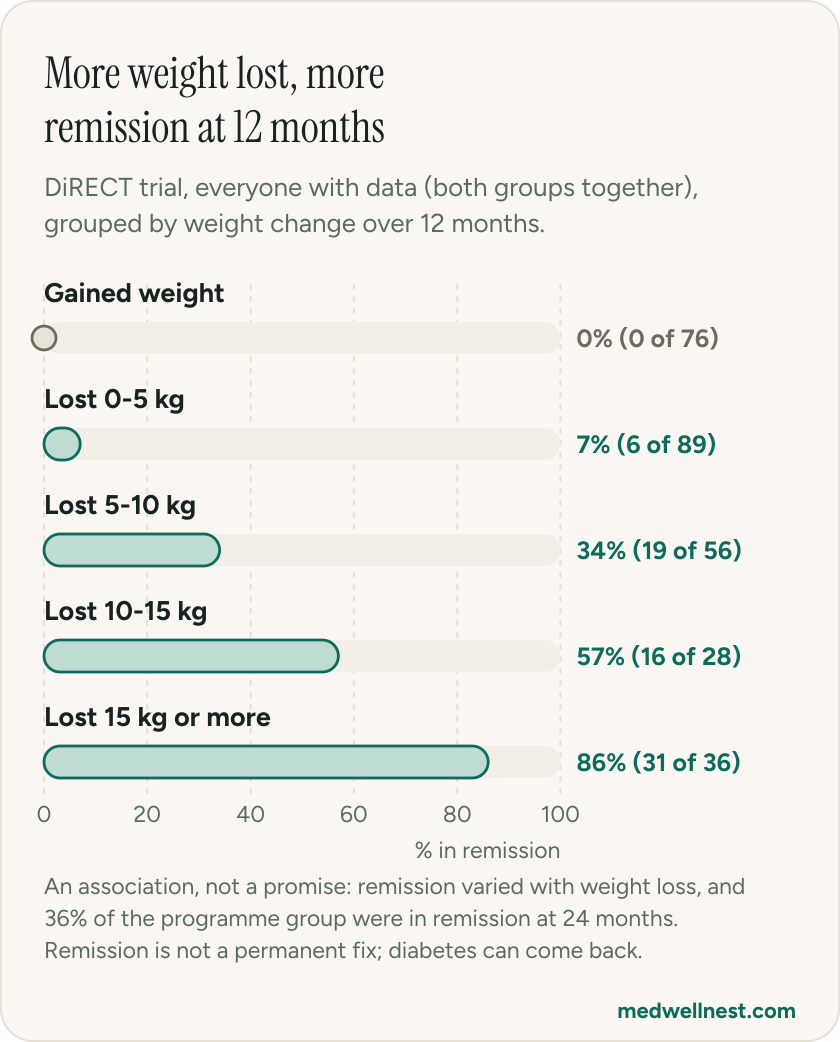
In DiRECT, the more weight a person lost, the more likely they were to be in remission at 12 months. Across everyone with data, remission was seen in none of 76 people who gained weight, 6 of 89 (7%) who lost 0 to 5 kg, 19 of 56 (34%) who lost 5 to 10 kg, 16 of 28 (57%) who lost 10 to 15 kg and 31 of 36 (86%) who lost 15 kg or more.
At 2 years the authors wrote that sustained remission was linked to the extent of sustained weight loss. In a post-hoc analysis of both groups together, 45 of the 272 people with data had kept off at least 10 kg at 24 months, and 29 of them (64%) were in remission. In the programme group, only 36 of 149 (24%) had kept off at least 10 kg at 24 months. This is a different count from the 36 who had lost 15 kg or more at 12 months; the two numbers happen to match. A link seen in a trial shows that weight loss and remission go together, not that weight loss alone caused every remission.
04
Does this apply to me? Who was in the trial, and what were the risks?
Only partly. Everyone in DiRECT was aged 20 to 65, had been diagnosed within 6 years and was not on insulin. The trial does not say what to expect for people on insulin, people diagnosed longer ago or people outside that age and weight range, and the sources we read report no separate results for them.
In the first year, 9 serious adverse events were reported by 7 of 157 people (4%) in the programme group and 2 by 2 people (1%) in the usual-care group; this safety count included 157 programme-group people, while the main results above count 149. Two events, biliary colic and abdominal pain in the same person, were judged potentially related to the programme. None led to anyone leaving the study.
The programme was run by clinicians. It involved withdrawing diabetes and blood pressure medicines, then a formula diet of 825 to 853 kcal a day for 3 to 5 months, a stepped return to ordinary food over 2 to 8 weeks, and structured support to keep the weight off. This page reports that evidence. It is not a diet plan to copy at home.
05
Can I stop my diabetes medicines if I lose weight?
Not on your own. The NHS says not to stop taking your medicine unless your healthcare professional or doctor tells you to. In DiRECT the clinicians withdrew medicines as part of the programme, and even so, at 24 months 51 of 129 people (40%) with data in the programme group were still using diabetes medicine, against 120 of 143 (84%) in the usual-care group.
Cutting calories sharply carries its own risk if you take certain medicines. The NHS says low blood sugar is common with insulin and can also happen with some other diabetes medicines, such as gliclazide and glimepiride, and that you are more likely to get it if you miss or delay meals or do not eat enough carbohydrate. It also says not to switch to a very strict, low-calorie diet without talking to a health professional first, because it may not be suitable if you take insulin or other diabetes medicine.
Low blood sugar can cause hunger, dizziness, sweating, shaking, confusion and, when severe, a seizure or loss of consciousness. Our hypoglycaemia story explains how to treat it.
06
What happens after remission, and can diabetes come back?
The trial numbers show that it can: the share of people in remission fell from 46% at 1 year to 36% at 2 years. The expert group suggested active observation for anyone in remission, so keep having HbA1c checks and ask your doctor how often. For type 2 diabetes in general, the NHS lists an HbA1c every 3 to 6 months, and checks of weight, cholesterol, blood pressure and kidneys at least once a year. Ask which of these continue if you are in remission.
Do not rely on symptoms to tell you. The NHS says symptoms of high blood sugar usually come on gradually and may only start when the level gets very high: feeling very thirsty, peeing a lot, feeling weak or tired, blurred vision and losing weight. If any of these return, get a blood test rather than waiting.
Weight loss, diabetes medicines and sugar: how fast to act
Emergency — act now
Low sugar with a seizure (fit), someone not responding normally or unconscious, or a low they cannot treat themselves: give no food or drink if they cannot swallow safely, give glucagon if available and you know how, and call emergency services now. The NHS says to call if glucagon is not available, if there is no recovery within 10 minutes of glucagon, or if they have been drinking alcohol. High sugar with feeling or being sick, stomach pain, breathing faster than usual or a fast heartbeat, drowsiness or struggling to stay awake, a fruity smell on the breath, confusion or a high ketone level: call emergency services now or go to an emergency department now. Do not drive yourself.
Same-day — call promptly
You take diabetes medicine and have vomiting, diarrhoea or a very high temperature: the NHS says to ask for an urgent appointment or phone the health helpline, so contact your doctor or diabetes team today and ask whether to pause any medicine. Also contact them today if you have frequent low sugars, a severe low from which you have now recovered, or lows at night while cutting down on food.
Routine — see a doctor
You want to try for remission, or to lose weight while on diabetes medicine: talk to your doctor or diabetes team first, before changing your diet or any medicine, and ask how often to repeat the HbA1c.
Values mentioned in this story
Each one opens a visual guide with its normal range and what moves it — upload a report and we place your own numbers on the same scale.
Sources
- Consensus report: definition and interpretation of remission in type 2 diabetes — Diabetologia 2021pubmed.ncbi.nlm.nih.gov
- DiRECT: primary care-led weight management for remission of type 2 diabetes, 12 months — The Lancet 2018pubmed.ncbi.nlm.nih.gov
- DiRECT: durability of the intervention, 2-year results — Lancet Diabetes & Endocrinology 2019pubmed.ncbi.nlm.nih.gov
- Treatment for type 2 diabetes — NHSnhs.uk
- Low blood sugar (hypoglycaemia) — NHSnhs.uk
- High blood sugar (hyperglycaemia) — NHSnhs.uk
Share this story
Curious where your own values stand?
Two minutes from upload to a full visual picture. Free to analyze.