In short
Vapes are not risk-free and nicotine can harm a teen's brain. For adults who smoke, Cochrane found nicotine e-cigarettes helped more people quit than nicotine replacement (risk ratio 1.61); that is no reason for others to start. If a child swallows e-liquid, call emergency services or go to an emergency department now.
Emergency if: A child has swallowed e-liquid or other nicotine liquid, or anyone has breathing that is difficult, rapid or has stopped, a seizure, fainting, a pounding or very fast heartbeat, vomiting with drooling or confusion after swallowing or breathing in nicotine: call emergency services now or go to an emergency department now. MedlinePlus says to seek immediate medical help and not to make the person vomit unless a poison helpline or health professional tells you to; do not wait to find out the product or amount. Severe breathing difficulty, severe or crushing chest pain, or coughing up blood after vaping also needs an emergency department now: the sources on vaping lung injury give no waiting time, so we chose the emergency tier as a precaution.
On this page
01
What is in a vape (e-cigarette) liquid and aerosol?
A vape, or e-cigarette, heats a liquid to make an aerosol that the user breathes in. WHO says these e-liquids may or may not contain nicotine, do not contain tobacco, and typically contain additives, flavours and chemicals that can be harmful. It says some products sold as nicotine-free have been found to contain nicotine, and that there are at least 16,000 flavours.
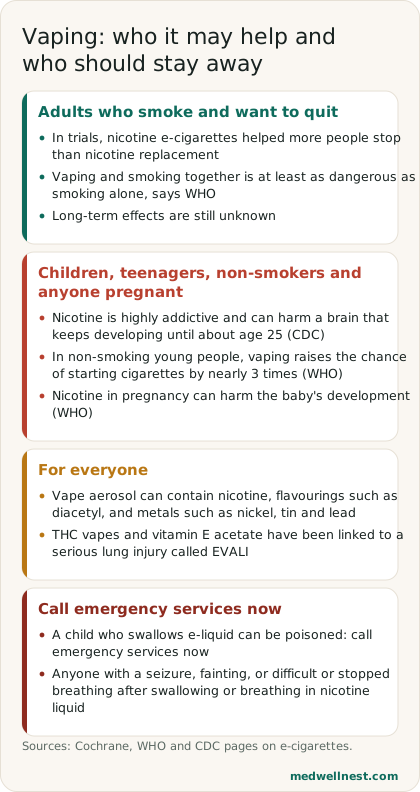
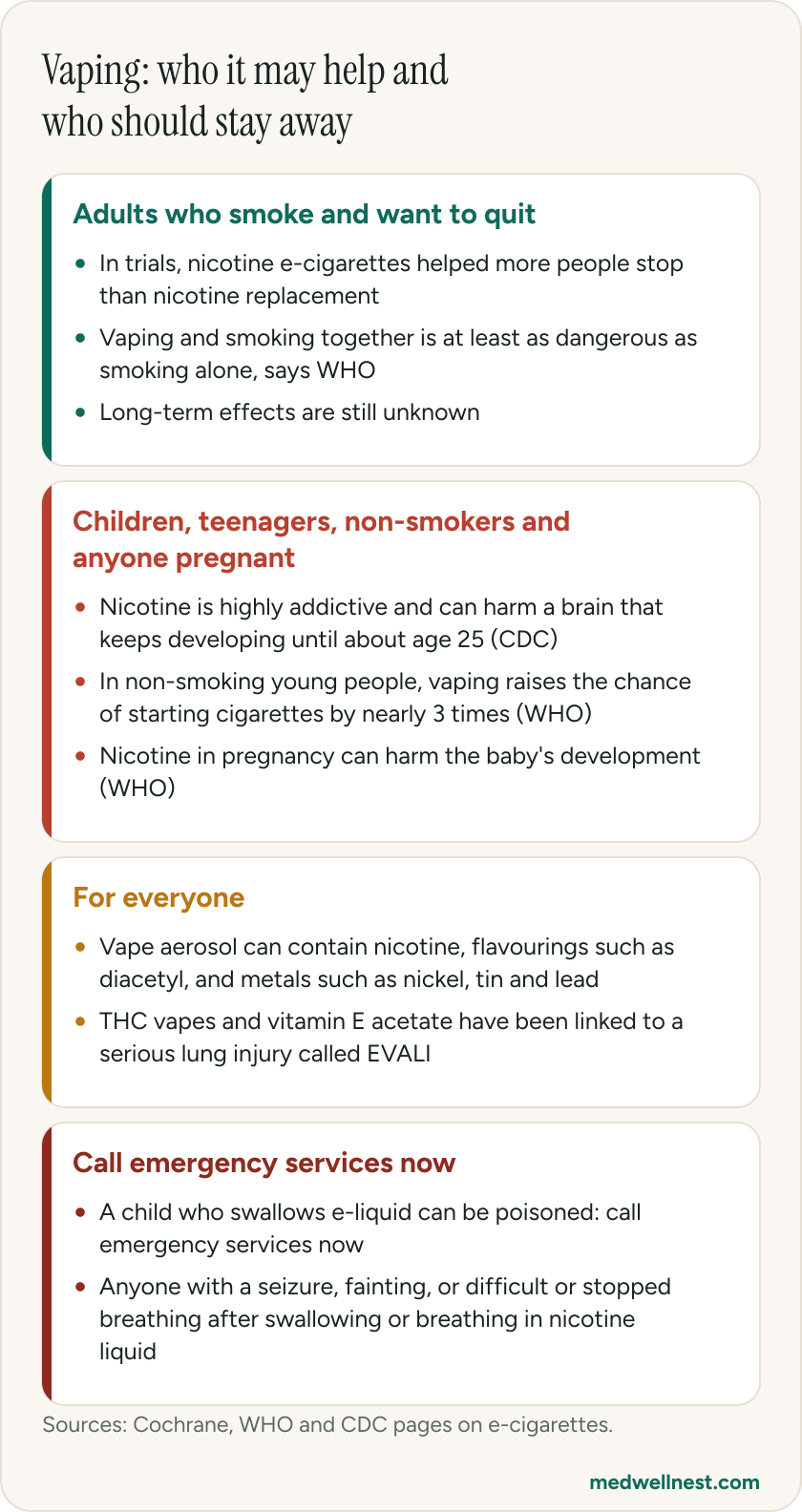
The CDC says e-cigarette aerosol can contain substances that are harmful or potentially harmful: nicotine, which it calls a highly addictive chemical that can harm adolescent brain development; flavourings such as diacetyl, a chemical linked to a serious lung disease; and heavy metals such as nickel, tin and lead. WHO adds that the aerosol raises indoor particle levels and can expose people nearby, and that vaping devices have been linked to burns from explosions or malfunctions.
02
Is vaping safe (vape kya safe hai)?
No source we used calls vaping safe. WHO says the evidence shows these products are harmful and not safe, though it is too early to say what the long-term effects are. It says they produce toxic substances, some known to cause cancer and some that raise the risk of heart and lung disorders, and that the safest approach is not to use either tobacco products or e-cigarettes. WHO also says dual use, meaning vaping and smoking together, is common and is at least as dangerous as smoking alone, and likely more dangerous.
The Cochrane review, which looks only at adults who smoke, says regulated e-cigarettes do not expose users to the same levels of chemicals that cause disease in people who smoke cigarettes, and that it detected no evidence of serious short-term harm from nicotine e-cigarettes. It also says longer, larger trials are needed to judge safety, and that illicit products or those containing other active substances such as THC may have different harm profiles. Less harmful than smoking is not the same as safe, and the comparison only applies to someone who would otherwise keep smoking.
03
What does vaping do to teenagers: nicotine addiction and the brain?
The CDC says nicotine is the main addictive substance in e-cigarettes and that it can harm brain development, which continues until about age 25. It describes the signs of nicotine addiction as craving nicotine, being unable to stop using it and developing a tolerance. WHO says nicotine use in children and adolescents has negative effects on brain development, with long-term consequences and potentially learning and anxiety disorders.
WHO says high-quality studies consistently find that e-cigarette use raises the uptake of ordinary cigarettes, particularly among non-smoking young people, by nearly 3 times. It also says nicotine exposure in pregnancy can harm the developing baby. WHO is concerned that e-cigarettes have been marketed to young people with flavours, cartoon characters and designs that look like toys, and says rates of use among young people exceed adult use in many countries. For parents, the practical message from these sources is that a young person who does not smoke has nothing to gain from starting. E-liquid is also a poisoning risk at home. WHO warns that devices may leak or children may swallow the poisonous e-liquid, and MedlinePlus says acute nicotine poisoning usually happens in young children and that a very small amount can cause it. Signs include vomiting, drooling, a burning mouth, restlessness or confusion, a fast pounding heartbeat, difficult or rapid breathing, seizures and fainting. If a child swallows e-liquid, call emergency services now or go to an emergency department now, and take the bottle with you; do not make the child vomit unless a poison helpline or health professional tells you to. If e-liquid gets on the skin, wash it with soap and plenty of water for at least 15 minutes. Keep vapes and refills out of children's reach.
04
Can vaping help me quit smoking? What does the Cochrane evidence say?
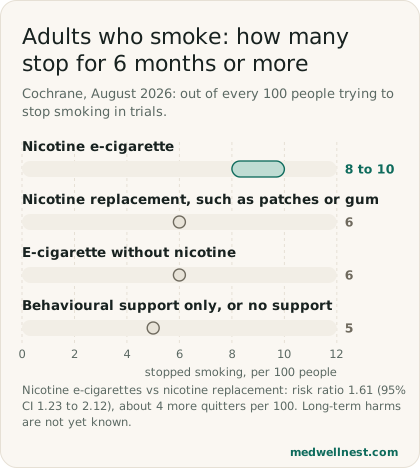
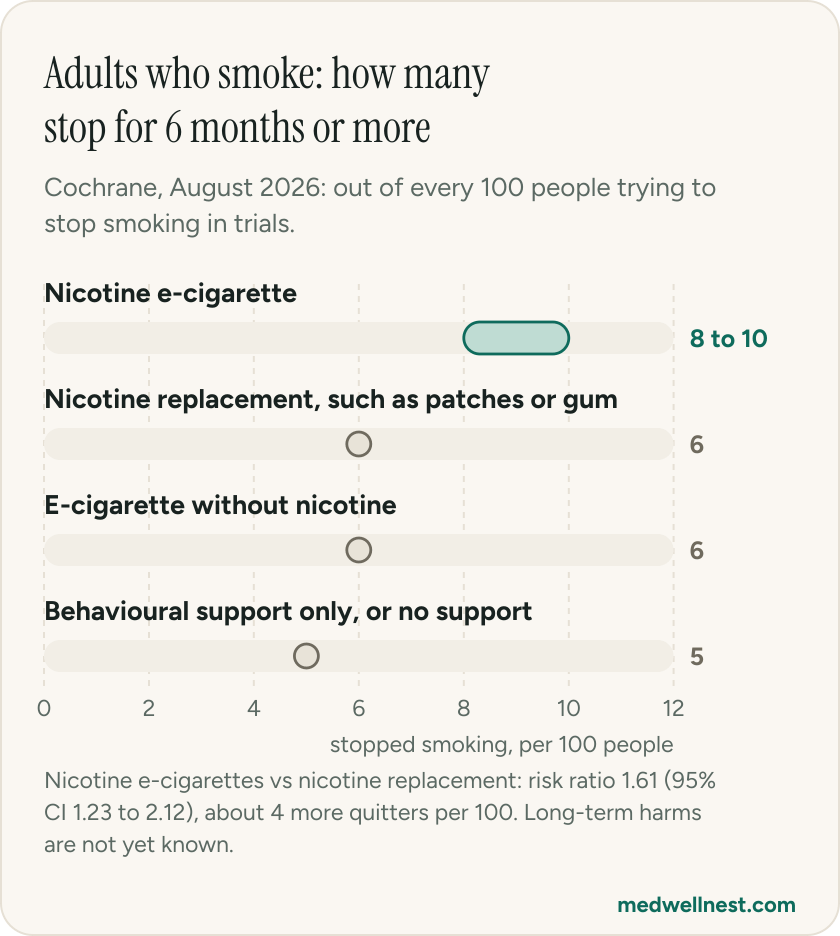
The latest Cochrane review, updated on 26 August 2026 as a living review, included 80 randomised trials with 29,861 adults who smoked, searched up to 1 January 2026. It found high-certainty evidence that nicotine e-cigarettes gave higher quit rates, measured as abstinence for at least 6 months, than nicotine replacement such as patches or gum: risk ratio 1.61 (95% confidence interval 1.23 to 2.12, 11 studies, 4,114 people), about 4 extra quitters per 100 (95% confidence interval 1 to 7 more). In the plain-language summary, for every 100 people using nicotine e-cigarettes to stop smoking, 8 to 10 might succeed, against 6 of 100 using nicotine replacement, 6 using e-cigarettes without nicotine and 5 with behavioural support only or no support.
Compared with e-cigarettes without nicotine, nicotine e-cigarettes probably helped more people quit (risk ratio 1.34, 1.05 to 1.69, moderate certainty). Serious adverse events were probably similar to nicotine replacement (moderate certainty). The review says the trials tested regulated nicotine e-cigarettes, and that longer, larger trials are needed to judge safety.
WHO takes a more cautious view: it says e-cigarettes sold as consumer products have not been proven effective for quitting at the population level, that proven help such as advice from health professionals, quit lines, digital services and nicotine replacement should come first, and that if e-cigarettes are used for quitting they should be regulated as medicines. Both can be true: in trials with adults who smoke, nicotine e-cigarettes helped more people quit than nicotine replacement, and that is not evidence that a non-smoker or a teenager benefits from vaping. If you do switch, going back to smoking is worse; the NHS says going back to vaping is much better than starting to smoke again.
05
What is EVALI, the vaping lung injury, and what is vitamin E acetate?
WHO says there is growing evidence that e-cigarettes could be associated with lung injury. It describes a 2019–2020 outbreak of serious lung injury, which public health investigators named e-cigarette or vaping product use-associated lung injury, or EVALI. Thousands of people were taken to hospital and some died. WHO quotes the investigators as saying that vitamin E acetate, an additive found in some products that contain cannabis (THC), is thought to have played a significant role, but that the evidence is not enough to rule out other chemicals.
EVALI is a reminder that what is in the liquid matters, and that informal products carry extra risk. The Cochrane review notes that illicit products or those containing other active substances such as THC may have different harm profiles from the regulated nicotine products it studied. The CDC lists respiratory symptoms (cough, chest pain, shortness of breath), stomach and bowel symptoms (abdominal pain, nausea, vomiting, diarrhoea) and general symptoms (fever, chills, weight loss) as the picture clinicians were asked to look for, and advises patients to see a health care provider immediately if they develop symptoms like those reported in the outbreak.
06
How do I quit vaping (vape ki aadat kaise chhode)?
The NHS says you may have withdrawal symptoms when you quit nicotine vaping: strong cravings, irritability or low mood, trouble concentrating, feeling hungrier and difficulty sleeping. It says you should only quit vaping if you are confident you can do it without smoking cigarettes. It describes three ways to cut down: gradually lower the nicotine strength, and if you find you are vaping more, you may have cut down too fast; stretch the time between sessions, for example from every 20 minutes to every 40; and create vape-free places or times and widen them.
To stop in one step, the NHS suggests asking a pharmacist or stop-smoking adviser about switching to a suitable nicotine replacement product, which can also help with withdrawal. It also suggests getting support from friends or family, teaming up with someone else who is quitting, staying busy and celebrating each vape-free day, and says it is fine if it takes a few tries. WHO lists the proven help for quitting tobacco: brief advice from health professionals, quit lines, mobile and digital services and nicotine replacement. A teenager who cannot stop should talk to a parent, school nurse or doctor rather than quit alone. Our quitting smoking story covers the tools in more detail.
Vaping: how fast to act
Emergency — act now
A child has swallowed e-liquid or other nicotine liquid, or anyone has breathing that is difficult, rapid or has stopped, a seizure, fainting, a pounding or very fast heartbeat, vomiting with drooling or confusion after swallowing or breathing in nicotine: call emergency services now or go to an emergency department now. MedlinePlus says to seek immediate medical help and not to make the person vomit unless a poison helpline or health professional tells you to; do not wait to find out the product or amount. Severe breathing difficulty, severe or crushing chest pain, or coughing up blood after vaping also needs an emergency department now: the sources on vaping lung injury give no waiting time, so we chose the emergency tier as a precaution.
Same-day — call promptly
You vape and develop a cough, shortness of breath, mild chest pain or tightness, fever or chills, or stomach symptoms such as abdominal pain, nausea, vomiting or diarrhoea: see a doctor the same day and say that you vape. The CDC says to see a health care provider immediately if you develop symptoms like those reported in the vaping lung injury outbreak. Stop vaping and avoid THC products from informal sources.
Routine — see a doctor
You want to quit vaping or smoking, or a young person you know vapes: talk to a doctor, pharmacist or stop-smoking adviser about support and nicotine replacement. Do not start vaping if you do not smoke.
Sources
- Electronic cigarettes for smoking cessation — Cochrane review (Lindson et al., living review updated August 2026)pubmed.ncbi.nlm.nih.gov
- Tobacco: E-cigarettes — WHO questions and answerswho.int
- Health effects of vaping — CDCcdc.gov
- Interim guidance for health care providers on suspected e-cigarette, or vaping, product use-associated lung injury — CDC MMWR, November 2019cdc.gov
- How to quit vaping — NHSnhs.uk
- Nicotine poisoning — MedlinePlus Medical Encyclopediamedlineplus.gov
Share this story
Curious where your own values stand?
Two minutes from upload to a full visual picture. Free to analyze.