In short
A reactive VDRL is a screening result, not a diagnosis. It needs a different test to confirm syphilis, and false positives happen in pregnancy and several other conditions. Here is how to read the titre and what follows.
Emergency if: Sudden loss or change of vision, sudden hearing loss, or a severe headache with a stiff neck, confusion or weakness on one side: go to the emergency department immediately.
On this page
01
Two kinds of syphilis blood test
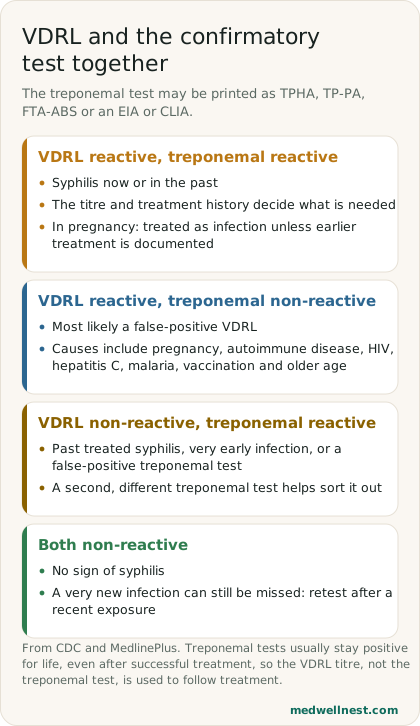
The VDRL is a screening test for syphilis. It belongs to a group called non-treponemal tests, along with the RPR, which pick up antibodies the body may make during the infection rather than the bacterium itself. The other group, treponemal tests, detects antibodies aimed at the syphilis bacterium, and may be printed on a report as TPHA, TP-PA, FTA-ABS, or an EIA or CLIA immunoassay.
The CDC's treatment guidelines say a diagnosis needs both kinds: one non-treponemal and one treponemal test. Using only one can give false-negative results early in the infection and false-positive results in people who do not have syphilis or were treated in the past.
The two groups do different jobs. Treponemal tests usually stay positive for life, even after successful treatment, although the CDC notes that 15 to 25% of people treated in the first stage turn negative after 2 to 3 years. That makes them good at confirming an infection but useless for tracking treatment. The VDRL or RPR titre is what doctors follow over time. Some labs now start with an automated treponemal test and then run a VDRL or RPR titre if it is positive.
02
Reactive, non-reactive and the titre
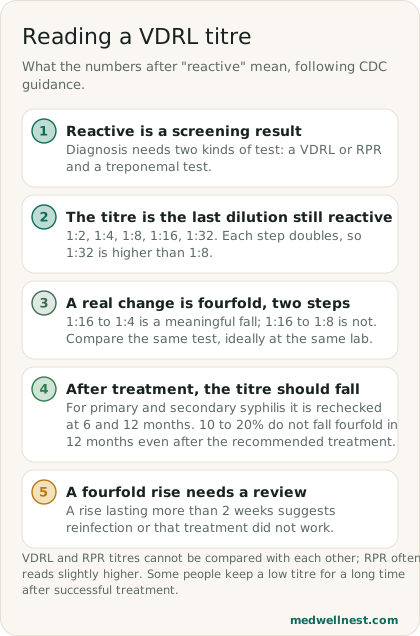
Non-reactive means no antibodies were detected. Reactive means they were, and the lab then dilutes the sample step by step to find the highest dilution that still reacts. That dilution is the titre: 1:2, 1:4, 1:8, 1:16, 1:32 and so on, with each step doubling. A titre of 1:32 therefore means more antibody than 1:8.
Small changes are noise. The CDC says a change has to be fourfold, which is two dilution steps, to count: 1:16 falling to 1:4 is meaningful, 1:16 to 1:8 is not. Repeat tests should use the same method, preferably at the same laboratory. VDRL and RPR results cannot be compared directly, and RPR titres often run slightly higher.
MedlinePlus notes that the VDRL picks up nearly 100% of infections in the secondary and latent stages, but can be falsely negative very early and very late in the disease. A non-reactive result soon after a possible exposure may need repeating.
03
False positives: when reactive is not syphilis
A reactive VDRL is not always syphilis. The CDC lists other infections such as HIV, autoimmune conditions, vaccinations, injecting drug use, pregnancy and older age as causes of false-positive results. MedlinePlus adds hepatitis C, Lyme disease, some types of pneumonia, malaria, and lupus and other autoimmune disorders.
This is exactly why the treponemal test matters. A reactive VDRL with a non-reactive treponemal test most often means a false-positive VDRL. The opposite combination, a non-reactive VDRL with a reactive treponemal test, can mean syphilis treated in the past, a very early infection, or a false-positive treponemal result, and the CDC recommends a second, different treponemal test to sort it out. Lupus is a well-known cause of a false-positive VDRL; our lupus guide explains the condition itself.
04
If you are pregnant
Syphilis testing is a routine part of antenatal care. The WHO and the CDC advise testing at the first antenatal visit, and the CDC advises repeating it at 28 weeks and at delivery for women living where syphilis is common or at ongoing risk. Any woman who has a stillbirth after 20 weeks should also be tested.
In pregnancy, a positive result is taken seriously. The CDC says a pregnant woman who tests positive should be considered infected unless earlier adequate treatment is clearly documented and her titres have fallen as expected. The WHO reports that syphilis in pregnancy that is not treated, treated late or treated with the wrong antibiotic leads to adverse birth outcomes, such as stillbirth, newborn death, prematurity and low birth weight, in 50 to 80% of cases.
Treatment should not wait. Penicillin is the only medicine known to treat the baby's infection and prevent congenital syphilis, so the CDC advises that women with a penicillin allergy are desensitised and still given penicillin. Partners should be tested and treated too. After treatment in the second half of pregnancy, contact your maternity team straight away if you notice fever, contractions or fewer movements from the baby, because the treatment can trigger a reaction that may bring on early labour. Most women do not see a fourfold fall in titre before delivery, and the CDC says this alone does not mean treatment has failed.
05
After treatment: watching the titre fall
After treatment, the VDRL titre usually falls and may become non-reactive over time. For primary and secondary syphilis, the CDC advises clinical and blood checks at 6 and 12 months, and for latent syphilis at 6, 12 and 24 months, each compared with the titre at the start of treatment.
A slow fall is common. The CDC notes that 10 to 20% of people treated for primary or secondary syphilis with the recommended treatment do not reach a fourfold fall within 12 months, and titres below 1:8 are less likely to fall fourfold than higher ones. Some people keep a low, stable titre for a long time after successful treatment, sometimes called a serofast state.
A fourfold rise that lasts more than 2 weeks, or symptoms that come back, suggests a new infection or treatment that did not work, and needs review and usually repeat treatment. The CDC also advises an HIV test for anyone diagnosed with syphilis.
06
Symptoms that should not wait
Syphilis can affect the eyes, ears and nervous system at any stage, including early on. The CDC warns that eye involvement can cause permanent loss of vision and that ear involvement can cause hearing loss that comes on suddenly, progresses quickly and can be permanent.
So a change in vision, ringing in the ears or dizziness in someone with a reactive result needs prompt medical assessment. A sudden loss of sight or hearing, or signs of meningitis or stroke, such as a severe headache with a stiff neck, confusion or weakness on one side, are an emergency.
When to act
Routine — see a doctor
A reactive VDRL with a non-reactive treponemal test and no symptoms: this is often a false positive. Discuss it with your doctor, who may repeat the tests.
Same-day — call promptly
A reactive VDRL confirmed by a treponemal test, especially in pregnancy: see your doctor today, because treatment should not be delayed. After treatment in the second half of pregnancy, contact your maternity team straight away for fever, contractions or fewer baby movements.
Emergency — act now
Sudden loss or change of vision, sudden hearing loss, or a severe headache with a stiff neck, confusion or weakness on one side: go to the emergency department immediately.
Sources
Share this story
Curious where your own values stand?
Two minutes from upload to a full visual picture. Free to analyze.