In short
Tiredness for weeks, an itchy rash and hair falling out months later are common after dengue. Here is what normal recovery looks like, how platelets come back, what to eat and which painkillers to avoid, and the signs that mean you are not recovering and need hospital now.
Emergency if: Severe belly pain, vomiting that keeps coming, bleeding from the gums or nose, black stools or blood in vomit, cold or pale clammy skin, fast breathing, drowsiness or restlessness, or no urine for 4–6 hours, especially in the days after the fever falls, or fainting or chest pain during recovery: go to hospital now.
On your report
Platelet Count, WBC / Total Leukocyte Count, Hematocrit / PCV
On this page
01
Recovery starts only after the critical phase
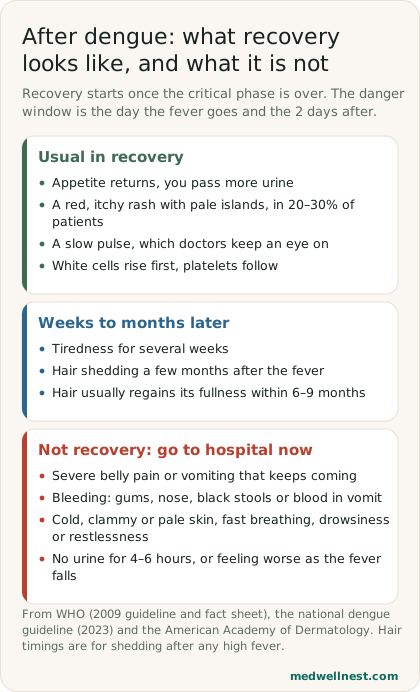
The World Health Organization (WHO) says most people with dengue get better in 1–2 weeks. The illness usually runs in three phases: fever, a critical phase and recovery. WHO's 2009 guideline places the critical phase around the time the fever comes down, usually on days 3–7 of the illness, when fluid can leak out of the blood vessels for about 24–48 hours. It asks families to treat the day the fever goes, and the 48 hours after it, as the time when complications usually happen.
So feeling weak on the day your fever breaks is not yet recovery. Recovery begins once that window has passed. WHO describes fluid moving back into the blood over the next 48–72 hours: appetite returns, stomach upset settles, and people pass more urine. The national dengue guideline (2023) says this recovery phase lasts 2–3 days, and that people who had shock or organ problems can expect a longer recovery.
02
The itchy rash and a slow pulse
A rash often appears as you recover. WHO describes it as isles of white in a sea of red: a spreading redness with small patches of normal skin, and some people itch all over. The national guideline says it is found in 20%–30% of patients and that some have marked redness with extreme itching of the arms and legs, palms and soles. It is part of recovery; ask your doctor what is safe to soothe the itch.
A slow heartbeat is also common in this stage, WHO says. The national guideline adds that it needs close watching for rare heart rhythm problems, which is why doctors keep checking your pulse. Palpitations should be checked by a doctor the same day; fainting or chest pain needs an emergency department now.
03
Weakness that lasts for weeks
WHO says that after recovery, people who have had dengue may feel tired for several weeks. The national guideline also lists a post-infectious fatigue syndrome and low mood among the unusual effects of dengue. Tiredness that slowly gets better, week by week, fits normal recovery. Tiredness that is getting worse, or comes with fever, breathlessness, pale skin or weight loss, needs a check-up rather than more rest.
No guideline sets a timetable for going back to work or exercise. Given that fatigue can last weeks and the pulse can run slow early in recovery, start with walking and light activity, build up over days to weeks, and stop and see a doctor if you get chest pain, palpitations, dizziness or breathlessness out of proportion to the effort.
04
Hair fall a few months later
Hair shedding after dengue usually starts well after the fever has gone, so the link is easy to miss. The American Academy of Dermatology (AAD) explains that a high fever or an illness with high fever is a common trigger for telogen effluvium, a temporary increase in shedding, and that most people notice it a few months after the event. Normal shedding is 50 to 100 hairs a day.
This shedding is temporary. The AAD says that as the body readjusts the excess shedding stops, and within six to nine months the hair tends to regain its normal fullness. These timings are for shedding after any high fever, not measured for dengue alone. See a doctor if bald patches appear, the scalp is itchy or scaly, or the shedding goes on beyond that time, because another cause may then need checking; our hair-loss guide covers the other causes.
05
Platelets come back on their own
Platelets recover without any special treatment. WHO says the white cell count usually starts to rise soon after the fever goes, and the platelet count recovers later than the white cells. The national guideline describes the same order and lists a platelet count above 50,000 per cubic millimetre among its criteria for leaving hospital, alongside no fever for 24 hours without fever medicine and a good appetite and urine output.
There is no fixed schedule for rechecking after you go home. If you were discharged with a low count, or still have bleeding gums, easy bruising or heavy periods, ask your doctor when to repeat the complete blood count (CBC). Our dengue report guide explains what each platelet level on the report means.
06
Food, papaya leaf and painkillers
There is no proven way to make platelets rise faster; they recover as the illness settles. WHO advises rest and plenty of liquids, and its 2009 guideline suggests oral rehydration solution, fruit juice and other fluids containing salts and sugar while unwell, with care about sugary drinks if you have diabetes. After that, eat a normal, balanced diet as your appetite returns.
Papaya leaf extract is popular, but the evidence is weak. A 2019 systematic review found nine studies, seven of which showed a rise in platelet counts, with a possibly shorter hospital stay; the pooled results were rated low-quality evidence. It found no evidence on whether papaya prevents plasma leakage, serious complications or death, and concluded that current evidence is insufficient to comment on its role in dengue. It is not a substitute for monitoring and hospital care.
For pain or fever, WHO suggests paracetamol. Its 2025 guideline makes a strong recommendation against anti-inflammatory painkillers (NSAIDs) in acute dengue of any severity, and its fact sheet names ibuprofen and aspirin, which can increase the risk of bleeding. Check combination cold and pain tablets for these ingredients, and ask a pharmacist if you are unsure.
When to act
Emergency — act now
Severe belly pain, vomiting that keeps coming, bleeding from the gums or nose, black stools or blood in vomit, cold or pale clammy skin, fast breathing, drowsiness or restlessness, or no urine for 4–6 hours, especially in the days after the fever falls, or fainting or chest pain during recovery: go to hospital now.
Same-day — call promptly
Palpitations during recovery, new fever after you had improved, or bleeding gums and bruising that have not settled: see a doctor today.
Routine — see a doctor
Tiredness that is not improving after several weeks, hair shedding that goes on beyond 6–9 months or leaves bald patches, or a question about when to recheck your platelets: book a doctor's visit.
Values mentioned in this story
Each one opens a visual guide with its normal range and what moves it — upload a report and we place your own numbers on the same scale.
Sources
- Dengue and severe dengue — WHO fact sheetwho.int
- Dengue: Guidelines for Diagnosis, Treatment, Prevention and Control, chapter 2: Clinical management — WHO, 2009ncbi.nlm.nih.gov
- National Guidelines for Clinical Management of Dengue Fever 2023 — National Center for Vector Borne Diseases Controlncvbdc.mohfw.gov.in
- WHO guidelines for clinical management of arboviral diseases: dengue, chikungunya, Zika and yellow fever — executive summary, WHO, 2025ncbi.nlm.nih.gov
- Carica papaya extract in dengue: a systematic review and meta-analysis — BMC Complementary and Alternative Medicine, 2019pmc.ncbi.nlm.nih.gov
- Do you have hair loss or hair shedding? — American Academy of Dermatologyaad.org
Share this story
Curious where your own values stand?
Two minutes from upload to a full visual picture. Free to analyze.