In short
Qdenga, a two-dose dengue vaccine, has been approved for ages 4 to 60. In its main trial it cut hospital stays for dengue by about 90% at first, but protection was not shown against two dengue types in people never infected before. Here is who it suits, who should not have it, and why mosquito protection still matters.
Emergency if: Trouble breathing, swelling of the face or throat, or feeling faint soon after the injection: this can be a severe allergic reaction, most of which happen within 30 minutes. Get emergency care at once.
On your report
Platelet Count, WBC / Total Leukocyte Count, Hematocrit / PCV
On this page
01
What has been approved
In July 2026 the government announced that the national drug regulator, the Central Drugs Standard Control Organisation (CDSCO), had granted marketing authorisation for Qdenga, also known as TAK-003, made by Takeda. The release called it the first dengue vaccine approved in the country, for people aged 4 to 60, given as two doses three months apart.
Qdenga is a live attenuated vaccine: it contains weakened versions of all four dengue virus types. The European Medicines Agency (EMA) explains that these cannot cause the disease but teach the immune system to recognise the virus. The same release says it is approved in 42 countries and has World Health Organization (WHO) prequalification.
Availability, which clinics stock it, and the price are changing quickly. The release did not give them, so ask your doctor or a local vaccination centre what is on offer where you live.
02
How it is given
Two injections are given under the skin of the upper arm, three months apart. WHO says the gap should not be shortened, and that if the second dose is delayed for any reason, the course does not need to restart: the second dose is simply given at the first opportunity.
No booster is recommended yet. WHO notes some waning of protection over the 57 months of follow-up in the main trial, but there are no data on booster doses, and studies are under way to work out whether and when one might help.
WHO also asks that the vaccine be given only where a severe allergic reaction can be treated, and that everyone be watched for at least 15 minutes afterwards. The EMA says most cases of anaphylaxis, a severe allergic reaction, happened within 30 minutes.
03
How much protection it gives
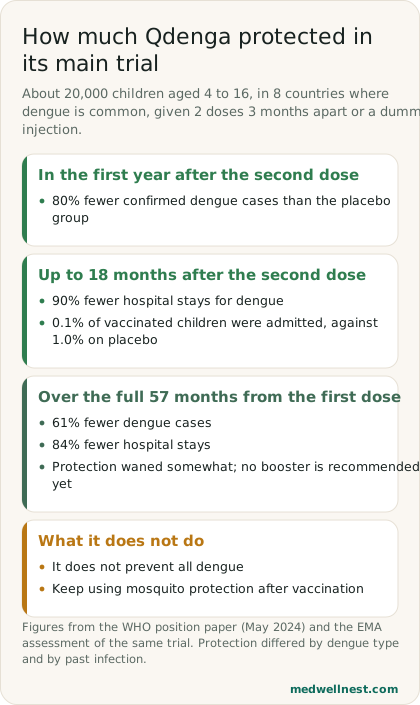
The evidence comes mainly from one large trial of about 20,000 children aged 4 to 16 in 8 countries in Asia and Latin America where dengue is common. In the year after the second dose, WHO reports, vaccinated children had 80% fewer confirmed dengue cases than those given a placebo, a dummy injection. Up to 18 months after the second dose, they had 90% fewer hospital stays for dengue: 0.1% of vaccinated children were admitted, against 1.0% on placebo, in the EMA's figures.
Protection faded somewhat with time. Counting from the first dose over 57 months, about four and a half years after the second, WHO puts it at 61% fewer dengue cases and 84% fewer hospital stays. That is still substantial, but it means vaccinated people can and do get dengue.
WHO is blunt about what this means: the vaccine does not prevent all dengue, and mosquito control must remain part of every programme. The EMA's product information says to keep using personal protection against mosquito bites after vaccination.
04
The gap: dengue types 3 and 4 in people never infected
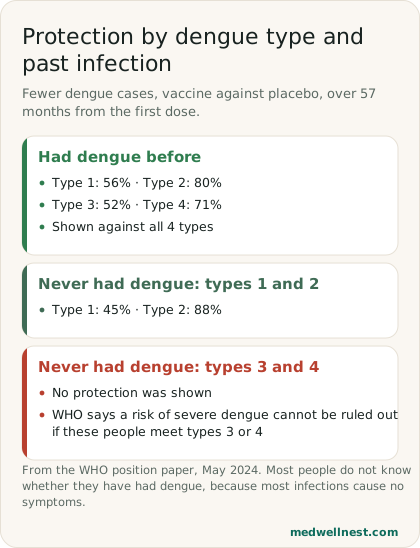
Dengue has four types. In children who had already had dengue before vaccination, WHO says the vaccine protected against all four. In children who had never had it, protection was shown only against types 1 and 2. Against type 3 it was not shown, and there were too few type 4 cases to tell. The EMA's product information says the same.
WHO adds a caution: for people who have never had dengue, the vaccine may not protect against types 3 and 4, and with current data a risk of severe dengue cannot be ruled out if they catch those types. In the trial, the only two cases of severe dengue among never-infected children were both type 3, and both were in the vaccinated group, though the numbers were too small to draw firm conclusions.
This is why WHO's recommendation is narrower than the licence. It advises using the vaccine in children aged 6 to 16 in places with heavy dengue transmission, where most children will already have met the virus. It does not recommend it for routine use under age 6, where it worked less well, and it sets an upper limit of 60. For people with conditions that raise the risk of severe dengue, such as diabetes, high blood pressure or sickle cell disease, it says vaccination could be offered outside that age band where severe dengue is a documented problem in such groups, but they should be told about the type 3 and 4 uncertainty.
05
Who should not have it
Because it is a live vaccine, the EMA says Qdenga must not be given in pregnancy or while breastfeeding, or to anyone whose immune system is weakened by a disease, by medicines that suppress immunity such as chemotherapy or high-dose steroids, or by HIV with signs of impaired immunity. Women who could become pregnant should avoid pregnancy for at least a month after vaccination. WHO adds that a dose given by accident in pregnancy is not a reason to end the pregnancy.
It must not be given to someone who had an allergic reaction to an earlier dose. It should be put off during an acute, severe illness with fever, though a minor infection such as a cold is not a reason to delay. If you have recently had blood, plasma or immunoglobulin, the EMA advises waiting at least 6 weeks, and preferably 3 months.
There are no data in people over 60, the EMA notes, and limited data in people with long-term illnesses. If that is you, discuss the balance with your doctor rather than assuming the vaccine is either needed or off-limits.
06
Side effects, and dengue tests after the vaccine
In trials, the EMA lists pain at the injection site in 50% of people, headache in 35%, muscle aches in 31%, redness at the site in 27%, feeling unwell in 24%, weakness in 20% and fever in 11%. These usually started within 2 days, were mild to moderate, lasted 1 to 3 days, and were less common after the second dose.
The weakened virus can circulate briefly after the first dose, in about half of people who had never had dengue. It usually appears in the second week and can cause mild headache, joint or muscle aches, or a rash. The EMA warns that dengue tests may turn positive during this time and cannot tell the vaccine virus from real dengue, so tell your doctor you were vaccinated if you are tested.
If you develop dengue symptoms at any time after vaccination, seek care as you would otherwise. WHO lists the signs of severe dengue, which often come after the fever settles: severe abdominal pain, repeated vomiting, fast breathing, bleeding gums or nose, blood in vomit or stool, restlessness, great thirst, and pale, cold skin.
When to act
Emergency — act now
Trouble breathing, swelling of the face or throat, or feeling faint soon after the injection: this can be a severe allergic reaction, most of which happen within 30 minutes. Get emergency care at once.
During or after a dengue-like fever, severe abdominal pain, repeated vomiting, fast breathing, bleeding gums or nose, blood in vomit or stool, restlessness, or pale, cold skin: go to emergency now, whether or not you were vaccinated.
Same-day — call promptly
Fever with headache, body aches or rash after vaccination or at any other time: see a doctor the same day, and tell them about the vaccine, because it can make dengue tests positive.
Routine — see a doctor
You are pregnant, breastfeeding, planning a pregnancy, over 60, have a weakened immune system, or have a long-term illness: talk it through with your doctor before booking a dose.
Values mentioned in this story
Each one opens a visual guide with its normal range and what moves it — upload a report and we place your own numbers on the same scale.
Sources
- CDSCO approves first dengue vaccine — Press Information Bureau, 21 July 2026pib.gov.in
- WHO position paper on dengue vaccines, May 2024 (Weekly Epidemiological Record No 18)iris.who.int
- Qdenga: EPAR medicine overview — European Medicines Agencyema.europa.eu
- Qdenga: product information (summary of product characteristics) — European Medicines Agencyema.europa.eu
- Dengue and severe dengue — WHO fact sheetwho.int
Share this story
Curious where your own values stand?
Two minutes from upload to a full visual picture. Free to analyze.