In short
Most viral fevers settle within a few days with rest and fluids, and antibiotics do not help them. Here is how long to wait, what to do at home, which dengue test fits which day of fever, and the signs that mean you should not wait at all.
Emergency if: Fever with difficulty breathing, blue lips, confusion, a stiff neck, a seizure, being hard to wake, or a child's rash that does not fade under a glass: call emergency services. In dengue season, vomiting that keeps on, belly pain, any bleeding, fainting or unusual drowsiness means go to hospital now.
On your report
Platelet Count, WBC / Total Leukocyte Count, Hematocrit / PCV, Absolute Neutrophil Count +1 more
On this page
02
How many days it usually lasts
For children, the NHS says the temperature usually returns to normal within 1 to 4 days. For adults, MedlinePlus advises contacting a doctor if a fever lasts longer than 48 to 72 hours, stays at or keeps rising above 39.4°C, or keeps coming and going for a week or more even when it is not very high.
The rest of the illness can take longer than the fever. Dengue, which is common in the rainy months, typically causes 2 to 7 days of symptoms, according to the WHO.
A high number is not the same as a serious illness. MedlinePlus notes that a simple viral infection can push the temperature to 38.9°C to 40°C without anything serious going on. The NICE guideline on fever in under-5s also warns against using how long the fever has lasted to judge how serious it is, though a child with a fever of 5 days or more should be checked for Kawasaki disease.
03
Home care that actually helps
The NHS advice is simple: rest, and drink enough fluid that your urine is light yellow and clear. Paracetamol or ibuprofen can be taken if you feel uncomfortable, and it helps to stay home and away from other people until the fever has gone. Check the pack or ask a pharmacist for the right amount, especially for children.
In dengue season, be careful with painkillers. The WHO says that in dengue, anti-inflammatory medicines such as ibuprofen and aspirin should be avoided because they can increase the risk of bleeding, and paracetamol is used for pain instead. Until dengue has been ruled out, ask your doctor before taking ibuprofen or aspirin.
For children, the NHS says not to undress or sponge them down, since a high temperature is a natural response to infection, and never to give aspirin under 16. NICE adds that fever medicine is for a child who is distressed, not for bringing the number down, and that it does not prevent febrile seizures. MedlinePlus warns against cold baths, ice or alcohol rubs.
04
Why antibiotics are not the answer
Antibiotics kill bacteria. They do not work against viruses, so taking them for a viral fever brings side effects without any benefit. NICE tells doctors not to prescribe oral antibiotics to a young child whose fever has no apparent source.
Some fevers do need them. Typhoid, for example, is a bacterial infection that is confirmed by blood testing and treated with antibiotics. That is the point of testing when a fever does not settle: it separates the few infections that need a specific treatment from the many that just need time.
05
Which test, and on which day, in dengue season
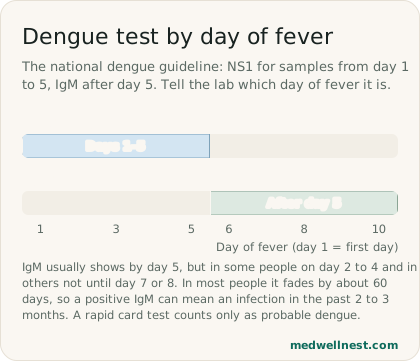
Timing decides which dengue test makes sense. The national dengue guideline says NS1 is used for samples collected from day 1 to 5 of fever, and IgM after day 5. IgM usually shows by day 5, but in some people as early as day 2 to 4 and in others not until day 7 or 8, so an early negative IgM does not rule dengue out.
The same guideline treats a positive rapid card test only as probable dengue, because of the poor sensitivity and specificity of the cards currently available. Malaria is confirmed with a parasite test, by microscopy or a rapid test, and early testing matters because its symptoms look like many other fevers.
Beyond these, MedlinePlus lists a blood count, a urine test and a chest X-ray as tests a doctor may use to find the cause. For a day-by-day walk through dengue, malaria and typhoid testing, see our guide Fever for Three Days: Which Blood Test, on Which Day?
06
Red flags in adults and children
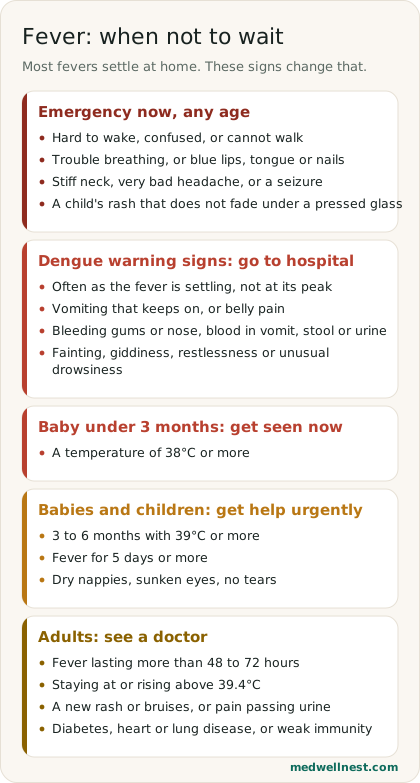
Get emergency help for a fever with any of the signs MedlinePlus lists: being hard to wake, confused or unable to walk, difficulty breathing, blue lips, tongue or nails, a very bad headache, a stiff neck or a seizure. In a child, the NHS adds a rash that does not fade when a glass is pressed on it, unusually cold hands and feet, pale, blue, grey or blotchy skin, grunting or very fast breathing, and being drowsy and hard to wake.
In babies the thresholds are lower. The NHS says to get urgent advice for a baby under 3 months with a temperature of 38°C or more, a baby of 3 to 6 months with 39°C or more, a child with a fever lasting 5 days or more, or signs of dehydration such as dry nappies, sunken eyes and no tears. NICE counts a baby under 3 months with 38°C or more as high risk for serious illness.
With dengue, the dangerous stage often comes as the fever settles. The national guideline lists warning signs: vomiting that keeps on, belly pain and tenderness, bleeding from the gums or nose, blood in vomit, stool or urine, or unusually heavy periods, fainting or giddiness, and lethargy or restlessness. Anyone who develops one should be admitted to hospital. The WHO says such symptoms need care immediately.
When to act
Routine — see a doctor
A fever that is settling within 2 to 3 days, with the person drinking well and no warning signs: rest and fluids at home. See your doctor if it is not settling or you are getting worse.
Same-day — call promptly
An adult with fever for more than 48 to 72 hours, a fever staying at or above 39.4°C, a new rash or bruises, pain passing urine, or a long-term illness or weak immunity: see a doctor today. A baby under 3 months with 38°C or more, or 3 to 6 months with 39°C or more (some sources use 38.3°C), needs to be seen straight away.
Emergency — act now
Fever with difficulty breathing, blue lips, confusion, a stiff neck, a seizure, being hard to wake, or a child's rash that does not fade under a glass: call emergency services. In dengue season, vomiting that keeps on, belly pain, any bleeding, fainting or unusual drowsiness means go to hospital now.
Values mentioned in this story
Each one opens a visual guide with its normal range and what moves it — upload a report and we place your own numbers on the same scale.
Sources
- Fever — MedlinePlus Medical Encyclopediamedlineplus.gov
- High temperature (fever) in children — NHSnhs.uk
- Fever in under 5s: assessment and initial management (NG143) — NICEnice.org.uk
- Dengue and severe dengue — WHO fact sheetwho.int
- National Guidelines for Clinical Management of Dengue Fever 2023 — NCVBDCncvbdc.mohfw.gov.in
- High temperature (fever) in adults — NHSnhs.uk
Share this story
Curious where your own values stand?
Two minutes from upload to a full visual picture. Free to analyze.