In short
About 37°C is average and 38°C or above is a high temperature for most purposes. The cut-off shifts a little with where you measure, babies have their own lower lines, and the sources do not all agree on them.
Emergency if: Fever with a stiff neck, a rash that does not fade under a glass, a fit, confusion, being hard to wake, struggling to breathe or blue lips or skin: call emergency services now.
On your report
WBC / Total Leukocyte Count, CRP, Absolute Neutrophil Count, Procalcitonin +1 more
On this page
01
Normal is a range, not one number
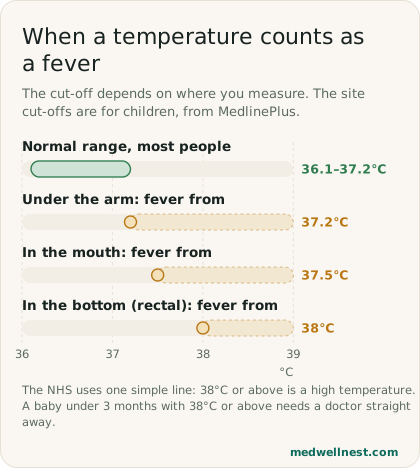
The average body temperature is usually given as 37°C (98.6°F). MedlinePlus notes that some studies find a wide normal range, from about 36.1°C to 37.2°C (97°F to 99°F). The NHS puts it simply: normal temperature is different for everyone and changes during the day.
Your temperature has a daily rhythm. In adults it is lowest in the early morning and usually highest in the evening. The American Academy of Pediatrics (AAP) describes the same pattern in children, highest in the late afternoon and early evening, and adds that infants tend to run warmer than older children.
Everyday things nudge it up as well. Exercise, a big meal, strong feelings, warm clothes, a hot or humid room and some medicines can all raise it, and MedlinePlus notes it can rise by about 0.5°C (1°F) or more in the second half of the menstrual cycle. So one warm reading after exercise or in a hot, humid room may simply reflect that, rather than a fever.
02
Where you measure changes the cut-off
For children, MedlinePlus counts a fever from 38°C (100.4°F) in the bottom (rectal), 37.5°C (99.5°F) in the mouth, and 37.2°C (99°F) under the arm. For adults, it says a mouth reading above 37.2°C to 37.5°C probably means fever, depending on the time of day.
Not every source draws the lines the same way. The AAP says that for mouth, ear and forehead readings you should still generally use 38°C (100.4°F) as the cut-off for a true fever, and that underarm readings may have a lower cut-off. The NHS uses one simple line for adults and children: 38°C or above is a high temperature.
In practice: know which site you used, and say so when you call a doctor. The NHS also says that if you feel hot, cold or shivery you may have a high temperature even when the thermometer reads below 38°C.
03
Choosing and using a thermometer
Use a digital thermometer. The NHS advises against glass thermometers because they can be dangerous, forehead strips because they are not accurate, and infrared thermometers because some do not meet safety regulations. The AAP also calls fever strips unreliable, and says touching the forehead or skin is not an accurate way to judge a fever.
For an adult mouth reading, the NHS says: clean the tip with cold water and soap and rinse it, turn it on, put the tip under your tongue towards the back of your mouth, close your lips around it and wait for the beep. You can also use the armpit, keeping your arm tight against your body until it beeps.
For children, the NHS suggests the armpit: place the tip inside the top of the armpit, close the arm over it, and leave it in place for as long as the leaflet says. If your child has just had a bath or been wrapped in a blanket, wait a few minutes and try again. The AAP advises against ear thermometers in babies under 6 months, whose ear canals are too small for an accurate reading, and says a rectal reading is the most reliable for infants.
04
Babies: lower lines, and sources that differ
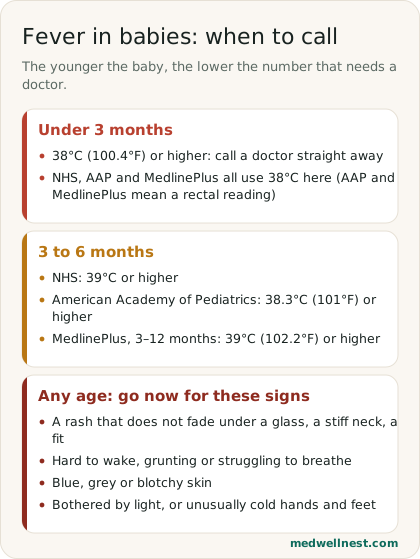
For a baby under 3 months (the AAP and MedlinePlus say 3 months or younger), all three sources we checked use the same number: 38°C (100.4°F) or higher. The NHS says to get urgent medical advice, even if you only think your baby has a high temperature. The AAP, which measures rectally at this age, says to call your paediatrician immediately, even if the baby has no other signs of illness. In practice, get a doctor's advice straight away.
Between 3 and 6 months the sources part ways, and it is fairer to show you all three. The NHS says to get urgent medical advice at 39°C or higher, or if you think they have a high temperature. The AAP says you may need to let your doctor know at 38.3°C (101°F) or higher. MedlinePlus, which groups 3 to 12 months together, says to contact the doctor right away at 39°C (102.2°F) or higher. For babies older than 6 months the AAP line is 39.4°C (103°F). MedlinePlus also says to contact a doctor right away if a child aged 2 or under has had a fever for more than 24 to 48 hours, or an older child for more than 48 to 72 hours.
At any age, the NHS says to call emergency services for a stiff neck, a rash that does not fade when you press a glass on it, a first fit, a child who is drowsy and hard to wake, grunting or struggling to breathe, being bothered by light, unusually cold hands and feet, or skin, lips or tongue turning blue, grey, pale or blotchy. Get urgent medical advice for a high temperature lasting 5 days or more, or signs of dehydration such as dry nappies, sunken eyes and no tears. MedlinePlus adds that teething does not push a child's temperature above about 37.8°C (100°F), so do not put a higher reading down to teething.
05
Adults: when a fever needs a doctor
The NHS says a high temperature is often just the body fighting an infection such as a cold or flu. MedlinePlus notes that even a simple viral illness can push temperature to 38.9°C to 40°C (102°F to 104°F) without meaning something serious. The NHS says to ask for an urgent appointment if you have been treating a high temperature at home and it is not getting better, or is getting worse.
MedlinePlus advises contacting a doctor right away if a fever reaches 40.6°C (105°F) or higher and does not come down readily with treatment, stays at or keeps climbing above 39.4°C (103°F), lasts longer than 48 to 72 hours, or keeps coming and going for a week or more. Do the same if you have a serious long-term illness such as heart disease, diabetes, sickle cell disease or COPD, a weakened immune system, a new rash or bruising, pain when passing urine, or you have recently travelled abroad.
Call emergency services if a person with a fever is very hard to wake, seems confused, cannot walk, has difficulty breathing, has blue lips, tongue or nails, has a very bad headache or a stiff neck, or has a seizure.
06
Looking after a fever at home
For adults, the NHS suggests rest, plenty of fluids so your pee stays light yellow and clear, and paracetamol or ibuprofen if you feel uncomfortable. Try to stay home and away from other people until the high temperature has gone.
For children, the NHS advises against undressing them or sponging them down, and against piling on clothes or bedding. Do not give aspirin to children under 16, paracetamol to babies under 2 months, or ibuprofen to babies under 3 months or under 5 kg, to a child who has chickenpox or is dehydrated, or to children with asthma unless a doctor has recommended it. MedlinePlus sets a later age for ibuprofen, 6 months, so ask a doctor or pharmacist before giving it to a young baby. MedlinePlus warns against cold baths, ice or alcohol rubs, which can cause shivering and push core temperature up. The aim is comfort, not a perfect number on the thermometer.
When to act
Routine — see a doctor
A temperature of 38°C or so in an adult or older child who is drinking, alert and comfortable: rest, fluids and paracetamol or ibuprofen if needed, and watch how it goes over the next day or two.
Same-day — call promptly
Get a doctor's advice today for: a baby under 3 months at 38°C or higher (today means straight away at this age); a baby of 3 to 6 months at 38.3°C or higher, the lowest of the three lines; a fever lasting more than 24 to 48 hours in a child aged 2 or under, or more than 48 to 72 hours in an older child or adult (the NHS line is 5 days); or a fever that keeps rising above 39.4°C.
Emergency — act now
Fever with a stiff neck, a rash that does not fade under a glass, a fit, confusion, being hard to wake, struggling to breathe or blue lips or skin: call emergency services now.
Values mentioned in this story
Each one opens a visual guide with its normal range and what moves it — upload a report and we place your own numbers on the same scale.
Sources
- High temperature (fever) in adults — NHSnhs.uk
- High temperature (fever) in children — NHSnhs.uk
- Fever — MedlinePlus Medical Encyclopediamedlineplus.gov
- Body temperature norms — MedlinePlus Medical Encyclopediamedlineplus.gov
- Fever and Your Baby — American Academy of Pediatrics (HealthyChildren.org)healthychildren.org
Share this story
Curious where your own values stand?
Two minutes from upload to a full visual picture. Free to analyze.