In short
The APGAR score on a baby's birth card adds up 5 quick checks made at 1 and 5 minutes. Here is how each sign is scored, why 8/9 is a normal result, what a low score can and cannot tell you, and the danger signs to watch for at home.
Emergency if: A newborn with a convulsion or fit, severe chest in-drawing, no spontaneous movement, fast breathing of more than 60 breaths a minute, poor feeding, a temperature above 37.5 °C or below 35.5 °C, yellow skin in the first 24 hours, or yellow palms and soles: take the baby to hospital now. WHO lists these as newborn danger signs and asks families to seek care early.
On your report
Total Bilirubin
On this page
01
What the APGAR score is
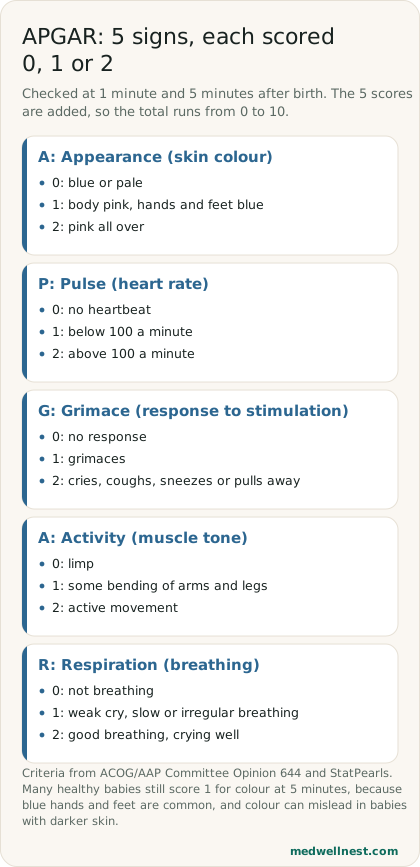
The APGAR score is a quick check of how a newborn baby is coping in the first minutes after birth. It was devised in 1952 by Dr Virginia Apgar, an anaesthetist. The American College of Obstetricians and Gynecologists (ACOG) and the American Academy of Pediatrics (AAP) describe 5 components: colour, heart rate, reflexes, muscle tone and breathing, each given 0, 1 or 2 points.
The points are added, so the total runs from 0 to 10. Every baby is scored at 1 minute and at 5 minutes after birth. If the 5-minute score is below 7, the score is repeated every 5 minutes up to 20 minutes. The letters of the name are a handy memory aid: Appearance, Pulse, Grimace, Activity and Respiration.
02
How each sign is scored
Appearance is skin colour: 0 for blue or pale, 1 for a pink body with blue hands and feet, and 2 for pink all over. Pulse is the heart rate: 0 if there is none, 1 if it is below 100 beats a minute, and 2 if it is above 100. Grimace is the response to stimulation: 0 for none, 1 for a grimace, and 2 for crying, coughing, sneezing or pulling away.
Activity is muscle tone: 0 for limp, 1 for some bending of the arms and legs, and 2 for active movement. Respiration is breathing: 0 if the baby is not breathing, 1 for a weak cry or slow, irregular breathing, and 2 for good breathing with a strong cry. StatPearls notes that many babies still score 1 for colour at 5 minutes, because blue hands and feet are common in healthy newborns, and that colour can mislead in babies with darker skin.
03
Reading 7/9, 8/9 and other pairs
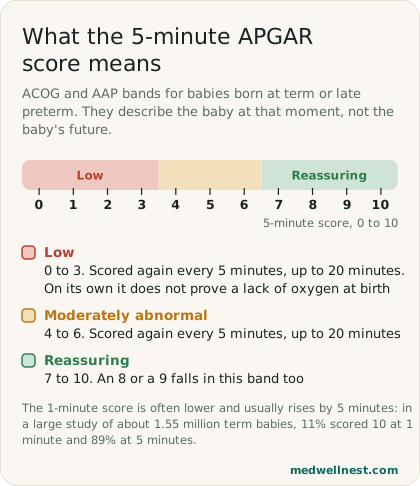
Birth cards usually show two numbers, such as 8/9 or 8 and 9. The first is the 1-minute score and the second is the 5-minute score. ACOG and AAP define a 5-minute score of 7 to 10 as reassuring, 4 to 6 as moderately abnormal, and 0 to 3 as low, for babies born at term or a little early (late preterm). So 8/9, 7/9 and 9/9 are all reassuring results.
A lower first number that rises by the second is the usual pattern, as the baby starts breathing and the circulation adjusts. In a large study of about 1.55 million babies born at term, only 11% scored 10 at 1 minute, while 89% scored 10 at 5 minutes. Losing a single point for colour, because the hands and feet are still a little blue, is common.
04
What the score cannot tell you
The APGAR score describes a baby at one moment. ACOG and AAP state that the score alone is not evidence of a lack of oxygen at birth (asphyxia), does not predict an individual baby's survival or later brain development, and should not be used for that purpose. A 1-minute score of 0 to 3 does not predict any individual baby's outcome.
Many things can lower a score without harm, including medicines or anaesthesia given to the mother, being born early, and simple differences between the people doing the scoring. ACOG notes that a healthy preterm baby may score low only because of immaturity. Population studies show that most babies with low APGAR scores do not develop cerebral palsy, although a low 5-minute score does raise the risk compared with a score of 7 to 10, which is why follow-up matters.
05
If your baby's score was low
Help for a baby who is not breathing well starts before the 1-minute score is even written down; the score records the baby's condition, it does not decide the care. The 5-minute score, and especially how much it changes between 1 and 5 minutes, shows how well the baby responded to that help. ACOG adds that when the 5-minute score is 7 or more, a lack of oxygen around birth is unlikely to have caused newborn encephalopathy, a brain problem in the first days of life.
If your baby needed help at birth or the score stayed low, ask the paediatrician what happened, what other tests were done, such as a blood gas from the umbilical cord, and what follow-up is planned. The answer should come from those results and the baby's examination, not from the APGAR number alone.
06
Danger signs to watch for at home
A good APGAR score does not protect against illness in the weeks after birth. The World Health Organization (WHO) lists danger signs that need a health check without delay: not feeding well, a convulsion or fit, fast breathing of more than 60 breaths a minute, severe chest in-drawing, no spontaneous movement, fever above 37.5 °C, a low temperature below 35.5 °C, any yellow skin in the first 24 hours, or yellow palms and soles at any age.
WHO asks families to seek care early if they see any of these signs between check-ups. Count breathing for a full minute while the baby is calm, and check temperature with a thermometer rather than by touch. Take a baby with any of these signs to a hospital or doctor straight away.
When to act
Emergency — act now
A newborn with a convulsion or fit, severe chest in-drawing, no spontaneous movement, fast breathing of more than 60 breaths a minute, poor feeding, a temperature above 37.5 °C or below 35.5 °C, yellow skin in the first 24 hours, or yellow palms and soles: take the baby to hospital now. WHO lists these as newborn danger signs and asks families to seek care early.
Routine — see a doctor
Questions about the APGAR numbers on the birth card, with a baby who is feeding and well: ask at the next newborn check-up. The score by itself does not need any test or treatment.
Values mentioned in this story
Each one opens a visual guide with its normal range and what moves it — upload a report and we place your own numbers on the same scale.
Sources
- The Apgar Score — ACOG/AAP Committee Opinion No. 644acog.org
- APGAR Score — StatPearls, NCBI Bookshelfncbi.nlm.nih.gov
- Association between Apgar scores of 7 to 9 and neonatal mortality and morbidity — BMJ 2019pmc.ncbi.nlm.nih.gov
- WHO recommendations on maternal and newborn care for a positive postnatal experience — WHO 2022who.int
Share this story
Curious where your own values stand?
Two minutes from upload to a full visual picture. Free to analyze.