In short
Keep the room at 16 to 20 °C, dress a baby in 1 more layer than you are wearing and feel the chest or back of the neck, not the hands. Overheating raises the risk of cot death, so no heater, hot water bottle or sigdi next to a sleeping baby.
Emergency if: Your baby's lips, tongue or skin turn blue, grey or paler than usual; your baby is limp and floppy, will not wake or is not responding as usual; is struggling to breathe or has stopped breathing; or is stiff, shaking or jerking: call emergency services now. A baby who is cold and floppy is in this group. Also go to an emergency department now if a baby under 3 months has a temperature of 38 °C or higher, unless a doctor can see your baby within 2 hours. The NHS lists the first signs as emergencies, and NICE guideline NG143 treats a temperature of 38 °C or higher under 3 months as a red feature needing a face-to-face assessment within 2 hours.
On this page
01
How warm should a newborn's room be in winter?
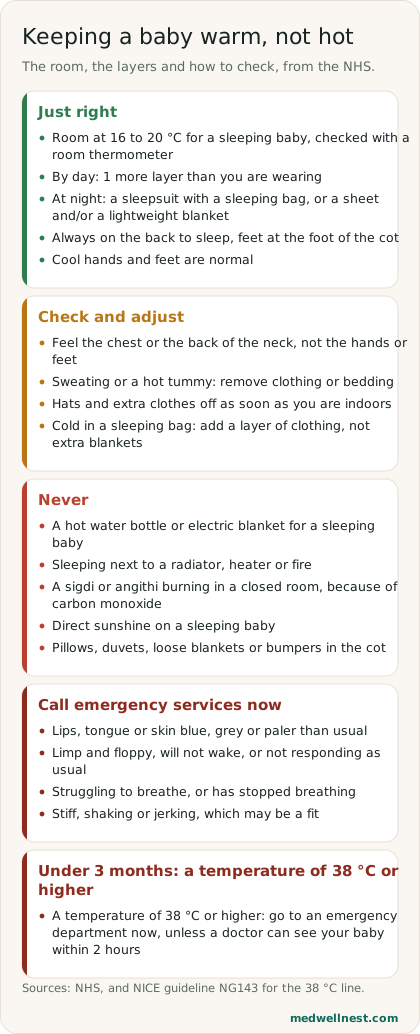
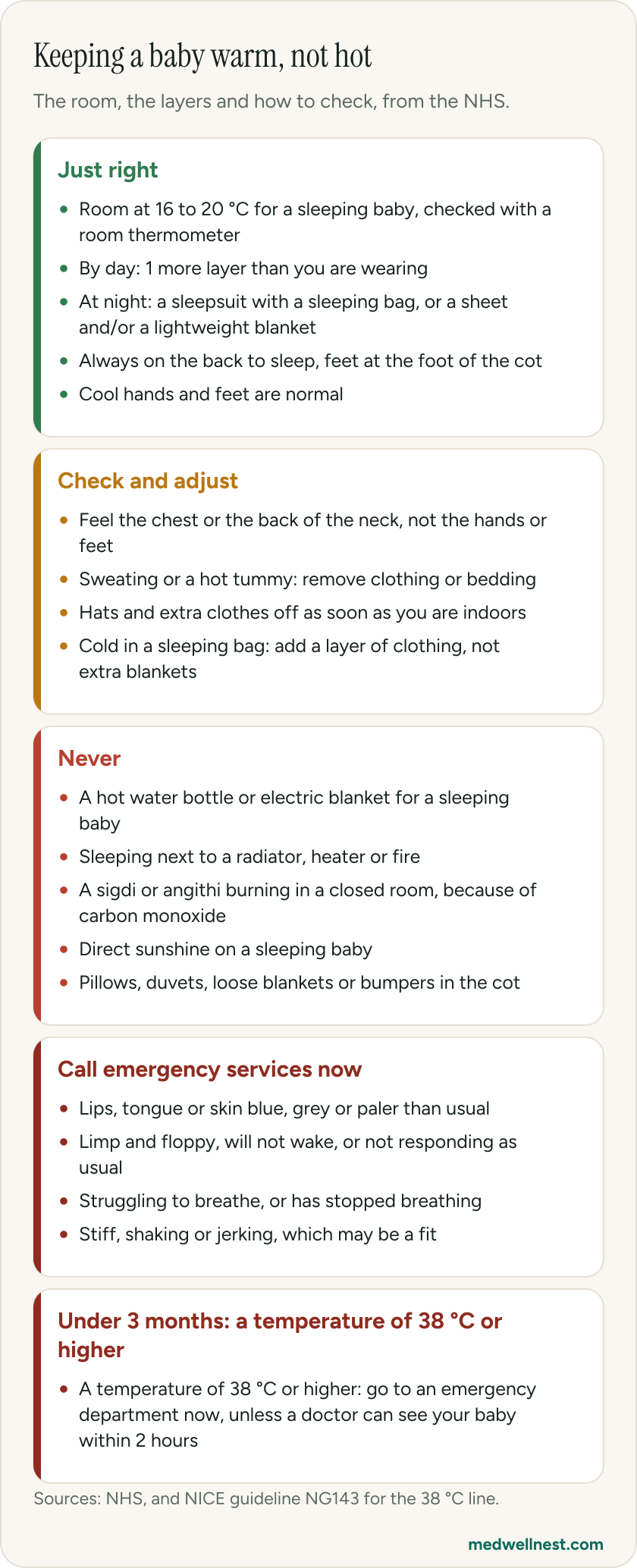
The NHS says a room temperature of 16 to 20 °C is comfortable and safe for sleeping babies, and advises using a room thermometer to check it. A baby in that room needs only light bedding or a lightweight, well-fitting baby sleeping bag. The NHS explains that small babies are not very good at regulating their own temperature, so they can overheat from too much clothing or bedding, or because the room is too hot.
This matters because overheating is linked to sudden infant death syndrome (SIDS, also called cot death). The NHS says overheating a baby increases the chances of SIDS and that research shows babies are better cooler than too hot. So the aim in winter is not the warmest room you can make. It is a steady room in the 16 to 20 °C range with the right layers on the baby.
02
How many layers should I put on a newborn in winter?
For the day, the NHS gives a rule of thumb: dress your baby in 1 extra layer of clothing compared with what you are wearing. If you are in a t-shirt and jumper, that means a vest, sleepsuit and a cardigan or jumper. The NHS adds that if you feel chilly your baby probably does too, and that hats and extra clothing should come off as soon as you are indoors or get into a warm car, bus or train, even if that means waking your baby.
At night the NHS says a sleepsuit with either a sleeping bag or a sheet and/or blanket should be fine. If you use a sleeping bag and your baby seems cold, add an extra layer of clothing, but not extra blankets. If you use blankets, choose lightweight cellular ones and avoid thick, fleecy or padded blankets, and remember that a folded blanket counts as 2 blankets. The NHS says even in winter most babies who are unwell or feverish do not need extra clothes.
03
How do I know if my baby is too cold or too hot?
Do not judge by the hands and feet. The NHS says to check your baby's temperature by feeling the chest or the back of the neck, and that cool hands or feet are normal. If the baby is sweating or the tummy feels hot to the touch, take off some clothing or bedding. A hot, sweaty baby is a signal to remove layers, not to add them.
A baby who feels cold is a different matter. WHO lists feeling cold among the danger signs in a newborn, along with feeding problems, reduced activity, difficult breathing, fever and fits, and says families should seek prompt medical care. A baby who is cold on the chest or tummy in a room at 16 to 20 °C, or who is unusually sleepy or feeding poorly, needs to see a doctor today rather than more blankets, and a baby who is cold and floppy, hard to wake or not feeding at all needs emergency help now.
04
Is it safe to use a heater, hot water bottle or sigdi near a newborn?
Not near a sleeping baby. The NHS says babies should never sleep with a hot water bottle or electric blanket, next to a radiator, heater or fire, or in direct sunshine. If a room feels cold, the NHS answer is an extra layer of clothing on the baby within the limits above, not a heat source beside the cot.
A sigdi or angithi in a closed room has a separate danger. The NHS says carbon monoxide is a poisonous gas that can be made by fires and appliances that burn gas, wood, oil or coal, and that it is colourless and has no smell, so you cannot tell it is there. Warming a sleeping baby's room this way can poison the whole family before anyone notices. Our story on sigdi and heater safety explains the signs and what to do.
05
Can I put a sweater and cap on my baby to sleep?
The NHS night-time advice is a sleepsuit plus a sleeping bag, or a sheet and/or blanket, and it tells you to remove hats as soon as you come indoors. So a woollen cap does not belong on a sleeping baby indoors. The NHS does not give a rule about sweaters. Its rule is to judge by the chest or back of the neck, to keep the room at 16 to 20 °C, and to add a layer of clothing, not blankets, if the baby in a sleeping bag seems cold.
Safe sleep covers more than temperature. The NHS says to place your baby on their back to sleep with the feet at the foot of the cot, to keep the cot clear of pillows, duvets, cot bumpers, loose blankets and soft toys, and not to sleep on a sofa or in an armchair with your baby. It also advises a separate cot or Moses basket in the same room as you for every sleep for at least the first 6 months.
06
Is skin-to-skin (kangaroo) care good for keeping a newborn warm?
Yes. WHO lists thermal protection, for example promoting skin-to-skin contact between mother and baby, among the care all babies should receive. For babies born early or small, WHO says increased attention to keeping the newborn warm, including skin-to-skin care, is part of their care, and its 2022 recommendations found that kangaroo mother care immediately after birth can substantially reduce deaths in preterm and low birthweight babies.
Skin-to-skin is warmth for a baby who is being held and watched, not a way to sleep. If you carry your baby in a sling, the NHS says it is not safe to feed the baby in the sling and the material must not cover the baby's head. When you want to sleep, the baby goes in the cot on the back, not on your chest on a sofa or armchair.
When to act
Emergency — act now
Your baby's lips, tongue or skin turn blue, grey or paler than usual; your baby is limp and floppy, will not wake or is not responding as usual; is struggling to breathe or has stopped breathing; or is stiff, shaking or jerking: call emergency services now. A baby who is cold and floppy is in this group. Also go to an emergency department now if a baby under 3 months has a temperature of 38 °C or higher, unless a doctor can see your baby within 2 hours. The NHS lists the first signs as emergencies, and NICE guideline NG143 treats a temperature of 38 °C or higher under 3 months as a red feature needing a face-to-face assessment within 2 hours.
Same-day — call promptly
Your baby feels cold on the chest or tummy even when dressed for a room at 16 to 20 °C, is feeding poorly, is unusually sleepy or less active than usual, or has trouble breathing that is not an emergency: see a doctor today. WHO lists feeling cold, feeding problems, reduced activity, difficult breathing, fever and fits as danger signs in a newborn that need prompt medical care. If your baby is sweating or has a hot tummy, remove a layer first, but do not wait if your baby also seems unwell. If your baby is cold and also floppy, hard to wake or not feeding at all, call emergency services now.
Routine — see a doctor
You are unsure how to dress your baby, which sleeping bag to buy, or whether your home is staying near 16 to 20 °C: ask your doctor or nurse at the next visit and use a room thermometer. For a sleeping bag, check the maker's guidance for winter thickness, as the NHS advises.
Sources
Share this story
Curious where your own values stand?
Two minutes from upload to a full visual picture. Free to analyze.