In short
A bone age X-ray of the left hand and wrist compares how mature a child's bones look with their calendar age. Here is how the Greulich–Pyle atlas is read, what within 2 SD means, what delayed or advanced can mean, and why adult height predictions are only estimates.
On this page
01
What the X-ray is, and why it is the left hand
Bone age is the age the bones appear to be on an X-ray, which can differ from the child's calendar age. StatPearls says the test is a standard front-on view of the hand and wrist, with an effective radiation dose of between 0.0001 and 0.1 mSv per exposure. A 2015 review in Clinical Pediatric Endocrinology says the two most commonly used methods, Greulich–Pyle and Tanner–Whitehouse 2, both use left hand and wrist X-rays, because the hand and wrist contain many bones and are easy to image.
The left hand is used because most people are right-handed, so the right hand is more likely to have been injured or deformed, StatPearls explains. The 2015 review calls bone age an effective indicator for diagnosing and treating various diseases. The ACMG short stature guideline, a genetics guideline, says it can be useful in assessing a child with short stature, but that a delayed result is nonspecific and associated with many different causes.
02
Greulich–Pyle: matching the film to an atlas
The Greulich–Pyle atlas, published in 1959, holds reference standards of the left hand and wrist, up to 18 years for girls and 19 for boys, StatPearls says. A paper in Skeletal Radiology (2017) explains that the standards are sex-specific and come from a group of children who were examined repeatedly between 1931 and 1942. The radiologist judges how closely the child's film matches one standard over another, and that match is the bone age on the report.
StatPearls describes the Tanner–Whitehouse method as scoring 20 regions of interest in the hand and wrist bones, which it calls more accurate and reproducible but more complex and time-consuming, and says the atlas is less reliable in some groups of children. The Clinical Pediatric Endocrinology review adds that rater variability is high in manual bone age methods, so two readers can give slightly different numbers for the same film.
03
Delayed, normal or advanced: the 2 SD rule
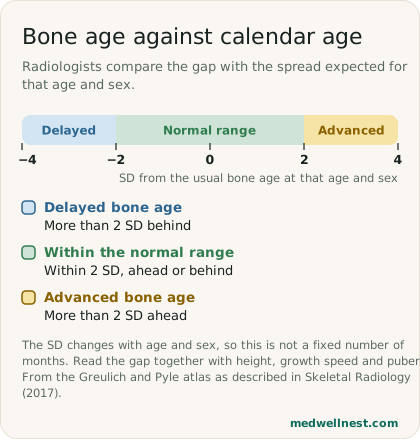
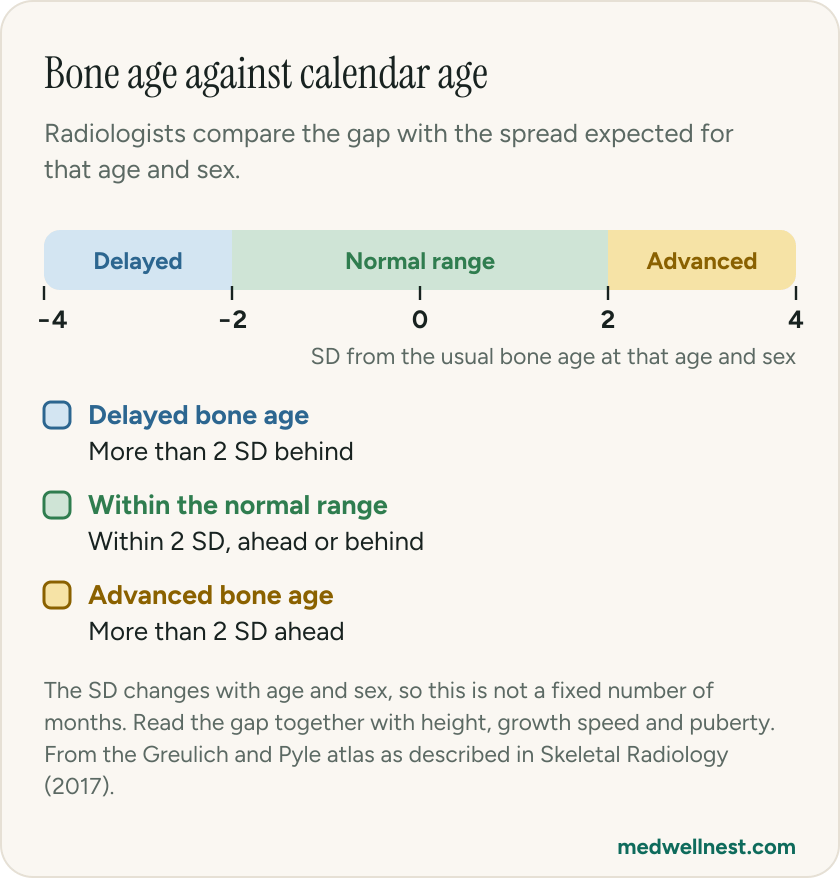
Skeletal Radiology says the atlas also contains tables of sex-specific average skeletal ages and standard deviations (SD) at each chronological age. The radiologist looks up the SD, compares bone age with calendar age, and decides whether the two are within 2 standard deviations of each other. The study is then classed as normal, delayed or advanced maturity. In plain words, a bone age within 2 SD either side is within the normal range, one more than 2 SD behind is delayed, and one more than 2 SD ahead is advanced.
The SD changes with age and sex, so there is no fixed number of months that counts as delayed; a report that says delayed or advanced comes from a table, not from a rule such as one year behind. A gap inside the range is normal variation. A single number also cannot say why a bone age is behind or ahead, which is why doctors read it with height, growth speed and puberty.
04
What delayed or advanced bone age can mean
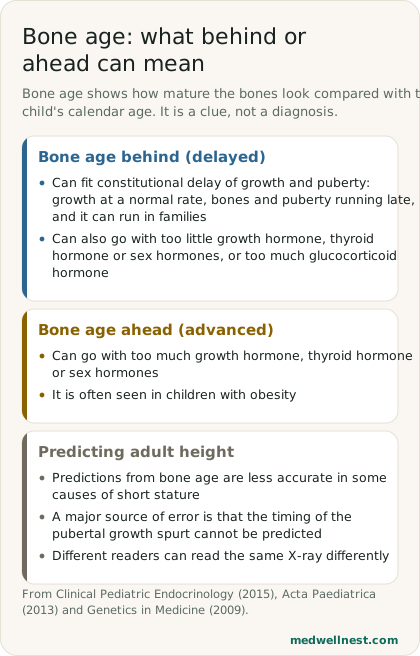
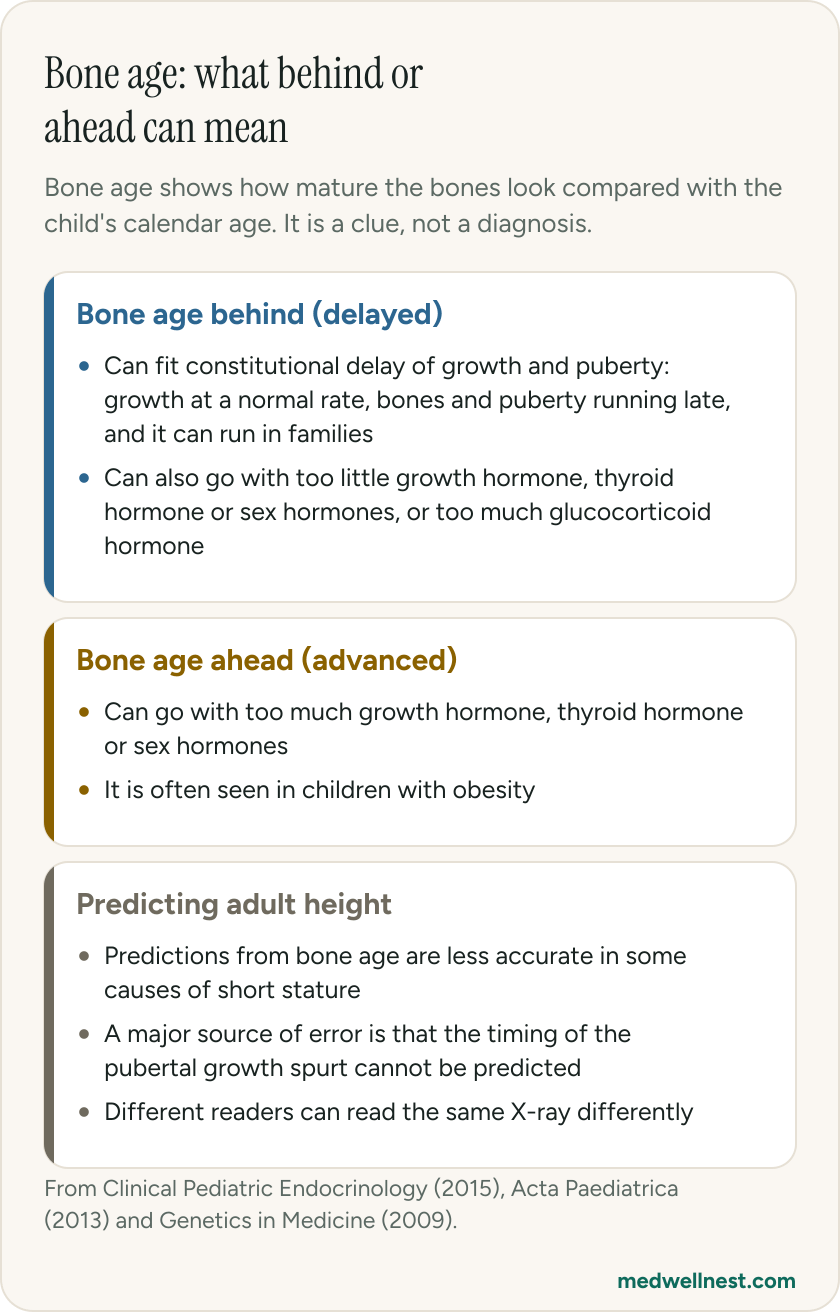
A delayed bone age often reflects a late but normal pattern. An Acta Paediatrica review (2013) describes constitutional delay in growth and puberty as growth at a normal rate with bone age delayed relative to actual age. The ACMG guideline adds that it is suggested by slowing of length or height in the first 3 years of life, a normal or near-normal growth speed in childhood of 4 to 7 cm a year, delayed bone age and puberty, and a final adult height within the normal range. It also says constitutional delay can run in families.
Hormones can also move bone age. The Clinical Pediatric Endocrinology review says deficiencies of growth hormone, IGF-I, thyroid hormone, oestrogen and androgen, and an excess of glucocorticoid, cause both poor growth and delayed bone age. Overproduction of growth hormone, IGF-I, thyroid hormone, oestrogen or androgen causes both overgrowth and advanced bone age. It adds that advanced bone age is often seen in children with obesity. The film is a clue; the explanation comes from examination and, when needed, blood tests.
05
Growth prediction: why the number is an estimate
Doctors sometimes use bone age to predict adult height, with methods such as Bayley–Pinneau and Tanner–Whitehouse mark II. The Clinical Pediatric Endocrinology review says the accuracy of these predictions varies with the cause of the growth problem, that both methods overestimate the adult height of short children, that manual bone age reading adds error, and that a major source of error is the inability to predict the timing of the pubertal growth spurt.
The review also says bone age may become a predictor of the timing of the fastest growth and of the first period. Treat a predicted adult height as a range your doctor may revisit as the child grows, not as a promise. For the ordinary range of growth by age, see our growth and milestones guide; for infants, weight is tracked on charts, which our baby weight chart by month explains.
06
When to see a doctor
A bone age report is not an urgent result. The reason it was ordered may matter more, and early signs of puberty are one reason to talk to the doctor. MedlinePlus says puberty usually begins between ages 8 and 13 for girls and 9 and 14 for boys. In girls, any of these before age 8 counts as precocious puberty: armpit or pubic hair, beginning to grow faster, breasts, a first period or mature outer genitals. In boys the signs before age 9 are armpit or pubic hair, growth of the testes and penis, facial hair, muscle growth or a deepening voice.
MedlinePlus adds that children who go through puberty too early may not reach their full height because growth stops too early, and advises seeing your child's provider if your child shows signs of precocious puberty.
What to do with the report
Routine — see a doctor
The report says delayed or advanced and your child is otherwise well: take it to the doctor who ordered it, together with a record of your child's heights, and ask what it means alongside growth speed and puberty. It is a clue, not a diagnosis.
Your child shows signs of puberty before age 8 for a girl or before age 9 for a boy, such as breasts, pubic or armpit hair, growth of the testes or penis, facial hair or a deepening voice: book a visit with your child's doctor.
Sources
- Bone Age — StatPearlsncbi.nlm.nih.gov
- Bone age: assessment methods and clinical applications — Clinical Pediatric Endocrinology, 2015pmc.ncbi.nlm.nih.gov
- Skeletal development of the hand and wrist: digital bone age companion — Skeletal Radiology, 2017pmc.ncbi.nlm.nih.gov
- Early recognition of growth abnormalities permitting early intervention — Acta Paediatrica, 2013pmc.ncbi.nlm.nih.gov
- ACMG practice guideline: genetic evaluation of short stature — Genetics in Medicine, 2009pmc.ncbi.nlm.nih.gov
- Precocious puberty — MedlinePlus Medical Encyclopediamedlineplus.gov
Share this story
Curious where your own values stand?
Two minutes from upload to a full visual picture. Free to analyze.