In short
A transvaginal cervical length scan measures the cervix because a short one raises the chance of preterm birth. Here is what 25 mm or less means, what funnelling is, which treatments are discussed, and the warning signs that mean contact the maternity unit now.
Emergency if: Regular or frequent contractions or tightening before 37 weeks, fluid leaking from the vagina (a gush or a trickle), vaginal bleeding, or new pelvic or lower abdominal pressure: contact your maternity unit or go to hospital now, or call emergency services if you cannot get there quickly. Do not wait. Mild cramps, a constant dull low backache or a watery, bloody or mucus-like change in discharge also mean call right away.
On this page
01
What the scan measures, and how it is done
The cervix is the lower, narrow end of the uterus, at the top of the vagina, as the American College of Obstetricians and Gynecologists (ACOG) puts it. Its length is measured on a transvaginal ultrasound, a scan done with a slim probe placed in the vagina. A 2012 review in the Journal of Pregnancy says the transvaginal method is the most reliable way to assess the cervix, being objective, reproducible and acceptable to patients, and that you should have an empty bladder.
The review adds that the probe is placed without pressure, because pressing too hard on the cervix can hide a problem. NICE refers to scans carried out between 16 weeks and 24 weeks of pregnancy. A 2025 review in the Journal of Clinical Medicine notes that a short cervix is sometimes an incidental finding in an otherwise low-risk pregnancy.
02
What counts as a short cervix
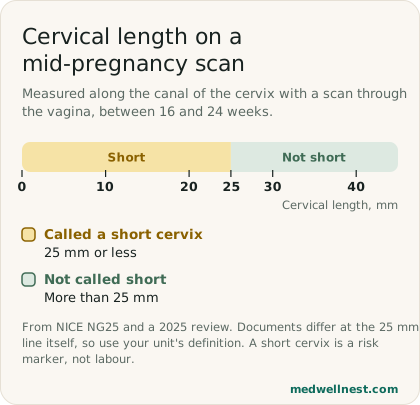
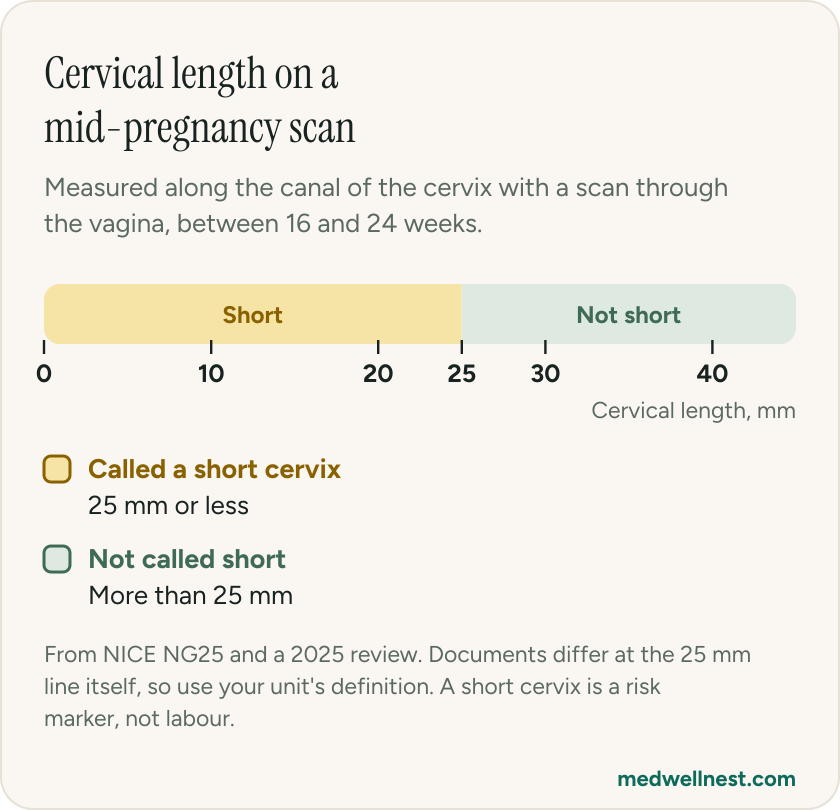
NICE's preterm labour guideline (NG25) uses a cervical length of 25 mm or less on a transvaginal scan carried out between 16 and 24 weeks. The 2025 review says a short cervix is most commonly defined as 25 mm or less in the middle of pregnancy. ACOG's patient page speaks of a short cervix diagnosed by ultrasound before 24 weeks without printing a number. Documents differ even at the 25 mm line: the same review's cerclage data use under 25 mm. Use the definition your unit gives you.
The review also says the relationship is inverse: the shorter the cervix, the higher the risk of preterm birth. A short cervix is a risk marker, not labour and not a diagnosis. ACOG notes that going into preterm labour does not automatically mean a preterm birth, and defines preterm labour as labour that starts before 37 weeks.
03
Why it is measured: the risk of preterm birth
ACOG lists a short cervix, measured on a transvaginal ultrasound, among the risk factors for preterm labour, alongside things such as early cervical dilation and past procedures on the cervix. It says women with a past preterm birth are 2 to 3 times more likely to deliver preterm in the future, and that preterm labour can happen to anyone without warning.
The point of measuring is that a result can change the plan. If the cervix is short, NICE and ACOG both describe treatments that can be offered, which is why finding it early gives you a choice rather than a verdict.
04
Funnelling and other words on the report
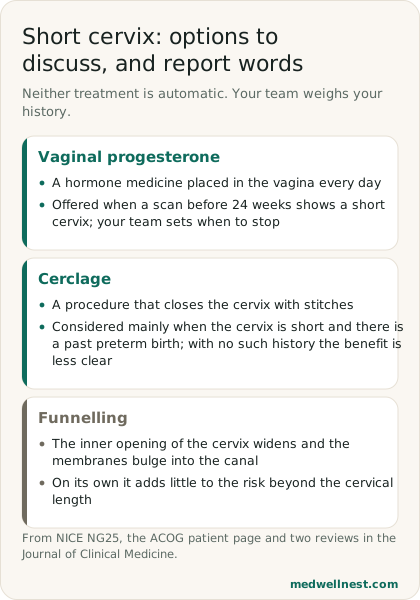
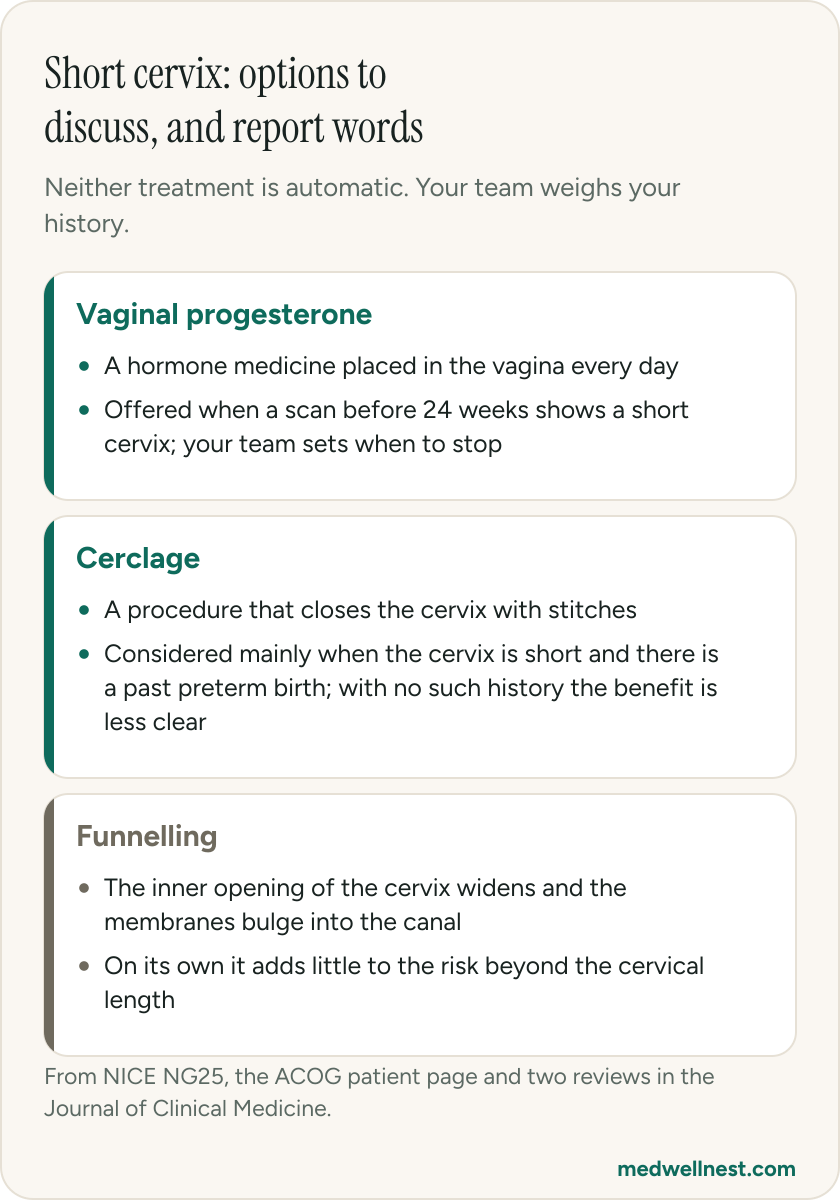
Funnelling means the inner opening of the cervix has widened and the membranes around the baby bulge into the cervical canal. The 2012 Journal of Pregnancy review describes it as the internal opening being wider than 5 mm. A 2021 review in the Journal of Clinical Medicine says funnelling does not significantly add to the risk of preterm birth that is linked to a shortened cervix.
The 2012 review says that, as an independent finding, funnelling does not add appreciably to the risk associated with a short cervix, and that in the studies it reviews women with a long cervix and funnelling were not at increased risk of preterm delivery. So read funnelling together with the length, not on its own.
05
Treatments to discuss: progesterone, cerclage and others
NICE says to offer a choice of vaginal progesterone or a cervical cerclage to women who have both a history of spontaneous preterm birth or late miscarriage and a cervical length of 25 mm or less between 16 and 24 weeks, to discuss the risks and benefits of each, and to make a shared decision. It says to consider progesterone for women with either the history or the short cervix, started between 16 and 24 weeks and continued until at least 34 weeks. A cerclage, a stitch that closes the cervix, can be considered for a short cervix after a previous early rupture of the waters or cervical trauma.
ACOG's patient page says vaginal progesterone, a gel or suppository placed in the vagina daily, may be given for a short cervix found before 24 weeks, and that cerclage may be done if there is also a past preterm birth. It gives the end point as 37 weeks unless delivery happens sooner, where NICE says at least 34 weeks, so your team will tell you when to stop. ACOG also says hormone shots are no longer recommended for preventing preterm birth.
The 2025 review says the value of cerclage is less clear in a short cervix found by chance with no earlier preterm birth, and that trials of a cervical pessary, a ring placed around the cervix, have given conflicting results, with a meta-analysis finding no significant difference in preterm birth. Which option fits depends on your history, so ask your team to explain the reasons. Doses are for your doctor to set.
06
Warning signs: do not wait for the next scan
ACOG says preterm labour needs medical attention right away. Its signs include regular or frequent contractions or tightening, often painless; a gush or trickle of fluid as the waters break; pelvic or lower abdominal pressure; a change in vaginal discharge to watery, bloody or mucus-like, or more discharge; a constant, low, dull backache; and mild abdominal cramps, with or without diarrhoea. MedlinePlus lists contractions every 10 minutes or more often, leaking fluid or bleeding from the vagina, pelvic pressure, backache and period-like cramps.
ACOG's advice is not to wait: call your maternity unit right away or go to the hospital. This applies even if your scan showed a normal cervical length. For the rest of the scan schedule, see our pregnancy tests and scans timeline and our 20-week anomaly scan guide.
Preterm labour warning signs
Emergency — act now
Regular or frequent contractions or tightening before 37 weeks, fluid leaking from the vagina (a gush or a trickle), vaginal bleeding, or new pelvic or lower abdominal pressure: contact your maternity unit or go to hospital now, or call emergency services if you cannot get there quickly. Do not wait. Mild cramps, a constant dull low backache or a watery, bloody or mucus-like change in discharge also mean call right away.
Routine — see a doctor
Your report says short cervix or funnelling and you feel well: a short cervix on its own does not mean you are in labour, but ask the doctor who reviewed the scan what the plan is, whether progesterone or cerclage should be discussed, and what to watch for. Keep your scheduled visits.
Sources
- Preterm labour and birth (NG25) — NICEnice.org.uk
- Preterm Labor and Birth — ACOGacog.org
- Preterm Labor — MedlinePlusmedlineplus.gov
- Updates in contemporary management of singleton pregnancies complicated by a short cervix — Journal of Clinical Medicine, 2025pmc.ncbi.nlm.nih.gov
- Cervical assessment for predicting preterm birth: cervical length and beyond — Journal of Clinical Medicine, 2021pmc.ncbi.nlm.nih.gov
- Transvaginal sonographic evaluation of the cervix in asymptomatic singleton pregnancy and management options in short cervix — Journal of Pregnancy, 2012pmc.ncbi.nlm.nih.gov
Share this story
Curious where your own values stand?
Two minutes from upload to a full visual picture. Free to analyze.