In short
A coronary calcium score counts calcified plaque; a CT coronary angiogram shows how narrow the arteries are. Here is what CAC 0, 1 to 99 and 100 or more mean, how CAD-RADS 0 to 5 grades a narrowing, who the test is for, and when chest pain cannot wait.
Emergency if: Chest pain now, or in the last 12 hours, especially pain lasting more than 15 minutes, spreading to the arm, back or jaw, or with sweating, nausea or breathlessness: call emergency services now. A past calcium score or angiogram does not rule out a heart attack.
On your report
LDL Cholesterol, Lipoprotein(a)
On this page
01
Two scans that answer different questions
A coronary artery calcium (CAC) scan measures calcium in the walls of the heart's arteries and turns it into a number, usually the Agatston score. Calcium is laid down in plaque, so the score is a measure of how much calcified plaque you have. It says nothing directly about narrowing, and CAD-RADS 2.0, the reporting system for coronary CT, notes that a calcium score alone misses soft, noncalcified plaque.
A CT coronary angiogram (CTCA) uses a contrast dye to show the inside of the arteries. It shows calcified and soft plaque, and how much each artery is narrowed. NICE offers CTCA as a first test for people whose chest pain sounds like angina. The calcium score is mainly a tool for people without symptoms; the angiogram is mainly for people who have them.
02
Who the calcium score is for
The 2019 American College of Cardiology and American Heart Association (ACC/AHA) guideline on preventing heart disease says a calcium score is not a screening test for everyone. It is a decision aid for selected adults, mainly those aged 40 to 75 whose estimated 10-year risk of a heart attack or stroke is intermediate, 7.5% to under 20%, or selected people at borderline risk, 5% to under 7.5%, who are unsure whether to take a statin.
In that group the score can move the estimate up or down. A score of 100 or more, or at the 75th percentile or higher for your age, sex and ethnicity, moves risk up; a score of 0 moves it down. The percentile compares your score with people like you, so the same number means more at 45 than at 75.
03
Reading the calcium score
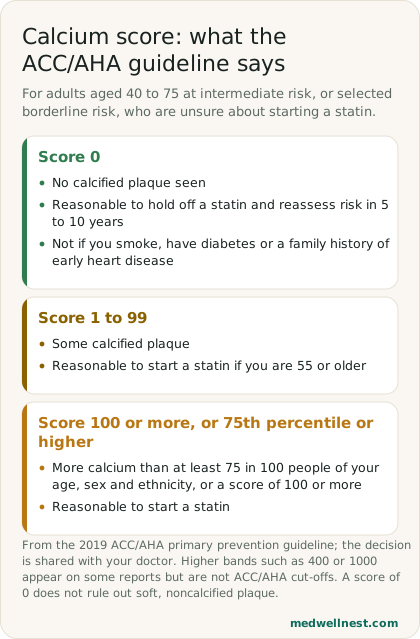
The guideline links three results to statin decisions. With a score of 0 it is reasonable to hold off a statin and reassess in 5 to 10 years, as long as there is no diabetes, smoking or family history of early heart disease. With 1 to 99 it is reasonable to start a statin from the age of 55. With 100 or more, or the 75th percentile or higher, it is reasonable to start one. These are shared decisions with your doctor, not instructions to act on alone.
Many reports print extra bands, and sources draw them differently. A 2017 review uses 1 to 100, 101 to 400 and above 400, while CAD-RADS 2.0 grades plaque as P1 for 1 to 100, P2 for 101 to 300, P3 for 301 to 999 and P4 above 1000. Only 0, 1 to 99, and 100 or more (or the 75th percentile) are the ACC/AHA decision points.
04
Why 0 is good news but not a clean chit
A score of 0 means no calcified plaque was seen, and in people without symptoms it points to a lower 10-year risk. The ACC/AHA guideline is careful, though: the absence of calcium does not rule out noncalcified plaque. In people who smoke, have diabetes or a family history of early heart disease, a score of 0 does not remove the risk from soft plaque or clots.
This matters most if you have symptoms. CAD-RADS 2.0 shows an example of a 70% to 99% narrowing made of noncalcified plaque, the kind a calcium score cannot see. So chest pain on exertion, or new breathlessness, needs assessment even after a score of 0, and the right test is chosen by your doctor, not by the old result.
05
Reading a CT coronary angiography report
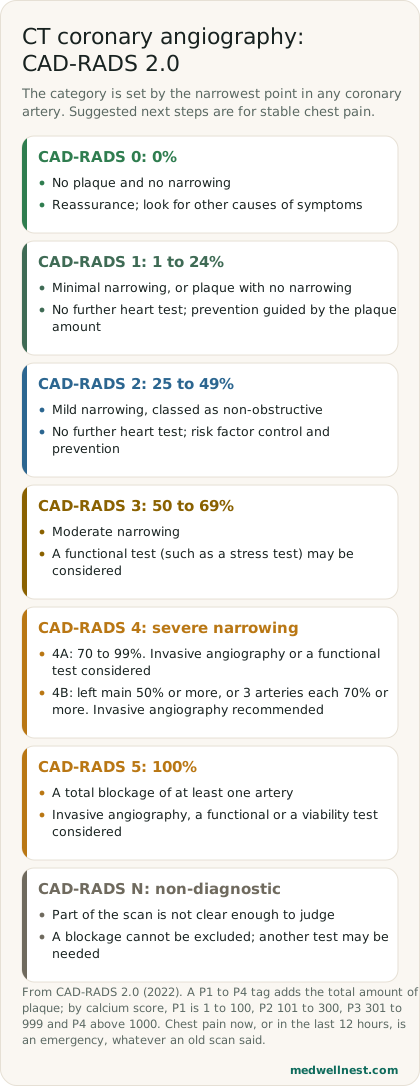
CAD-RADS 2.0 gives one category for the whole scan, set by the most narrowed point in any artery. CAD-RADS 0 means no plaque and 0% narrowing. CAD-RADS 1 is 1% to 24%, or plaque without narrowing; 2 is 25% to 49%; 3 is 50% to 69%; 4A is 70% to 99%; 4B is a narrowing of 50% or more in the left main artery, or 70% or more in all 3 main arteries; and 5 is a total blockage. CAD-RADS N means part of the scan was not clear enough to judge.
For people with stable chest pain, CAD-RADS 2.0 suggests no further heart test for categories 0 to 2, considering a functional test such as a stress test for 3, and considering invasive angiography or functional testing for 4A and 5, with angiography recommended for 4B. A letter P with a number from 1 to 4 adds how much plaque there is overall. The report's written impression and your cardiologist's advice come before the code.
06
When chest pain cannot wait
Neither scan is a test for a heart attack happening now. NICE lists the symptoms that may mean an acute coronary syndrome: pain in the chest, arms, back or jaw lasting longer than 15 minutes; chest pain with nausea, vomiting, marked sweating or breathlessness; and new chest pain, or angina that suddenly worsens and comes with little or no exertion. NICE adds that not everyone has central chest pain as the main symptom.
Chest pain now, or in the last 12 hours, with any of these features needs emergency care: call emergency services rather than booking a scan. A normal calcium score or a reassuring angiogram from the past does not change that.
When to act
Emergency — act now
Chest pain now, or in the last 12 hours, especially pain lasting more than 15 minutes, spreading to the arm, back or jaw, or with sweating, nausea or breathlessness: call emergency services now. A past calcium score or angiogram does not rule out a heart attack.
Same-day — call promptly
Chest pain that suggested a heart problem 12 to 72 hours ago and has now settled: get checked by a doctor today, with an ECG.
Routine — see a doctor
A calcium score of 100 or more, or a CT angiogram reported as CAD-RADS 3, 4 or 5, without symptoms now: book an appointment with your doctor or cardiologist to plan the next test and prevention.
Values mentioned in this story
Each one opens a visual guide with its normal range and what moves it — upload a report and we place your own numbers on the same scale.
Sources
- 2019 ACC/AHA Guideline on the Primary Prevention of Cardiovascular Disease — Circulationahajournals.org
- 2018 AHA/ACC Guideline on the Management of Blood Cholesterol — Circulationahajournals.org
- CAD-RADS 2.0 – 2022 Coronary Artery Disease Reporting and Data System — SCCT/ACR/ACC/NASCIpmc.ncbi.nlm.nih.gov
- Coronary artery calcium score: current status — Radiologia Brasileira 2017pmc.ncbi.nlm.nih.gov
- Recent-onset chest pain of suspected cardiac origin (CG95) — NICEnice.org.uk
Share this story
Curious where your own values stand?
Two minutes from upload to a full visual picture. Free to analyze.