In short
Dark, thick, velvety patches on the neck, armpits or groin are usually not dirt and scrubbing will not remove them. They often point to extra weight, insulin resistance, prediabetes or diabetes. A sudden crop of many patches can be a warning sign of cancer, so see a doctor today.
On your report
HbA1c, Fasting Glucose
On this page
01
Why is my neck or underarm turning dark, and is it dirt?
A dark, velvety neck or underarm that does not wash off is usually not dirt. The American Academy of Dermatology (AAD) says people with this condition sometimes wrongly believe a dye or something they touched has discolored the skin and try scrubbing it away, but vigorous scrubbing will not get rid of it. The condition is called acanthosis nigricans. The AAD says it is not contagious and not harmful in itself.
The reason to look at it is what it may be telling you. The AAD says acanthosis nigricans is sometimes a warning sign of a health problem that needs medical attention, so it is important to see a dermatologist if you notice an area of darker, thicker skin. The NHS likewise says it could be a sign of an underlying condition and needs to be checked by a doctor.
02
What is acanthosis nigricans and what does it look like?
Acanthosis nigricans (AN) is a skin condition that causes one or more areas of skin to darken and thicken, and the AAD says the skin often feels like velvet. The NHS describes dry, dark patches that usually appear in the armpits, neck or groin, most often in skin folds, and says some people also have tiny growths called skin tags on the patches. The patches often appear gradually without other symptoms, and the skin may sometimes be itchy.
It can affect teenagers and adults. The AAD includes a photograph of the condition on the hands of a 15-year-old girl and says it affects obese children as well as adults.
03
Is a dark neck a sign of insulin resistance, prediabetes or diabetes?
Often, yes. The NHS says the most common cause of acanthosis nigricans is obesity, and the AAD agrees. An expert group review published in 2024 calls acanthosis nigricans a visible skin manifestation of conditions such as prediabetes, diabetes, polycystic ovary syndrome (PCOS), metabolic syndrome and cancer, and describes it as a proven skin marker of insulin resistance. It concludes that it is a simple, non-invasive, cost-effective screening tool for early identification of insulin resistance.
The AAD says AN is more common in people who have diabetes and can be a sign of prediabetes, and that making lifestyle changes before diabetes develops can prevent diabetes. The NHS lists type 2 diabetes among the causes. A dark neck does not prove you have any of these, but it is a good reason to ask for a blood sugar check rather than treating it as a cosmetic problem. Our stories on the prediabetes window and on the HbA1c chart explain what the numbers mean.
04
What other causes are there, such as medicines or hormones?
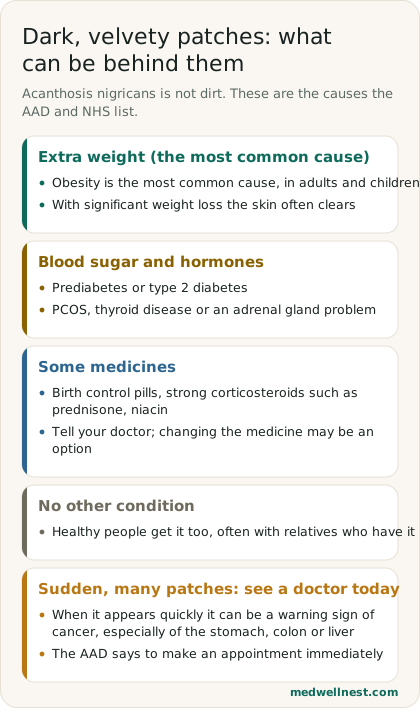
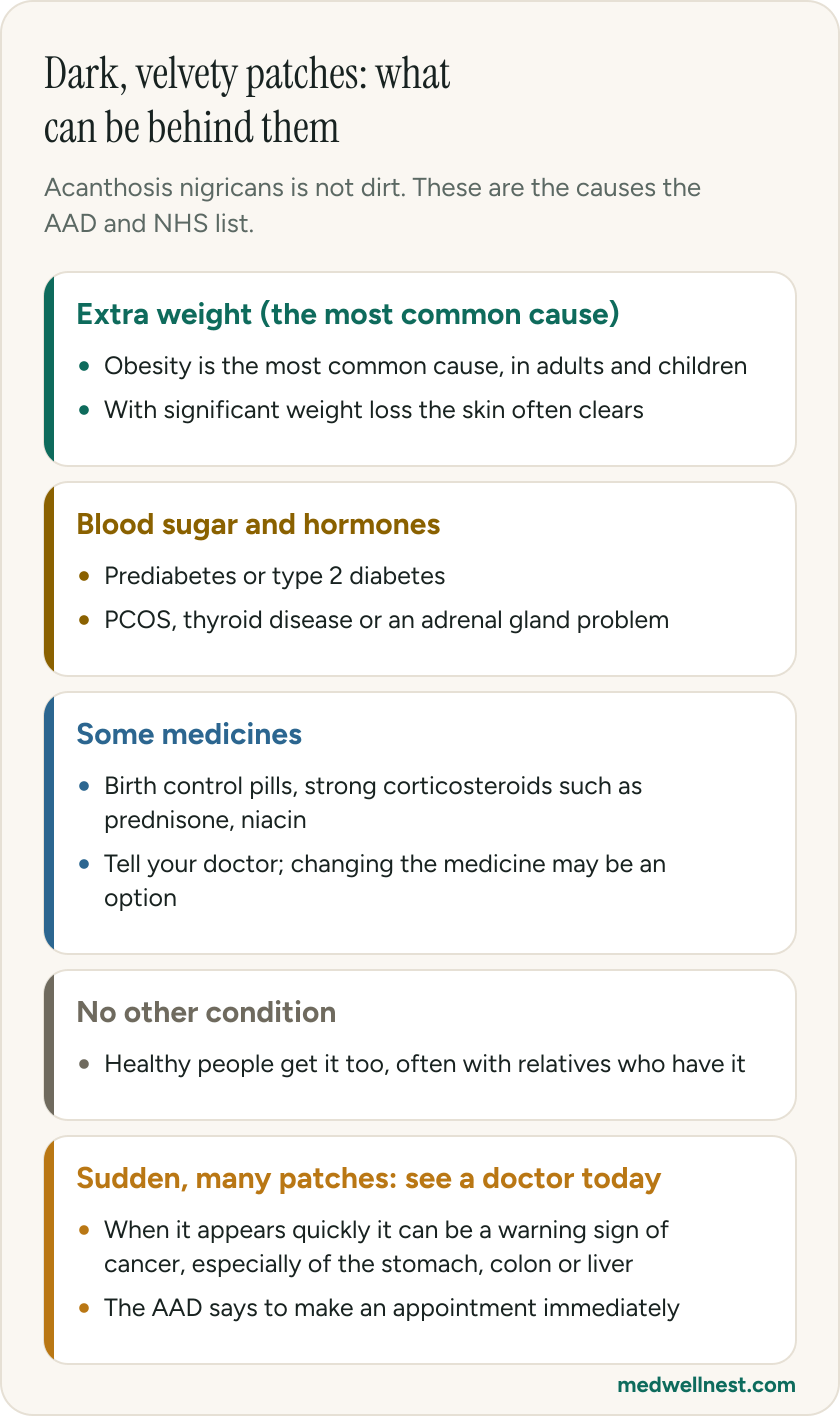
The AAD lists three other groups of causes. A reaction to a medicine: birth control pills, strong corticosteroids such as prednisone, and niacin can cause it. A hormonal condition: PCOS, thyroid disease or a problem with the adrenal glands. And cancer, covered in the next section. The NHS adds Cushing's syndrome and an underactive thyroid, steroids and hormone treatments such as the contraceptive pill, and, rarely, a faulty gene inherited from a parent.
Some people have no underlying condition at all. The AAD says completely healthy people also get acanthosis nigricans and tend to have relatives with it, and the NHS says it is more common in people with black or brown skin. If a medicine is the cause, the AAD says changing medicines might be an option, so tell your doctor about everything you take.
05
Can dark neck patches be a sign of cancer?
Rarely, but this is the one pattern to act on. The AAD says acanthosis nigricans tends to appear slowly, over months or years. If it appears suddenly, it can be a warning sign of cancer, and the AAD says to make an appointment immediately, so see a doctor today. When it develops quickly, the AAD says, it can be a sign of a cancer especially in the stomach, colon or liver. The NHS also says that, rarely, it can be a sign of something more serious such as cancer, usually stomach cancer.
The AAD advises that if you suddenly see many dark, velvety patches on your skin, you should immediately make an appointment with your dermatologist or primary care doctor. Most dark necks are not cancer; the warning is about sudden onset of many patches.
06
What tests will a doctor do for acanthosis nigricans?
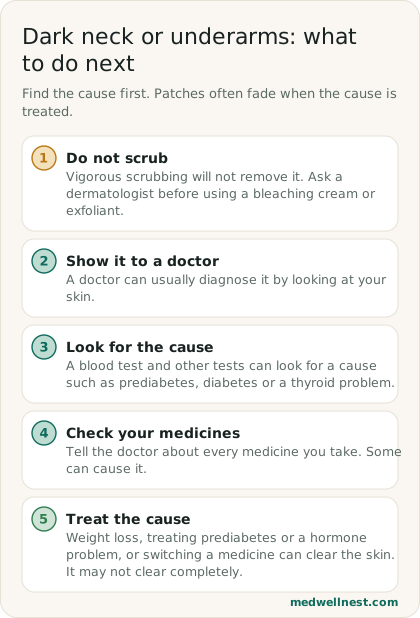
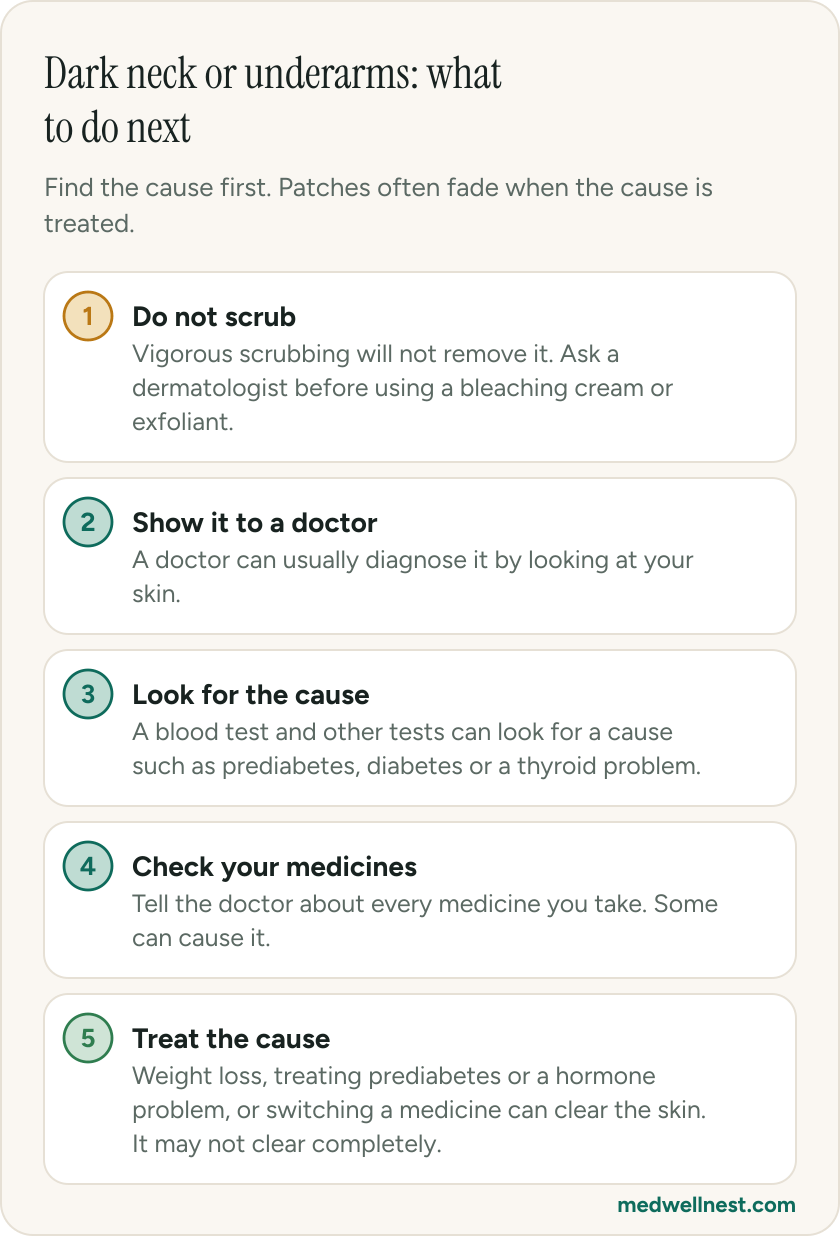
The AAD says a dermatologist can usually diagnose acanthosis nigricans by looking at your skin, and the NHS says the same of a doctor. The AAD adds that you may then need a blood test and other medical tests to find out whether you have another condition, since it can be a warning sign of prediabetes, thyroid disease or another condition. The NHS says you may need tests to find out what is causing the patches.
The sources we read do not list which blood tests are done, so that is for your doctor to decide. If prediabetes or diabetes is suspected, our guide to diabetes blood tests and the HbA1c chart explain the usual sugar tests and what the results mean.
07
How do I get rid of a dark neck? Do creams and scrubbing work?
Treat the cause first. The AAD says many people see their skin clear when the condition behind it is treated, and that getting prediabetes under control often helps the patches fade. Studies it cites found skin often clears completely with significant weight loss. The NHS says the patches should fade over time once the cause is treated and that there is no specific treatment for the patches themselves. The AAD cautions that treating an underlying condition may not clear the patches completely.
Do not scrub, and ask before using skin products. The AAD says to ask a dermatologist before using a bleaching cream, exfoliant or other skin care product, because these rarely fade acanthosis nigricans and can irritate the skin and make it worse. The AAD says it is not necessary to treat the patches, but a dermatologist can offer treatments if you want clearer skin; it notes that none is designed specifically for this condition and that it can be hard to treat.
Dark neck or underarm patches: how fast to act
Routine — see a doctor
You have new dark, thick, velvety patches that appeared gradually: book a visit with a doctor or dermatologist to look for a cause such as extra weight, prediabetes or diabetes, a hormone condition or a medicine. The NHS and AAD both say to have any new dark patches checked. Ask a dermatologist before using bleaching products, and do not scrub.
Same-day — call promptly
You suddenly see many dark, velvety patches, or patches appear quickly: see a doctor today, a dermatologist or your primary care doctor. The AAD says to make an appointment immediately, because this can be a sign of cancer, especially of the stomach, colon or liver. Do not wait to see whether it settles.
Values mentioned in this story
Each one opens a visual guide with its normal range and what moves it — upload a report and we place your own numbers on the same scale.
Sources
- Acanthosis nigricans: overview — American Academy of Dermatologyaad.org
- Acanthosis nigricans: causes — American Academy of Dermatologyaad.org
- Acanthosis nigricans: diagnosis and treatment — American Academy of Dermatologyaad.org
- Acanthosis nigricans: self-care — American Academy of Dermatologyaad.org
- Acanthosis nigricans — NHSnhs.uk
- Expert group review of acanthosis nigricans with recommendations for early detection and timely management (2024) — PubMedpubmed.ncbi.nlm.nih.gov
Share this story
Curious where your own values stand?
Two minutes from upload to a full visual picture. Free to analyze.