In short
Up to one egg a day is not linked to heart disease in a large pooled analysis. Ghee, butter, coconut oil and palm oil are high in saturated fat, and coconut oil raised LDL by 10.47 mg/dL across 16 trials. WHO says industrial trans fat, found in vanaspati, should be avoided.
Emergency if: Pain or discomfort in the centre of the chest, or in the arms, left shoulder, elbows, jaw or back, especially with shortness of breath, feeling or being sick, light-headedness, a cold sweat or turning pale; or sudden weakness or numbness of the face, arm or leg, especially on one side, sudden confusion, trouble speaking or understanding speech, sudden trouble seeing, walking or keeping your balance, a sudden severe headache with no known cause, or fainting: call emergency services now. The WHO lists these as symptoms of a heart attack or stroke and says people who have them should seek medical care immediately.
On your report
LDL Cholesterol, Non-HDL Cholesterol, Total Cholesterol
On this page
01
Can I eat eggs if my cholesterol is high?
Going by the best pooled evidence, eating up to one egg a day is not linked to heart disease risk overall. A 2020 BMJ review combined 33 estimates from cohort studies on several continents, covering 1 720 108 people, and found that each extra egg a day was not linked to heart disease (relative risk 0.98, 95% confidence interval 0.93 to 1.03). The authors concluded that eating eggs in moderation, up to one a day, is not linked to heart disease risk overall.
Two cautions. These are observational studies, not trials of eating eggs. And the finding is about up to one egg a day, so it says little about several a day.
The paper's own three cohorts left out people who already had heart disease, type 2 diabetes or cancer at the start. So if your LDL is high, or you have diabetes or heart disease, ask your doctor how many eggs suit you. Our lifestyle-change story shows how small the LDL effect of dietary cholesterol is compared with the type of fat you eat.
02
Is ghee safe for high cholesterol?
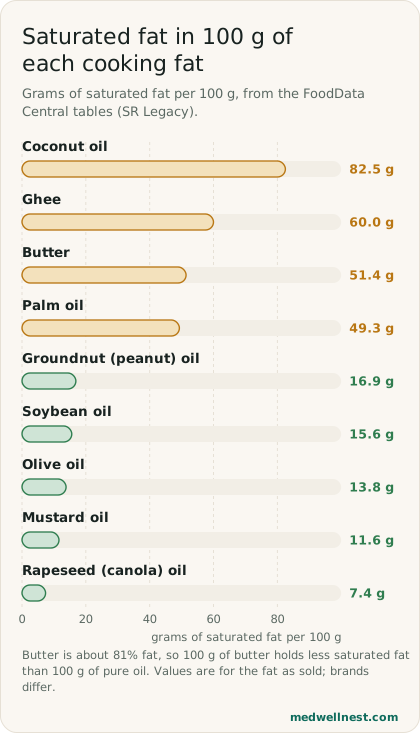
Ghee is nearly all fat, and about 60 g of every 100 g is saturated fat, more than the 51.4 g in 100 g of butter (which is about 81% fat), according to the FoodData Central tables. Saturated fat raises LDL cholesterol, which is why the NHS lists butter, lard and ghee among the foods to eat less of when you want to lower cholesterol, and olive oil and rapeseed oil among the foods to eat more of.
We did not find large trials that follow ghee eaters for heart attacks, so the advice rests on its saturated fat content. Less does not mean never. A teaspoon of ghee on a roti is not the same as ghee in several dishes a day. The NHS list covers much more than ghee: meat pies, sausages and fatty meat, cream and cheese, cakes and biscuits, and food that contains coconut oil or palm oil.
A practical step is to measure: use a teaspoon rather than pouring, and move some of your cooking to mustard, groundnut, soybean, olive or rapeseed oil, which hold about 7 to 17 g of saturated fat per 100 g in the table.
03
Is coconut oil good or bad for cholesterol?
A 2020 meta-analysis in Circulation pooled 16 trials that compared coconut oil with other cooking fats for at least 2 weeks. Coconut oil raised LDL cholesterol by 10.47 mg/dL (95% confidence interval 3.01 to 17.94) and HDL by 4.00 mg/dL (2.26 to 5.73) compared with non-tropical vegetable oils. The effects remained after the authors left out non-randomised or poor-quality trials, and they concluded that the finding should inform choices about coconut oil.
So 'coconut oil raises good cholesterol' is true but incomplete: LDL, the number that drives plaque, rose by more than twice as much as HDL. Our low HDL story explains why a rise in HDL is not treated as a benefit. The NHS also lists food that contains coconut oil or palm oil among the foods to eat less of.
Palm oil sits close to ghee in the table, at 49.3 g of saturated fat per 100 g. Because the NHS says 'food that contains' palm oil, check labels on packaged snacks, bakery items and fried food, not only the oil you pour at home.
04
What about vanaspati, margarine and bakery fats?
These can carry industrial trans fat, which is made by partially hydrogenating liquid oil. WHO names margarine, vegetable shortening, vanaspati ghee, fried foods and baked goods such as crackers, biscuits and pies as sources, and says baked and fried street and restaurant foods often contain it. WHO says industrially produced trans fat has no known health benefit and should be avoided, and recommends keeping all trans fat below 1% of total energy, less than 2.2 g a day on a 2000-calorie diet.
WHO says high trans fat intake raises the risk of coronary heart disease by 21%, of death from coronary heart disease by 28% and of death from any cause by 34%, and attributes more than 278 000 deaths a year worldwide to industrially produced trans fat. It adds that trans fat also occurs naturally in meat and dairy foods from cows, sheep and goats, and that both kinds are equally harmful. Read labels for 'partially hydrogenated oil'.
05
So which fat or oil should I use?
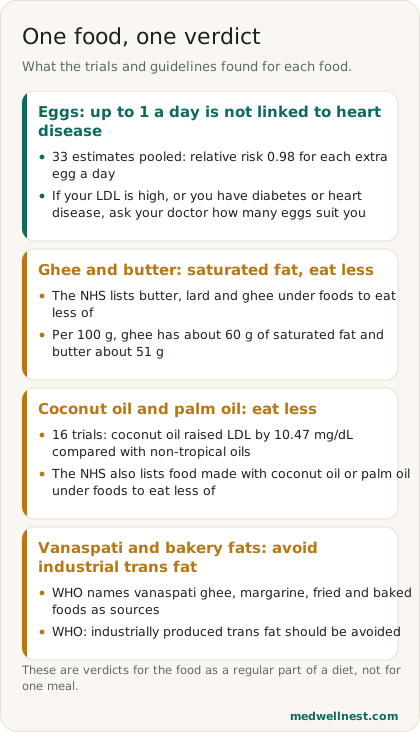
No single oil is magic. The evidence points one way: use modest amounts of liquid oils that are low in saturated fat, eat less ghee, butter, coconut oil and palm oil, avoid industrial trans fat, and keep eggs to no more than one a day if you enjoy them. The verdicts below put each food on one card.
No oil fixes a high-risk LDL. If your doctor has said your LDL needs medicine, food swaps work alongside the medicine, not instead of it. Our lifestyle-change story shows how far each change goes.
06
What warning signs need emergency help?
High cholesterol usually has no symptoms, and food choices lower risk over years, not hours. The WHO says a heart attack or stroke may be the first sign of disease in the blood vessels. It lists pain or discomfort in the centre of the chest, or in the arms, left shoulder, elbows, jaw or back, as heart attack symptoms, and sudden weakness of the face, arm or leg, most often on one side, as the most common stroke symptom. Treat these as an emergency, not as a food question.
Cholesterol and food: how fast to act
Routine — see a doctor
Your LDL is high, or you have diabetes or heart disease and are unsure how many eggs, how much ghee or which oil suits you: book a visit and bring your lipid profile. Food swaps help, but if your doctor says you need medicine, they work alongside it, not instead of it.
Emergency — act now
Pain or discomfort in the centre of the chest, or in the arms, left shoulder, elbows, jaw or back, especially with shortness of breath, feeling or being sick, light-headedness, a cold sweat or turning pale; or sudden weakness or numbness of the face, arm or leg, especially on one side, sudden confusion, trouble speaking or understanding speech, sudden trouble seeing, walking or keeping your balance, a sudden severe headache with no known cause, or fainting: call emergency services now. The WHO lists these as symptoms of a heart attack or stroke and says people who have them should seek medical care immediately.
Values mentioned in this story
Each one opens a visual guide with its normal range and what moves it — upload a report and we place your own numbers on the same scale.
Sources
- Egg consumption and risk of cardiovascular disease: three cohorts and updated meta-analysis — BMJ 2020pubmed.ncbi.nlm.nih.gov
- Effect of coconut oil consumption on cardiovascular risk factors: systematic review and meta-analysis — Circulation 2020pubmed.ncbi.nlm.nih.gov
- How to lower your cholesterol — NHSnhs.uk
- Trans fat — WHO fact sheetwho.int
- Cardiovascular diseases (CVDs) — WHO fact sheetwho.int
- FoodData Central — food composition databasefdc.nal.usda.gov
Share this story
Curious where your own values stand?
Two minutes from upload to a full visual picture. Free to analyze.