In short
The ESC/EAS guideline rates each proven change at about 5 to 10% off LDL, or under 5%. Statins cut LDL by 30 to 50% or more. Lifestyle is the base for everyone, but people at high risk usually need both. Chest pain or stroke signs need emergency help now.
Emergency if: Chest pain or pressure that feels tight, crushing or squeezing, or pain spreading to your arm, neck or jaw, especially with sweating, feeling or being sick or shortness of breath; severe difficulty breathing; lips or skin turning pale, blue or grey; someone passing out and not responding normally; or a sudden drooping face, weakness in one arm, slurred or confused speech or other stroke signs (FAST): call emergency services now. Do not drive yourself to hospital. The NHS lists these as heart attack and stroke symptoms, and says stroke symptoms that stop after a short time still need medical help straight away.
On your report
LDL Cholesterol, Non-HDL Cholesterol, Total Cholesterol
On this page
01
How much can I lower LDL cholesterol without medicine?
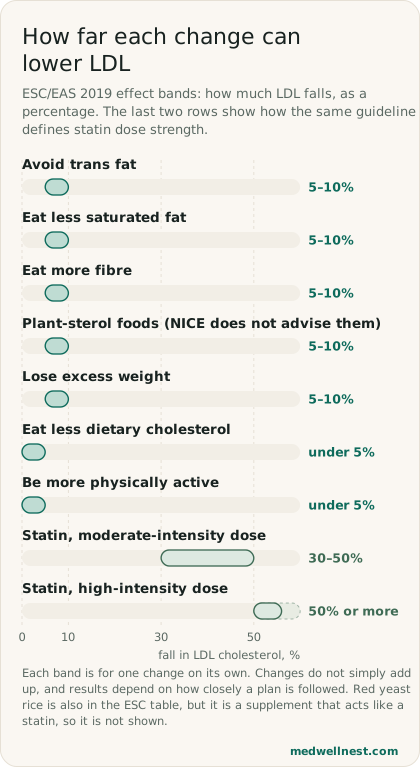
The 2019 guideline of the European Society of Cardiology and the European Atherosclerosis Society (ESC/EAS) puts numbers on it in one table. Six changes are each rated at about 5 to 10% off LDL: avoiding trans fat, eating less saturated fat, eating more fibre, using foods enriched with plant sterols, using red yeast rice supplements and losing excess weight. Two are rated smaller, under 5%: eating less dietary cholesterol and being more physically active. The chart below shows seven of these eight; it leaves out red yeast rice, because it is a supplement that acts like a statin and the guideline raises safety concerns about it (see the section on supplements).
These are bands for each change on its own, not promises, and they do not simply add up. In one trial of 345 adults with high cholesterol who chose their own food, advice on a combined diet built on plant sterols, soy protein, viscous fibre and nuts lowered LDL by about 13 to 14% over 6 months, against about 3% on standard low-saturated-fat advice. The fall was larger in people who followed the plan more closely.
02
Which food changes lower LDL the most?
Change the type of fat first. The ESC/EAS and NICE both advise keeping saturated fat low: for people at high risk of or with heart disease, NICE says 7% or less of total energy, replaced where possible with unsaturated fat, for example olive or rapeseed oil. The ESC/EAS adds that avoiding any trans fat is a key measure. Our eggs, ghee and coconut oil story takes the fats one by one.
Fibre comes next. The ESC/EAS recommends 25 to 40 g a day of total fibre, including at least 7 to 13 g of soluble fibre, from legumes, fruit, vegetables and wholegrain cereals such as oats and barley. It says oat and barley beta-glucan lowers LDL by 3 to 5% at 3 to 10 g a day, depending on the product. These are food amounts from the guideline, not supplement advice.
Nuts help a little. A review of 61 trials found that each daily serving of tree nuts (28.4 g) lowered LDL by 4.8 mg/dL on average, with stronger effects at 60 g a day or more. Soy is less clear: the guideline says soy protein may lower LDL modestly when it replaces animal protein, but that this was not confirmed once other changes in the diet were taken into account.
03
Do plant sterols, red yeast rice and other supplements work?
Plant sterols lower LDL, but the evidence stops short of outcomes. The ESC/EAS says 2 g a day of phytosterols, taken as fortified foods, lowers LDL by 7 to 10% on average and that no study has checked whether this prevents heart disease, but it says such foods may be considered for some people with high cholesterol: those at lower risk who do not need medicine, and as an add-on to medicine. NICE says not to advise plant stanols or sterols to prevent cardiovascular disease, whether someone is being treated to prevent a first or a repeat event, or has kidney disease or diabetes.
Red yeast rice is in the same ESC table, but it acts like a statin. The guideline says products differ in how much of the active ingredient (monacolin) they contain, that buyers cannot tell the difference, that long-term safety is not fully documented, that concerns about contaminants in some preparations have been raised, and that statin-like side effects have been reported. Ask your doctor before using it, especially if you already take a prescribed statin.
Other products fare worse. The guideline says studies found no significant effect of policosanol on LDL, and that berberine needs better-quality trials before its benefit can be confirmed.
04
Does exercise, weight loss or eating fewer eggs lower LDL?
Weight loss counts. The guideline says that even a modest loss, 5 to 10% of body weight, improves lipid abnormalities, and it rates reducing excess weight in the 5 to 10% LDL band. Exercise moves LDL by under 5%, but the same table rates it as the strongest lifestyle change for raising HDL and a useful one for lowering triglycerides, so it stays in the plan. The ESC/EAS general aim is 30 to 60 minutes of moderately vigorous activity most days.
Dietary cholesterol, from egg yolk, shellfish and organ meat, has the smallest LDL effect in the table, under 5%. Advice has moved. NICE removed its reference to restricting dietary cholesterol because it found no evidence comparing such diets with normal ones, while the ESC/EAS still says to keep it under 300 milligrams a day, particularly if cholesterol is high. The two guidelines differ here, so ask your doctor what suits you.
05
Why isn't lifestyle alone enough for some people?
Because the fall needed can be bigger than the fall lifestyle offers. For people at very high risk the ESC/EAS aims for at least a 50% fall from baseline and an LDL below 55 mg/dL; for high risk, at least 50% and below 70 mg/dL; for moderate risk, below 100 mg/dL. The same guideline defines a moderate-intensity statin dose as one expected to lower LDL by 30 to 50%, and a high-intensity dose as one expected to lower it by 50% or more, on average.
The size of the fall matters. The ESC/EAS summarises an analysis of more than 170 000 people in 26 trials: for each 1 mmol/L (about 39 mg/dL) that LDL fell, major vascular events fell by about 22% over 5 years.
Whether you are offered medicine is a doctor's decision, based on your total risk and not on LDL alone. For a first heart attack or stroke, NICE says doctors should discuss lifestyle changes, manage other risk factors, offer a repeat risk check after you have tried to change, and offer a statin if lifestyle change is ineffective or not appropriate. For people who already have heart or artery disease, NICE says not to delay a statin, and to discuss lifestyle at the same time. NICE also says any statin at any dose reduces cardiovascular risk.
Very high numbers are a different case. NICE says a total cholesterol above 9.0 mmol/L (about 350 mg/dL), or non-HDL above 7.5 mmol/L (about 290 mg/dL), needs specialist assessment even without a family history, because it can point to an inherited cholesterol disorder. If your report shows numbers like that, see a doctor soon rather than relying on diet alone.
06
How long before LDL comes down, and when should I retest?
The guidelines give no single timetable for diet alone. NICE says people should be offered another risk check after they have tried to change their lifestyle, without a fixed date. For people who start or change cholesterol medicine, NICE says a full lipid profile and liver enzyme test should be done 2 to 3 months later, and that a fasting sample is not mandatory for the lipid profile.
Keep the plan simple: choose one or two changes you can keep up, such as a fat swap and a daily walk, rather than ten you will drop. Take your report to your doctor and ask which risk group you are in, because your LDL goal depends on it. Our lipid profile guide explains each line of the report and the goals by risk group.
07
What warning signs need emergency help?
High cholesterol usually causes no symptoms, so the first sign can be a heart attack or stroke. The NHS lists the heart attack signs as chest pain that may feel like crushing or squeezing and may spread to the arm, neck and jaw, shortness of breath, sweating and feeling sick, and the stroke signs as face weakness, arm weakness and speech problems. Treat these as an emergency, not as a cholesterol question.
High LDL and warning signs: how fast to act
Routine — see a doctor
Your LDL or non-HDL is above the goal for your risk group, or you want to know what medicine would add to lifestyle changes: book a visit and bring your lipid profile. Ask which risk group you are in and what your goal is. If your total cholesterol is above 9.0 mmol/L (about 350 mg/dL) or non-HDL above 7.5 mmol/L (about 290 mg/dL), book that visit within days, because NICE asks for specialist assessment.
Emergency — act now
Chest pain or pressure that feels tight, crushing or squeezing, or pain spreading to your arm, neck or jaw, especially with sweating, feeling or being sick or shortness of breath; severe difficulty breathing; lips or skin turning pale, blue or grey; someone passing out and not responding normally; or a sudden drooping face, weakness in one arm, slurred or confused speech or other stroke signs (FAST): call emergency services now. Do not drive yourself to hospital. The NHS lists these as heart attack and stroke symptoms, and says stroke symptoms that stop after a short time still need medical help straight away.
Values mentioned in this story
Each one opens a visual guide with its normal range and what moves it — upload a report and we place your own numbers on the same scale.
Sources
- 2019 ESC/EAS Guidelines for the management of dyslipidaemias — Atherosclerosisdoi.org
- Cardiovascular disease: risk assessment and reduction, including lipid modification (NG238) — NICEnice.org.uk
- Effects of tree nuts on blood lipids: meta-analysis of 61 trials — Am J Clin Nutr 2015pubmed.ncbi.nlm.nih.gov
- Dietary portfolio of cholesterol-lowering foods, randomized trial — JAMA 2011pubmed.ncbi.nlm.nih.gov
- Heart attack — NHSnhs.uk
- Symptoms of a stroke — NHSnhs.uk
Share this story
Curious where your own values stand?
Two minutes from upload to a full visual picture. Free to analyze.