In short
In large blinded trials, 27.1% of people on a statin and 26.6% on a dummy pill reported muscle pain or weakness, so most muscle complaints on a statin are not caused by it. Statins do raise diabetes risk slightly: about 1 extra case per 255 people over 4 years. Do not stop on your own.
Emergency if: Sudden swelling of the lips, mouth, throat or tongue, a tight throat or trouble swallowing, struggling to breathe, or lips or skin turning blue, grey or pale after taking a statin: this can be anaphylaxis, a severe allergic reaction, so call emergency services now, as the NHS advises for these signs. The same applies to pain or discomfort in the centre of the chest, or in the arms, left shoulder, elbows, jaw or back, or sudden weakness of the face, arm or leg, sudden confusion or trouble speaking: call emergency services now. These are not statin questions; the WHO lists them as heart attack and stroke symptoms and says people who have them should seek medical care immediately.
On your report
LDL Cholesterol, SGPT (ALT), HbA1c
On this page
01
Do statins really cause muscle pain?
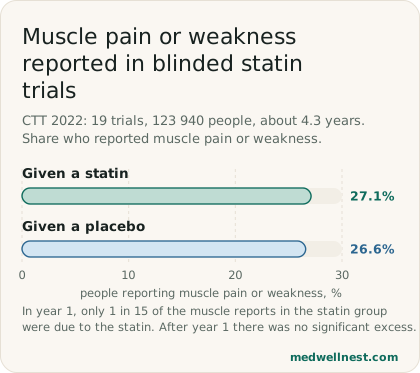
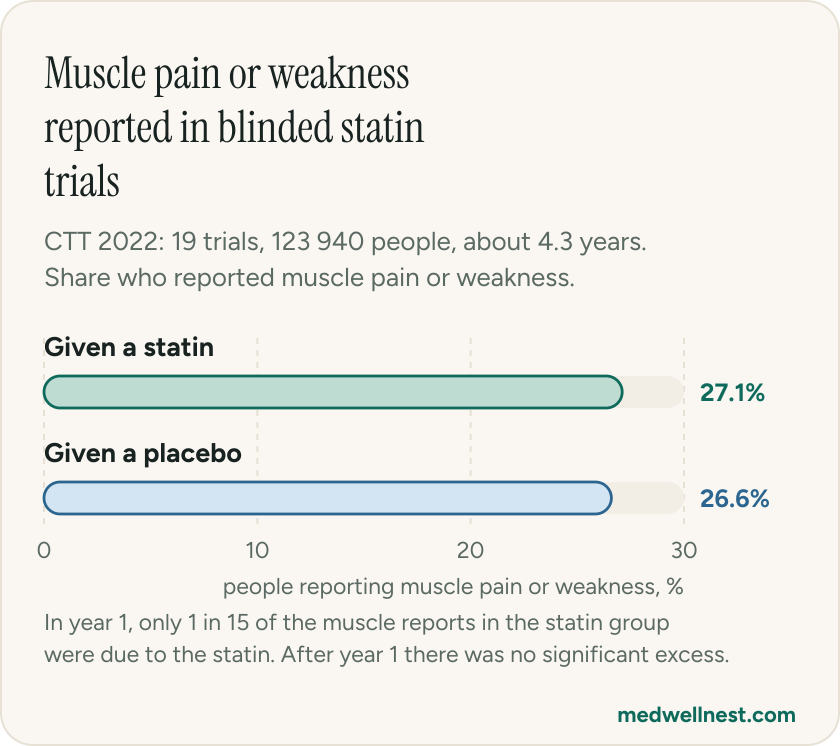
Less often than most people think. The Cholesterol Treatment Trialists' Collaboration pooled 19 double-blind trials of a statin against a dummy pill (placebo), with 123 940 people followed for about 4.3 years. Muscle pain or weakness was reported by 27.1% of people given a statin and 26.6% of people given a placebo (rate ratio 1.03). In these trials, where the average age was 63, about 1 in 4 people on the dummy pill also reported muscle pain or weakness, so these complaints are common whatever tablet people take.
There was a small real excess in the first year: 11 extra reports for every 1000 person-years on a statin. The authors worked out that only 1 in 15 of the muscle reports from people on a statin in year 1 were actually due to the statin. After year 1 there was no significant excess. Over all years, they conclude that more than 90% of muscle-symptom reports by people on a statin were not due to it, and that the small risk is much lower than the known cardiovascular benefits.
The excess is not zero. Stronger statin regimens had a somewhat higher rate ratio (1.08) than lower-intensity regimens (1.03), and the statin raised a muscle blood marker, creatine kinase, by a clinically insignificant amount. If your muscles do ache, that is a reason to talk to your doctor, not to assume it is all in the mind.
02
What is the nocebo effect, and what did the SAMSON trial find?
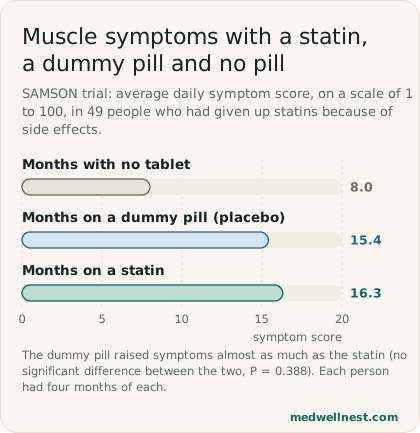
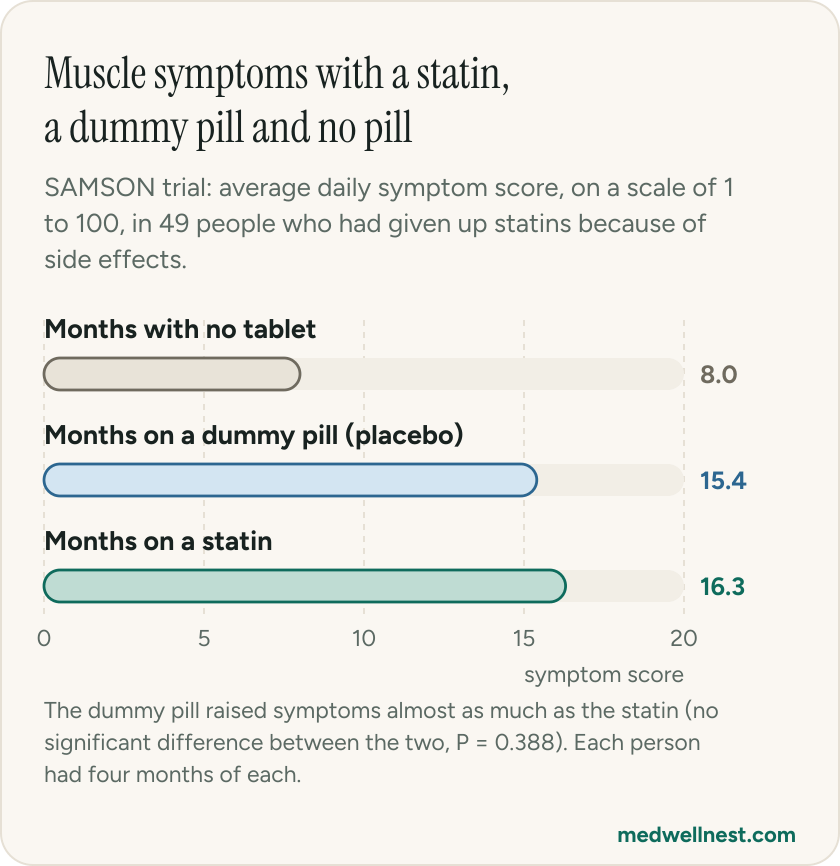
The nocebo effect means that expecting side effects can produce real symptoms. The SAMSON trial tested it in people who had given up statins because of side effects. Sixty people were randomised and 49 finished. Each took a statin, a dummy pill and no tablet in different months, 4 months of each, and rated symptoms every day on a 1 to 100 scale.
The average score was 8.0 in months with no tablet, 15.4 on the dummy pill and 16.3 on the statin, and the difference between dummy and statin was not significant (P = 0.388). The trial's nocebo ratio, the share of symptoms caused by the statin tablet that the dummy tablet also caused, was 0.90. The authors concluded that the majority of symptoms caused by statin tablets were nocebo. Six months after the trial, 30 of the 60 participants (50%) were back on statins.
This does not mean your pain is imaginary. The symptoms in the dummy months were real enough to score nearly twice as high as in the no-tablet months. The trial's point is narrower: when symptoms start, and how strong they are, cannot by themselves show that the statin is the cause. A small group of people do have a true statin effect, as the pooled trials above show, so the sensible step is a proper review, not a guess in either direction.
03
What should I do if my muscles ache on a statin?
Do not stop the statin on your own. The NHS medicines page says to keep taking the medicine unless your doctor tells you to stop, because if you stop, your cholesterol levels may go up again. It says to speak to a pharmacist or doctor if a side effect bothers you or does not go away, and that they may be able to advise how to reduce it. It also says people usually take the medicine for a long time, sometimes for life.
Go to the visit prepared. Note when the aches started, where they are, and what else changed around that time. Bring a list of every medicine, herbal remedy, vitamin and supplement you take: the NHS lists several that may not mix well with atorvastatin, such as some antibiotics and antifungal medicines, and says too much grapefruit juice can increase the chance of side effects. It also says to limit alcohol, which can raise the risk of side effects such as liver problems.
Because a symptom alone does not prove the statin is the cause, a review is worth having before the treatment is changed or stopped. Stopping removes the protection against heart attack and stroke that the statin was prescribed to give, and in SAMSON the relief people felt after stopping was similar for the statin and the dummy pill, so relief on stopping does not prove the cause either.
04
Do statins cause diabetes?
Slightly, yes. A meta-analysis of 13 statin trials (91 140 people, average follow-up 4 years) found that 4278 people developed diabetes. Statin therapy was linked to a 9% higher risk of new diabetes (odds ratio 1.09; 95% confidence interval 1.02 to 1.17). In absolute terms, treating 255 people with a statin for 4 years caused one extra case of diabetes.
The authors concluded that the risk is low, both in absolute terms and when compared with the reduction in coronary events, and that practice for people at moderate or high cardiovascular risk, or with existing cardiovascular disease, should not change. In their analysis the risk was highest in trials with older participants.
If you have prediabetes, are overweight or have a family history of diabetes, ask your doctor how often to check your blood sugar or HbA1c while on a statin. A statin is not a reason to skip those checks, and any change to the medicine should be decided with your doctor. Our prediabetes story explains the numbers.
05
What about the liver and memory?
Liver problems are a rare reason for concern. The NHS lists inflammation of the liver, which can turn the skin and whites of the eyes yellow, among the possible serious side effects of atorvastatin, and says most serious side effects are rare. Our statins and liver story explains why a liver enzyme (SGPT or ALT) test is often ordered and what a small rise usually means.
We make no claim about memory. The sources this page relies on do not address it, and a claim without a source would be a guess. If you notice changes in memory or thinking, mention them to your doctor as you would any new symptom.
06
Who should not take a statin, and what is rare but serious?
The NHS says atorvastatin is not recommended in pregnancy because it can affect how the baby develops. It says to tell your doctor if you are pregnant or trying to get pregnant, and to stop it 3 months before you start trying to conceive. Tell your doctor too if you have liver or kidney problems, an underactive thyroid, a muscle condition in you or a close relative, a past bleed in the brain, or if you regularly drink a lot of alcohol.
Rare serious side effects are on the NHS list: muscle damage causing cramps, severe pain and weakness, sometimes with a high temperature and red or brown urine; inflammation of the liver with yellow skin or eyes; inflammation of the pancreas with severe stomach pain; and an allergic reaction with a swollen throat or tongue, a raised itchy rash or difficulty breathing. The NHS says to seek urgent advice if you think you might be having serious side effects. Signs of a severe allergic reaction need emergency help; see the tiers below.
On a statin: how fast to act
Routine — see a doctor
Muscle aches, tiredness or another side effect that bothers you or does not go away: speak to your pharmacist or doctor soon, and keep taking the statin until they tell you otherwise. Ask whether a different statin or a change in how you take it is an option.
Same-day — call promptly
Severe muscle pain, cramps or weakness, especially with a high temperature or red or brown urine; yellow skin or yellow whites of the eyes; or severe stomach pain while on a statin: these can be rare but serious side effects, so get urgent medical advice the same day, as the NHS advises. If you cannot reach a doctor that day, go to an emergency department.
Emergency — act now
Sudden swelling of the lips, mouth, throat or tongue, a tight throat or trouble swallowing, struggling to breathe, or lips or skin turning blue, grey or pale after taking a statin: this can be anaphylaxis, a severe allergic reaction, so call emergency services now, as the NHS advises for these signs. The same applies to pain or discomfort in the centre of the chest, or in the arms, left shoulder, elbows, jaw or back, or sudden weakness of the face, arm or leg, sudden confusion or trouble speaking: call emergency services now. These are not statin questions; the WHO lists them as heart attack and stroke symptoms and says people who have them should seek medical care immediately.
Values mentioned in this story
Each one opens a visual guide with its normal range and what moves it — upload a report and we place your own numbers on the same scale.
Sources
- Effect of statin therapy on muscle symptoms: individual participant data meta-analysis — Lancet 2022pubmed.ncbi.nlm.nih.gov
- Side effect patterns in a crossover trial of statin, placebo and no treatment (SAMSON) — JACC 2021pubmed.ncbi.nlm.nih.gov
- Statins and risk of incident diabetes: collaborative meta-analysis — Lancet 2010pubmed.ncbi.nlm.nih.gov
- Atorvastatin: side effects — NHSnhs.uk
- Cardiovascular diseases (CVDs) — WHO fact sheetwho.int
- Anaphylaxis — NHSnhs.uk
Share this story
Curious where your own values stand?
Two minutes from upload to a full visual picture. Free to analyze.