In short
Only some blood tests need fasting, usually 8 to 12 hours with plain water allowed. Glucose tests often do; HbA1c, a CBC and vitamin D usually do not; a cholesterol test can be done without fasting under guidelines. Always follow your lab's instruction.
Emergency if: You take insulin or other diabetes medicines, and while fasting you have a seizure, faint, or are too confused to answer or swallow: call emergency services now. MedlinePlus says severe low blood glucose can lead to seizures and brain damage.
On your report
Fasting Glucose, HbA1c, Triglycerides, LDL Cholesterol +2 more
On this page
01
Do I need to fast before a blood test, and for how many hours?
Only if the person who ordered the test tells you to. MedlinePlus says you should not fast if your provider does not tell you to, because fasting for some tests can itself change the results. When fasting is needed, it means no food and no drink except plain water, and also no chewing gum, smoking or exercise.
MedlinePlus says you usually need to fast for 8 to 12 hours, and that your provider will tell you the exact time for your test. It suggests booking a fasting test early in the morning so that most of the fast is spent asleep, and asking any questions at least a full day ahead. Fasting matters because the sugar, fat and protein you absorb from a meal can change the levels in your blood.
02
Which blood tests need fasting, and which do not?
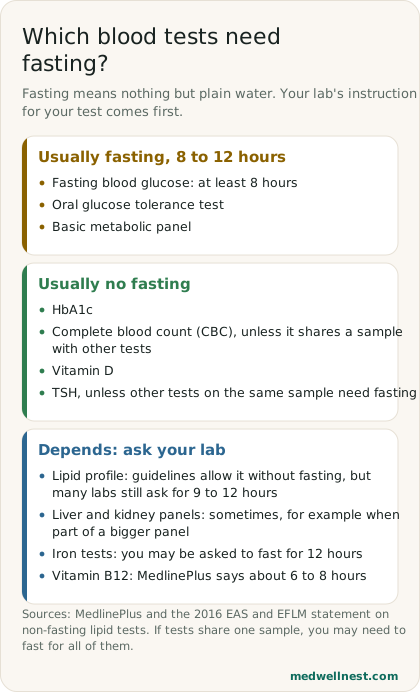
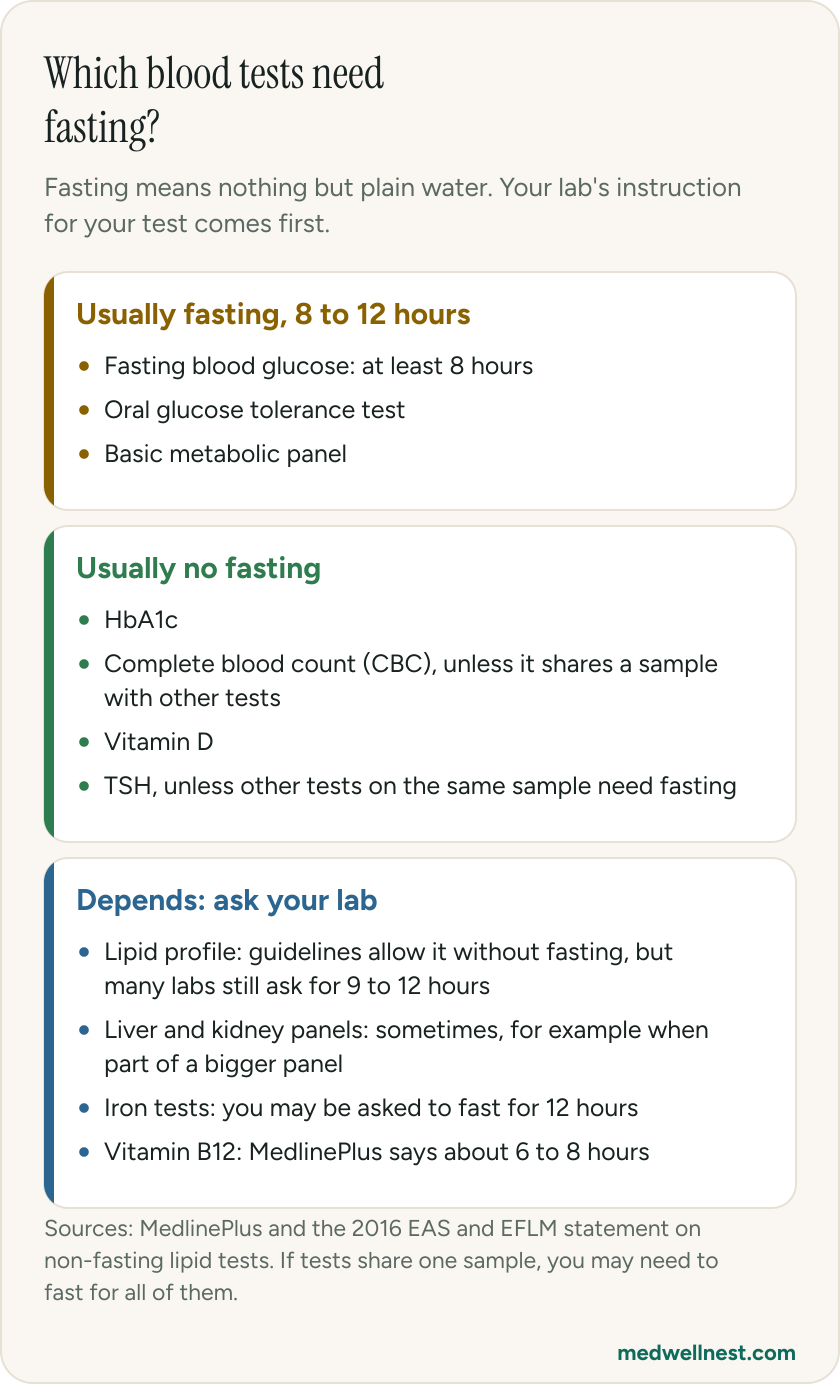
MedlinePlus says these usually need fasting: blood glucose (fasting glucose needs at least 8 hours), the oral glucose tolerance test, cholesterol and lipid tests, and the basic metabolic panel. It says you may also be asked to fast for liver and kidney panels, and that some liver tests need it only when they are part of a larger panel. For iron tests it says your provider may ask for 12 hours.
MedlinePlus says HbA1c does not need fasting, that a complete blood count (CBC) usually needs no special preparation, and that a vitamin D test needs none. For a TSH test, MedlinePlus lists no fasting of its own. There is a catch: if other tests are run on the same blood sample, you may need to fast for them.
Some tests have their own rule. MedlinePlus says for a vitamin B12 test you should not eat or drink for about 6 to 8 hours. So read the instruction that comes with your booking, and ask if it is missing. Our guides to HbA1c, to the CBC, to thyroid reports and to vitamin D reports explain each result.
03
Do I need to fast for a lipid profile or cholesterol test?
MedlinePlus says you may need to fast for 9 to 12 hours for a cholesterol test, and many labs still ask for it. But a joint statement of the European Atherosclerosis Society and the European Federation of Clinical Chemistry and Laboratory Medicine, published in 2016, recommends routine use of non-fasting lipid profiles.
The statement found that, 1 to 6 hours after habitual meals, the largest average changes were small: triglycerides up by 0.3 mmol/L (26 mg/dL), and total cholesterol and LDL cholesterol each down by 0.2 mmol/L (8 mg/dL). HDL cholesterol was not affected by fasting. Non-fasting and fasting results were comparable in predicting cardiovascular disease. It says fasting samples may be considered when non-fasting triglycerides are above 5 mmol/L (440 mg/dL).
So a lab that accepts a non-fasting sample is following guidelines, and a lab that asks you to fast is also acceptable. If you were told to fast, fast; do not decide on your own. Our guide to lipid profile reports explains the numbers.
04
Can I drink water, tea or coffee before a blood test? What about my medicines?
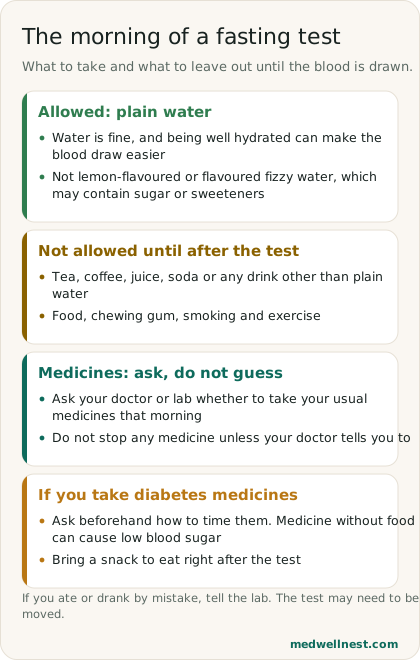
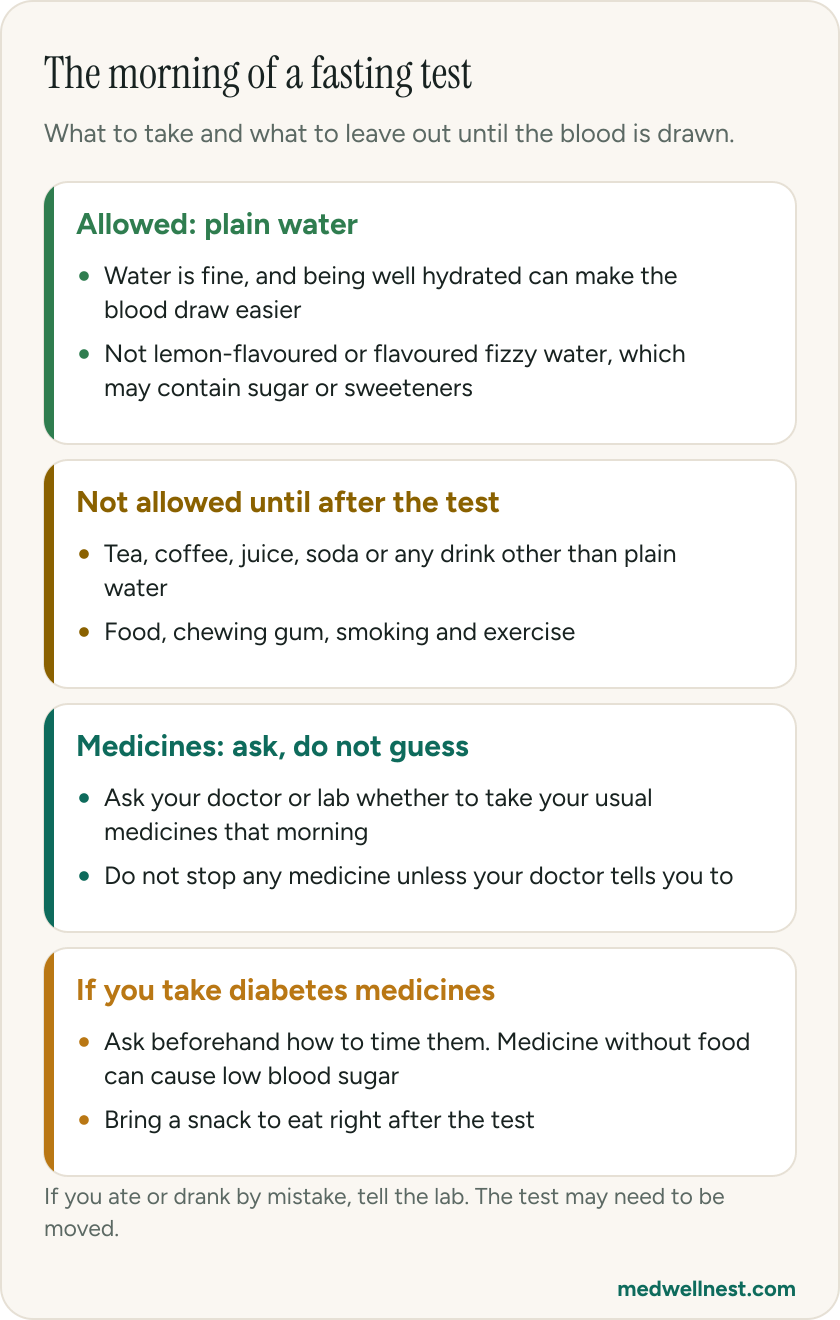
Plain water is allowed, and MedlinePlus says staying well hydrated can make drawing blood a little easier, because more fluid in the veins makes them easier to find. Juice, coffee, soda and other drinks can get into your blood and change results. Lemon-flavoured or flavoured fizzy water may contain sugar or sweeteners. Since fasting means nothing but plain water, tea with sugar or milk does not fit either.
For medicines, MedlinePlus says to ask your provider whether to take your usual prescription and over-the-counter medicines. For some tests you may be asked to stop one, but you should not stop any medicine unless your provider tells you to. Tell your provider about any vitamins and supplements as well.
05
What if I take diabetes medicines, or I ate something by mistake?
MedlinePlus says low blood glucose is often caused by certain diabetes medicines, including insulin, and that in people with diabetes it can follow not eating enough, especially after taking diabetes medicine. Severe low blood glucose can cause seizures and brain damage. So ask your doctor or the lab, before the day, how to time your diabetes medicines for a fasting test, and do not skip or change them on your own. Bring a snack, because MedlinePlus says light-headedness is common after a fasting test. This page is about fasting for a test; our guide to fasting with diabetes covers religious and intermittent fasting.
If you ate or drank something other than water by mistake, tell the lab. MedlinePlus says the test may need to be moved to another day so that the result is accurate.
When to act
Emergency — act now
You take insulin or other diabetes medicines, and while fasting you have a seizure, faint, or are too confused to answer or swallow: call emergency services now. MedlinePlus says severe low blood glucose can lead to seizures and brain damage.
Same-day — call promptly
You have a fasting test booked, take diabetes medicines and have not been told how to take them: call your doctor or the lab today, not on the morning of the test.
Routine — see a doctor
You are not sure whether your test needs fasting: ask when you book, at least a full day ahead, as MedlinePlus advises. Do not fast if you were not told to.
Values mentioned in this story
Each one opens a visual guide with its normal range and what moves it — upload a report and we place your own numbers on the same scale.
Sources
- Fasting for a Blood Test — MedlinePlusmedlineplus.gov
- Blood Glucose Test — MedlinePlusmedlineplus.gov
- Cholesterol Levels — MedlinePlusmedlineplus.gov
- Fasting is not routinely required for determination of a lipid profile — EAS/EFLM joint consensus statement (2016)pubmed.ncbi.nlm.nih.gov
- Complete Blood Count (CBC) — MedlinePlusmedlineplus.gov
- Vitamin D Test — MedlinePlusmedlineplus.gov
Share this story
Curious where your own values stand?
Two minutes from upload to a full visual picture. Free to analyze.