In short
A temperature of 38C or more in pregnancy needs checking. Paracetamol is the usual first choice per the NHS, ACOG and SMFM; ibuprofen and other NSAIDs are generally avoided, especially from 20 weeks. Here is the 2025 debate in order, and the signs that cannot wait.
Emergency if: A fever with a severe headache that is getting worse, a stiff neck, difficulty breathing, a rash that does not fade when pressed with a glass, or your baby moving less than usual: go to an emergency department now. The NHS says sudden breathlessness needs to be checked immediately, and that a change in your baby's movements or a severe headache are signs to get help for.
On your report
WBC / Total Leukocyte Count, Platelet Count, CRP
On this page
01
Is a fever dangerous in pregnancy?
A fever needs attention. The NHS says a high temperature can be a sign of an infection, so it is important to get it checked, and that signs include feeling hotter than usual, shivering, or a thermometer reading of 38C or above. ACOG says a fever in pregnancy is associated with a higher risk of neural tube defects and other birth defects, and SMFM says an untreated fever, particularly in the first 3 months, is known to be linked to birth defects and miscarriage.
These are links seen in studies, not proof that a fever will harm your baby. SMFM says you should not just 'tough it out', because untreated fever and pain both carry risks. The cause of the fever matters as well as the temperature. So get the fever checked, find the cause, and ask your doctor how to treat it; paracetamol is the usual first choice (see below).
02
Can I take paracetamol in pregnancy?
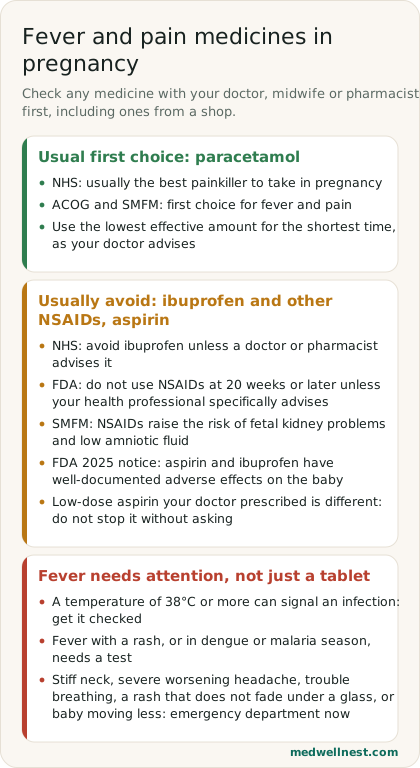
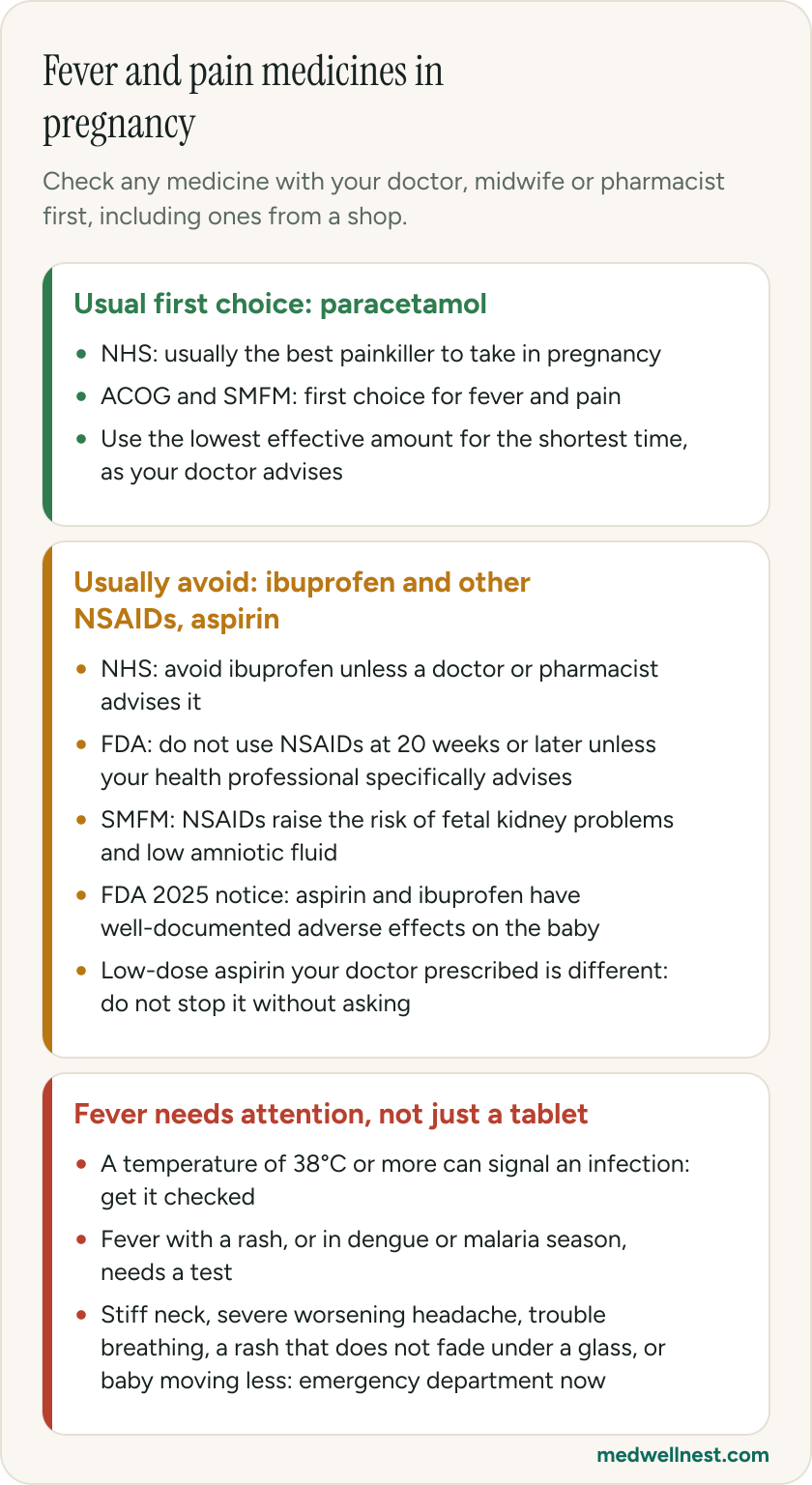
Usually yes. The NHS says paracetamol is usually the best painkiller to take if you are pregnant. ACOG says acetaminophen, which is the same medicine, remains the analgesic and antipyretic of choice in pregnancy, at the lowest effective dose for the shortest necessary time and in consultation with your doctor. SMFM's June 2026 statement says acetaminophen remains the recommended first-line medicine for pain and fever in pregnancy.
Check any medicine with your doctor, midwife or pharmacist before you take it, including ones from a shop, and follow the packet. This page gives no doses, because the right amount depends on you. Do not stop a medicine your doctor prescribed without checking first.
03
What was the 2025 debate about paracetamol and autism?
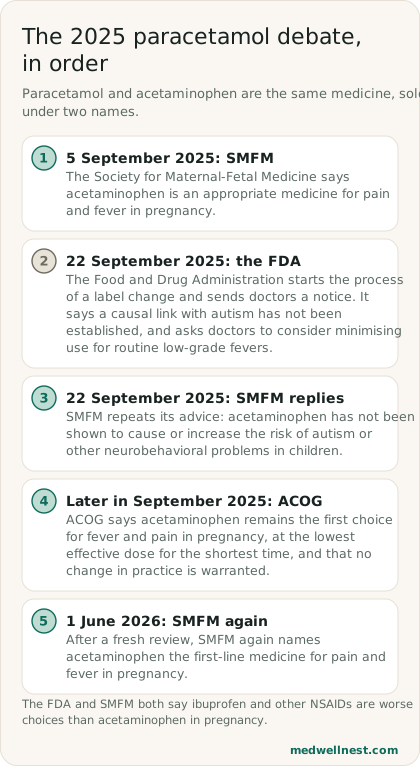
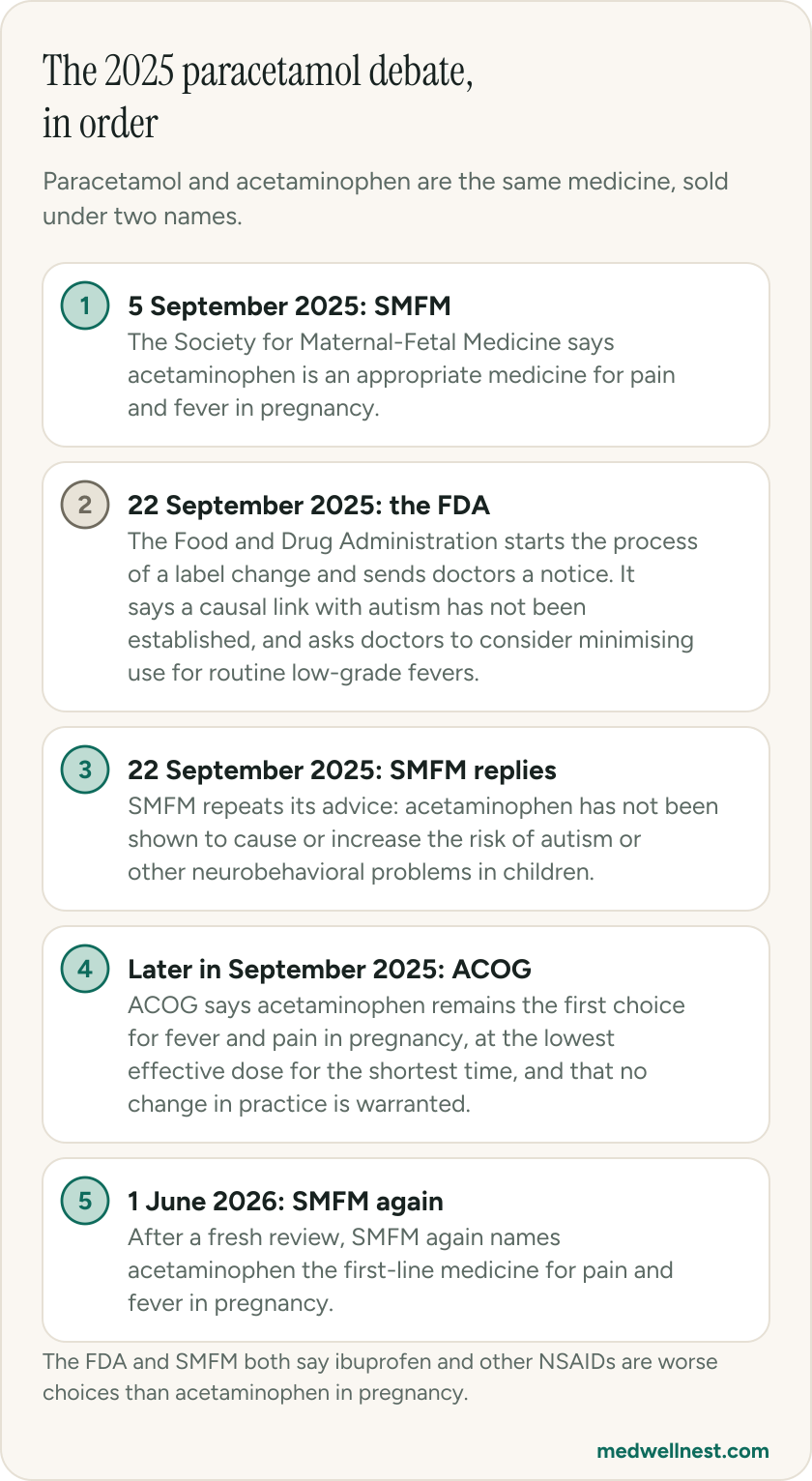
On 22 September 2025 the Food and Drug Administration (FDA), a medicines regulator, started the process of changing the label on acetaminophen and sent doctors a notice. The notice said studies had described an association with neurological conditions such as autism and ADHD in children, that a causal relationship has not been established and that contrary studies exist, and that doctors should consider minimising its use for routine low-grade fevers. It also called acetaminophen the safest over-the-counter option in pregnancy among all painkillers and fever medicines.
The main obstetric bodies disagreed with that framing. SMFM said on 5 September and again on 22 September 2025 that acetaminophen is an appropriate medicine for pain and fever in pregnancy and that no causal link to autism has been shown. ACOG's September 2025 advisory said the weight of evidence does not support a causal link, that no change in practice is warranted, and that the two studies that best accounted for family and genetic factors, which compared siblings, found no significant link. SMFM repeated this after a fresh review on 1 June 2026.
What it means for you: this is a disagreement about how strong the evidence is and how readily to use it for mild fevers, not about which medicine comes first. All the bodies above, including the FDA, say paracetamol is a safer choice than ibuprofen or aspirin. The practical advice is to use it when you need it, at the lowest amount that works, for the shortest time, and to ask your doctor how to handle a fever.
04
Can I take ibuprofen or aspirin in pregnancy?
Generally no. The NHS says you should avoid ibuprofen in pregnancy unless a doctor or pharmacist advises it. The FDA's 2020 safety communication says pregnant women should not use NSAIDs (non-steroidal anti-inflammatory drugs, the group that includes ibuprofen) at 20 weeks or later unless their health professional specifically advises it, and that this applies to prescription and over-the-counter NSAIDs. SMFM says NSAIDs increase the risk of fetal kidney problems, early closing of a blood vessel in the baby's heart (the ductus arteriosus), low amniotic fluid and bleeding in the mother.
General fever pages on health sites often list ibuprofen as a choice for adults. In pregnancy the advice is different, so check the pregnancy advice, not the general one. If a doctor has prescribed aspirin or any other regular medicine for you, do not stop it without asking.
05
Fever with a rash, or in dengue or malaria season: why a test matters
A fever is a symptom, not a diagnosis, and paracetamol only brings the temperature down; it does not treat the cause. The NHS says a high temperature can be a sign of infection, so it needs to be checked. If your fever comes with a rash, or you live in or have been in an area with dengue or malaria, ask for a test the same day rather than treating at home and waiting. Our guide to which fever test to do and when explains the choices, and our dengue and malaria guides cover those two illnesses.
Check the temperature with a thermometer and write down the readings and the time. If the fever is not coming down or is getting worse, or other symptoms appear, do not wait.
When to act
Emergency — act now
A fever with a severe headache that is getting worse, a stiff neck, difficulty breathing, a rash that does not fade when pressed with a glass, or your baby moving less than usual: go to an emergency department now. The NHS says sudden breathlessness needs to be checked immediately, and that a change in your baby's movements or a severe headache are signs to get help for.
Same-day — call promptly
A temperature of 38C or more, chills, a fever with a rash, a fever in a dengue or malaria area, or a fever that is not coming down or is getting worse: see a doctor today and ask about a test. The NHS says a high temperature in pregnancy should be checked, as it can be a sign of infection.
Routine — see a doctor
You want to know what you can take for a cold, cough, pain or acidity: ask your pharmacist, midwife or doctor before taking anything, including medicines from a shop and herbal products, and ask what your plan should be if you get a fever.
Values mentioned in this story
Each one opens a visual guide with its normal range and what moves it — upload a report and we place your own numbers on the same scale.
Sources
- Pregnancy symptoms you need to get help for — NHSnhs.uk
- Ibuprofen for adults: painkiller that also treats inflammation (pregnancy section) — NHSnhs.uk
- Acetaminophen Use in Pregnancy and Neurodevelopmental Outcomes — ACOG Practice Advisory, September 2025acog.org
- SMFM Reaffirms Acetaminophen as First-Line Medication for Treating Pain and Fever During Pregnancy — Society for Maternal-Fetal Medicine, June 2026smfm.org
- Notice to Physicians on the Use of Acetaminophen During Pregnancy — FDA, 22 September 2025fda.gov
- FDA recommends avoiding use of NSAIDs in pregnancy at 20 weeks or later — FDA Drug Safety Communication, 2020fda.gov
Share this story
Curious where your own values stand?
Two minutes from upload to a full visual picture. Free to analyze.