In short
A follicular study follows a growing follicle and the womb lining over a few scans. Here is how fast a dominant follicle grows, the sizes clinics act on, what the lining number means, and why these cut-offs come from fertility-treatment studies and vary.
Emergency if: On fertility medicines, with shortness of breath, severe tummy pain or fainting: get emergency care now. The HFEA warns that severe ovarian hyperstimulation, though very rare, can be life-threatening.
On your report
LH (Luteinizing Hormone), Progesterone
On this page
01
What a follicular study is
A follicular study is a series of vaginal ultrasound scans done over a few days of one cycle. Each scan measures the follicles, the small fluid-filled sacs on the ovaries that each hold an egg, and the thickness of the womb lining, the endometrium. It is used to see whether and when a follicle is getting ready to release its egg, to time sex or insemination, and to monitor fertility medicines.
Monitoring matters most on medicines. NICE's fertility guideline, NG257, which replaced the older CG156 in March 2026, says ultrasound measurement of follicle size and number is an integral part of treatment with gonadotrophin injections, to reduce the risk of a multiple pregnancy and of ovarian hyperstimulation. To confirm that ovulation actually happened, NICE uses a blood test for progesterone in the second half of the cycle, on day 21 of a 28-day cycle, and says not to rely on temperature charts.
02
How a dominant follicle grows
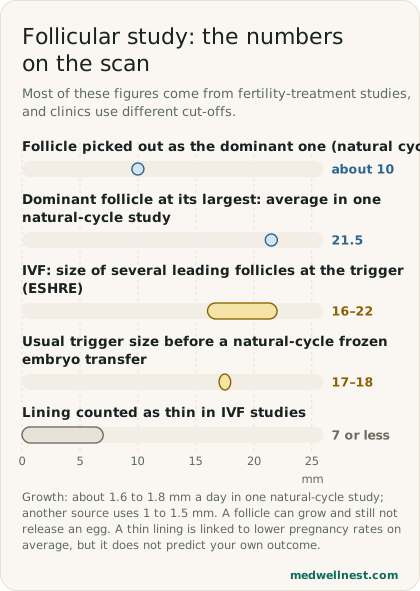
Several follicles start to grow each cycle, and usually one is singled out to become the dominant follicle. In a study that scanned 49 ovulating women every 1 to 3 days, follicles were tracked from 7 mm, the dominant follicle was singled out at about 10 mm, and from then it grew by about 1.8 mm a day on average. It reached an average of 21.5 mm at its largest about 7 days after it was singled out, and ovulation followed about a day later.
These are averages, and other sources use slower figures: a 2025 study of frozen embryo transfers works with a growth rate of 1 to 1.5 mm a day. Growth alone does not prove ovulation. In the 49-woman natural-cycle study, some dominant follicles grew to an average of 13.1 mm and then shrank without releasing an egg, which is why a scan series is often paired with a hormone test.
03
What size counts as ready
The sizes you hear quoted come mainly from fertility treatment, not natural cycles. The European Society of Human Reproduction and Embryology (ESHRE) says in its 2025 guideline that the link between follicle size at the trigger injection and outcome has not been studied enough, and that doctors may choose the size case by case. Most often, it says, the trigger is given when several of the leading follicles are between 16 and 22 mm.
Clinics differ. Before a frozen embryo transfer in a natural cycle, many give the trigger when the leading follicle reaches 17 to 18 mm, but a 2025 study of 14,431 such cycles found live birth rates of 35.7% to 39.0%, with no significant difference, across follicle sizes from just over 10 mm to 18 mm or more, with extra progesterone support. So a report of a 15 mm or 16 mm follicle is a point on a curve, not a pass or fail.
04
The lining in the same scan
The same scan measures the endometrium, the womb lining, which thickens through the first half of the cycle. The day of your cycle matters, so the number is only meaningful beside the date; our guide to endometrial thickness gives the typical ranges by cycle day.
A thin lining worries many people, but the evidence is weaker than the numbers suggest. A 2014 meta-analysis of IVF studies found a lining of 7 mm or less in only 2.4% of cycles, with a lower clinical pregnancy rate, 23.3% against 48.1%, yet thickness was almost useless at predicting who would conceive, and the authors said it did not justify cancelling treatment. ESHRE says routine monitoring of the lining during ovarian stimulation is probably not recommended.
05
Why the numbers on your report vary
Most published cut-offs come from people on fertility medicines, where many follicles grow at once, so they may not fit a natural cycle. Even in treatment, ESHRE says the timing is decided on several things together: how many follicles are growing, the hormone results that day, how long stimulation has lasted, the plan for embryo transfer, the burden and cost to you, how earlier cycles went, and the clinic's own organisation. Ask your clinic which size it acts on, and on which day it wants to see you next.
If several follicles are growing on medicines, the scan is also how your doctor judges the risk of twins or more and of ovarian hyperstimulation, which is exactly what NICE says monitoring is for. And if you are given a trigger injection, ask when to do a home pregnancy test, because fertility medicines can make one falsely positive, as our guide to faint test lines explains.
06
Reading your own scan series
A useful report shows the same follicle growing across scans, the lining thickening, and a plan for the next step. A follicle that stops growing or shrinks, or a lining that stays thin, is something to discuss with your fertility specialist, who will put it together with your hormone results, age and history. No single number predicts whether you will conceive this cycle.
Home ovulation tests measure the hormone surge that comes before ovulation and can be used alongside scans. Our guide to the fertile window explains how they work, and our guide to endometrial thickness covers the lining in more detail, including what a thick lining means after menopause.
When to act
Emergency — act now
On fertility medicines, with shortness of breath, severe tummy pain or fainting: get emergency care now. The HFEA warns that severe ovarian hyperstimulation, though very rare, can be life-threatening.
Same-day — call promptly
On fertility medicines, with a swollen or painful tummy, sickness or vomiting, or passing much less urine: contact your clinic straight away, the same day. The HFEA says to report these signs of ovarian hyperstimulation to your clinic immediately.
Routine — see a doctor
A follicle that stops growing, or a lining that stays thin: discuss it with your fertility specialist at your next visit.
Values mentioned in this story
Each one opens a visual guide with its normal range and what moves it — upload a report and we place your own numbers on the same scale.
Sources
- Fertility problems: assessment and treatment (NG257, 2026) — NICEnice.org.uk
- ESHRE guideline: ovarian stimulation for IVF/ICSI, an update in 2025pmc.ncbi.nlm.nih.gov
- Dominant follicle growth patterns and endocrine dynamics in anovulatory and ovulatory waves in women (2023)pmc.ncbi.nlm.nih.gov
- Outcomes of modified natural cycle frozen embryo transfer by dominant follicle size at trigger (2025)pmc.ncbi.nlm.nih.gov
- Endometrial thickness and pregnancy rates after IVF: a systematic review and meta-analysis (Kasius et al., 2014)pubmed.ncbi.nlm.nih.gov
- Risks of fertility treatment — HFEAhfea.gov.uk
Share this story
Curious where your own values stand?
Two minutes from upload to a full visual picture. Free to analyze.