In short
A heart blockage is fatty build-up narrowing the arteries that feed the heart. In the ISCHEMIA trial of 5179 people with stable disease, starting with a stent or bypass did not clearly beat starting with medicines over 5 years. A heart attack needs emergency care now.
Emergency if: Chest pain or pressure that does not stop after resting for a few minutes or after your angina medicine; sudden chest discomfort that does not go away; pain spreading to your arm, neck, jaw, shoulder, stomach or back; or chest pain with sweating, feeling sick, light-headedness or breathlessness: call emergency services now. Do not drive yourself. Pale, blue or grey skin, severe difficulty breathing, or someone passing out and not responding normally also needs emergency services now.
On your report
LDL Cholesterol, Total Cholesterol, HDL Cholesterol
On this page
01
What does heart blockage (coronary artery disease) mean?
"Heart blockage" is the everyday name for coronary heart disease, also called coronary artery disease. The NHS describes the cause as fatty deposits (atheroma) building up in the arteries that supply the heart. Angina, the chest pain this causes, happens when the heart does not get enough blood, usually because those vessels have become narrowed or blocked by fatty deposits.
Stable disease and a heart attack are different situations. The NHS says angina attacks usually last less than 10 minutes and stop after resting for a few minutes or taking angina medicine. Chest pain that does not stop with rest or medicine, or that spreads or comes with sweating, feeling sick, light-headedness or breathlessness, could be a heart attack. That is an emergency, not a question about stents.
02
What does a 70% blockage on my angiogram report mean?
A coronary angiogram is an X-ray, taken with dye, that shows the heart arteries. The percentage on the report is how much narrower the artery looks at that spot. Our story on the calcium score and CT angiogram explains the CT grading scale. None of the sources used for this story sets one percentage above which a stent is needed, so "70% means a stent" is not a rule they give.
The ESC guideline summary on chronic coronary syndromes says that when a narrowing is of "intermediate" severity, its functional severity should be tested before treatment, using invasive tests of flow such as fractional flow reserve (FFR) or the instantaneous wave-free ratio. It also says an invasive angiogram is recommended for people with a very high likelihood of disease, severe symptoms despite medicines, angina at a low level of exercise, or high event risk. In practice the decision rests on your symptoms, which artery is narrowed, how many arteries, whether the narrowing limits blood flow, and how well the heart pumps.
03
Is a stent or bypass always needed? What did the ISCHEMIA trial find?
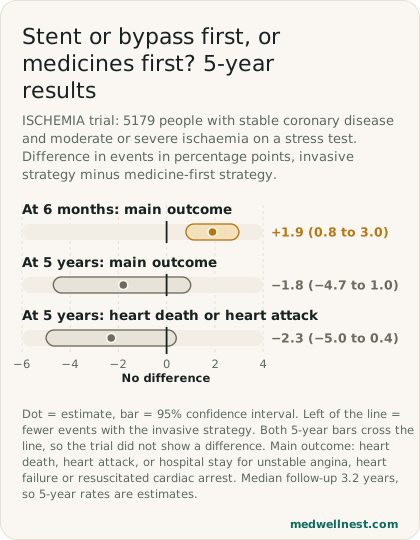
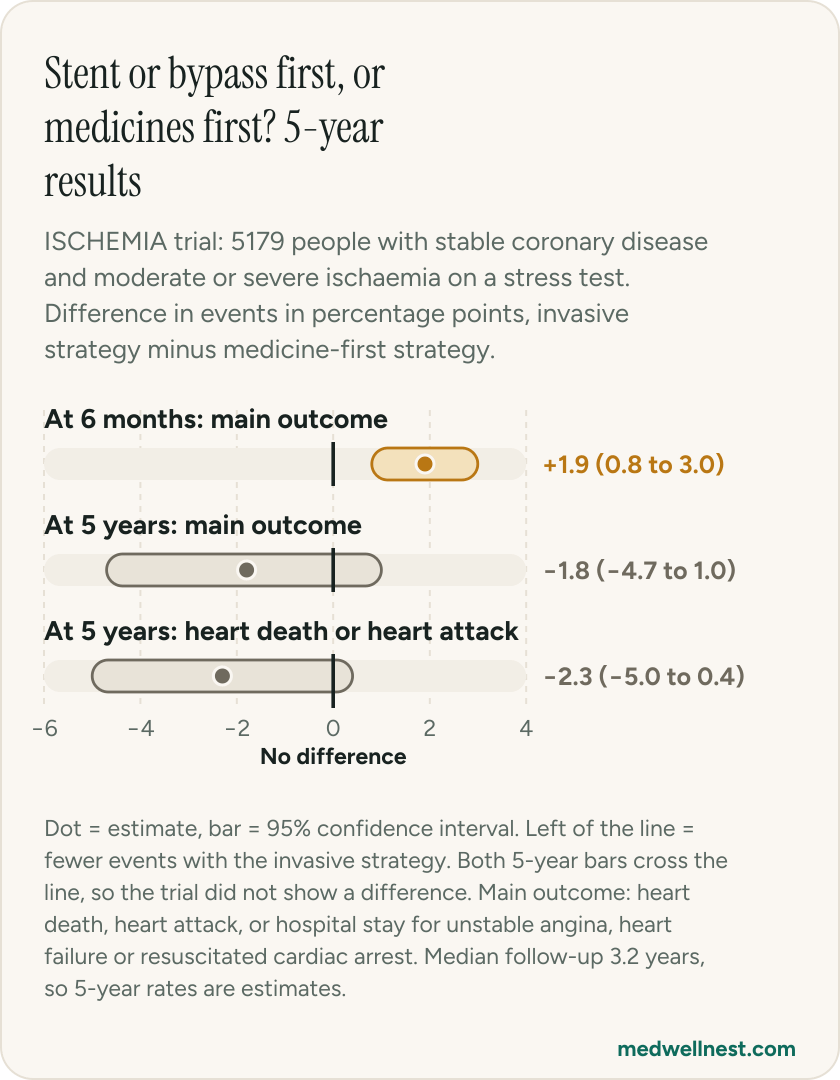
ISCHEMIA randomly assigned 5179 people with stable coronary disease to either an initial invasive strategy (angiography, then a stent or bypass when feasible, plus medicines) or an initial conservative strategy (medicines alone, with angiography only if medicines failed). All had moderate or severe reduced blood flow (ischaemia) on a stress test. Follow-up lasted a median of 3.2 years, so the 5-year figures are estimates of how many people would have had an event by 5 years, not counts in people all followed that long. By 5 years, the main outcome (death from heart causes, heart attack, or hospital stay for unstable angina, heart failure or resuscitated cardiac arrest) had occurred in an estimated 16.4% of the invasive group and 18.2% of the conservative group. The difference of -1.8 percentage points (fewer events with the invasive strategy) had a 95% confidence interval of -4.7 to 1.0, which includes no difference.
Early on, the invasive group did slightly worse: 5.3% against 3.4% at 6 months. Deaths from any cause were 145 against 144. The authors say the findings depended on how heart attack was defined, and that 15% of the medicine-first group had a procedure before any main outcome event. The trial's authors conclude they found no evidence that an initial invasive strategy reduced ischaemic events or death over that time.
The trial does not apply to everyone. It excluded people with a recent acute coronary syndrome, unprotected left main artery narrowing of 50% or more, an ejection fraction below 35%, class III or IV heart failure, kidney function below a set level, or angina that was unacceptable despite maximal medicines.
04
Does a stent or bypass relieve chest pain better than medicines?
The trial's separate health-status report measured angina with the Seattle Angina Questionnaire, scored 0 to 100. Scores rose in both groups. The invasive group scored 4.1 points higher at 3 months and 2.9 points higher at 36 months. The gap was larger in people who had angina every day or week at the start (8.5 against 0.1 points at 3 months, compared with people with no angina), and 35% of all participants had no angina at baseline.
The authors describe the overall differences as modest, reflecting minimal differences in people without angina and larger ones in people who had angina. The NHS says that if symptoms cannot be controlled with medicines, procedures or surgery may be needed to open up or bypass blocked arteries.
05
When do a stent or bypass clearly help?
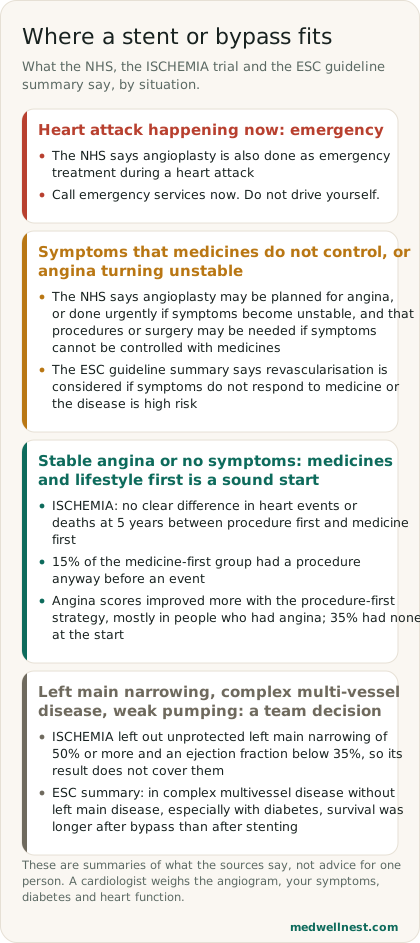
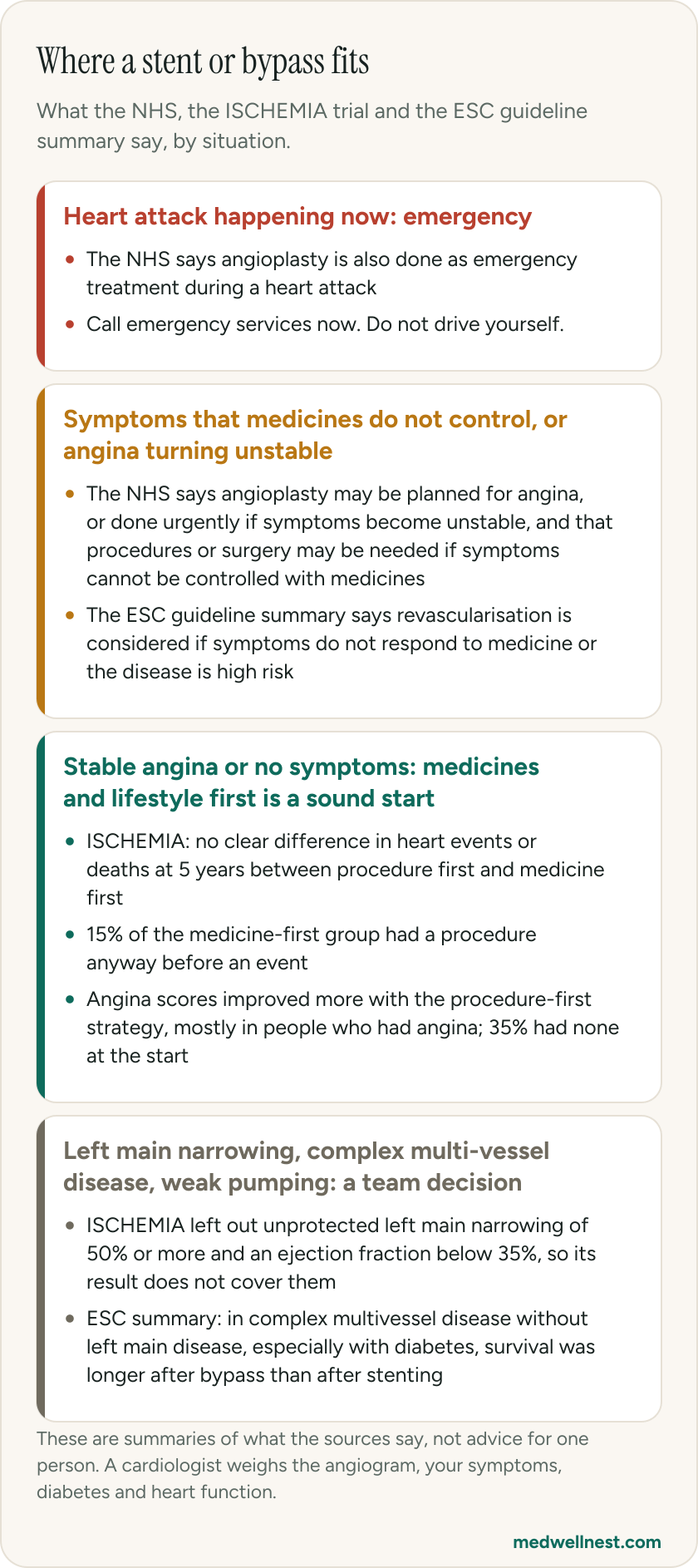
The NHS says angioplasty can be planned for angina, or done urgently if symptoms have become unstable, and is also done as an emergency treatment during a heart attack. The NHS says bypass surgery is carried out in people whose arteries are narrowed or blocked, using a graft to take blood around the narrowed section. The ESC summary says revascularisation (a stent or bypass) is considered if symptoms do not respond to medicine or the disease is high risk.
On survival, the ESC summary says that in people with normal pumping function and no significant left main or proximal left anterior descending artery narrowing, revascularisation over medicines alone does not prolong overall survival. For complex multivessel disease without left main disease, especially with diabetes, it says survival was longer after bypass than after stenting. Choosing between them is a team decision based on your own angiogram and heart function.
06
What do medicines and lifestyle do for a blockage?
The NHS says treatment for coronary heart disease manages symptoms and reduces the chance of problems such as heart attacks. The medicine classes it lists are blood thinners (such as aspirin and clopidogrel) that reduce the chance of a clot, statins that lower LDL cholesterol, beta blockers that slow the heartbeat and are often used for angina, nitrates that relax blood vessels and relieve heart pain, and medicines that lower blood pressure (ACE inhibitors, angiotensin receptor blockers, calcium channel blockers and diuretics). The ESC summary says one antiplatelet medicine, aspirin or clopidogrel, is generally recommended long term in people with obstructive disease.
The NHS gives two warnings. Heart medicines should not be stopped suddenly without a doctor's advice, because symptoms may get worse. And aspirin should not be taken to prevent a heart attack unless you have been diagnosed with coronary heart disease or advised to by a doctor. On lifestyle, the NHS says stopping smoking after a heart attack quickly lowers your future risk to near that of a non-smoker, and that healthier eating and regular exercise also lower future risk. The ESC summary calls lifestyle and risk-factor changes, together with medicines, the cornerstones of care. Our heart disease prevention and lipid profile stories cover those steps.
07
What should I ask my cardiologist, and what needs emergency help?
Useful questions are: which artery is narrowed and by how much, whether a flow test such as FFR was or should be done, whether my symptoms are controlled on medicines, whether a stent or bypass is being suggested to relieve symptoms or for another reason, and how my diabetes, blood pressure and cholesterol should be managed. Shared decision making between you and your doctors is central in the ESC summary.
The NHS says to call emergency services now for chest pain that does not stop after resting for a few minutes or after angina medicine, sudden chest pain or discomfort that does not go away, pain spreading to the arm, neck, jaw, shoulder, stomach or back, or chest pain with sweating, feeling sick, light-headedness or breathlessness. Do not drive yourself. If you know you have a blockage and your angina is worse, more frequent, longer or happens at rest, the NHS says to get urgent medical advice the same day.
Heart blockage: how fast to act
Emergency — act now
Chest pain or pressure that does not stop after resting for a few minutes or after your angina medicine; sudden chest discomfort that does not go away; pain spreading to your arm, neck, jaw, shoulder, stomach or back; or chest pain with sweating, feeling sick, light-headedness or breathlessness: call emergency services now. Do not drive yourself. Pale, blue or grey skin, severe difficulty breathing, or someone passing out and not responding normally also needs emergency services now.
Same-day — call promptly
You know you have angina or a blockage and the chest pain is worse than before, happens more often, lasts longer or comes on at rest, or you have new chest pain or angina symptoms that come and go: get urgent medical advice today. Do not wait for your next planned visit.
Routine — see a doctor
A report shows a narrowing and you have no worsening symptoms: book a visit with your cardiologist to ask which artery is affected, whether a flow test is needed and which medicines you need. Keep taking heart medicines and do not stop them suddenly.
Values mentioned in this story
Each one opens a visual guide with its normal range and what moves it — upload a report and we place your own numbers on the same scale.
Sources
- Initial Invasive or Conservative Strategy for Stable Coronary Disease (ISCHEMIA) — N Engl J Med 2020pubmed.ncbi.nlm.nih.gov
- Health-Status Outcomes with Invasive or Conservative Care in Coronary Disease (ISCHEMIA) — N Engl J Med 2020pubmed.ncbi.nlm.nih.gov
- 2024 ESC Guidelines for chronic coronary syndromes: key points — American College of Cardiologyacc.org
- Coronary heart disease: treatment — NHSnhs.uk
- Heart attack — NHSnhs.uk
- Angina — NHSnhs.uk
Share this story
Curious where your own values stand?
Two minutes from upload to a full visual picture. Free to analyze.